Expert Q&A: Neil Stoneman on the challenges of measuring content performance

Performance measurement. It’s the closing chapter in the content production process. A chance to take a beat and reflect on the impact of your newly launched asset before you start all over again on your next piece.

Well, not quite. If you want to set yourself up for good data and a meaningful look at how your content is performing, you need to start thinking about measurement much earlier in the process. To help us pinpoint the right time to start planning (and answer a few probing questions about the pitfalls of content metrics) we spoke to performance marketing expert Neil Stoneman.

Radix: Hi Neil, thanks for talking with us! Let’s start at the beginning: when’s the right time to start thinking about performance measurement for content?

Neil: Working out an ROI figure for content isn’t the easiest thing in the world. So you need to have conversations about measurement at the very start of the content production process if you want to be successful. You need clear goals if you want clear metrics.

That means collaborating more closely than many organisations generally manage. If departments or teams operate as silos, they’ll deliver as silos. Everyone in the chain needs to invest time in understanding the other components of marketing and how they’re contributing to the whole.

Radix: What happens if marketers don’t do this prep work up front?

Neil: Marketing isn’t an exact science, but in my experience, the quality of the writing and design is pretty closely correlated to the success of a piece. Skipping the prep work puts these components in jeopardy.

Say you’re creating an ebook. If your writers know what it’s for, where it’s going to be deployed, and what the marketing team want to achieve with it, they can make decisions accordingly. Same goes for the designers, the web team, and everyone else involved.

You can’t apply metrics retroactively and expect content to perform well – it just won’t be set up for it. If a piece is out in the world and there hasn’t been a conversation and a plan for what it should achieve and what success looks like, that ship has sailed.

Radix: How can content marketing teams keep their goals front and centre during the creation process?

Neil: Goals have a habit of disappearing during the process, which can create a lot of chaos as the project diverges from the original plan.

Without the ultimate goal in mind, stakeholders can get distracted by the minutiae. And then they suddenly switch from worrying about the tone of voice to asking how many leads their content produced.

Your initial goals should serve as a guide for every decision you make throughout the process. Sometimes that requires careful stakeholder management or firm pushback to manage expectations and keep a project on track. Keeping marketers, SMEs, creatives, and other stakeholders on the same page throughout means you’re more likely to produce successful content.

Radix: Some types of content are harder to monitor than others. How can you measure content performance when it’s in a difficult-to-track format?

Neil: People often ask, “Is content a channel?” And many would say it isn’t, and that it can’t be used as a channel. But there are simple additions that help even static formats act as a channel.

To go back to the ebook example, even a PDF can offer useful metrics – if you make sure you include effective calls to action. CTAs shouldn’t just float at the end of the document; they need to be contextual, especially in long pieces that cover a lot of different topics.

If you mark each CTA with its own UTM tag, you’ll be able to see exactly what convinced your reader to move on to the next stage in the process. Anecdotally, some of my clients have seen three times more conversions on demos and contact forms from content readers versus non-content readers.

Radix: In performance measurement, there’s always a lot of talk about the negatives of ‘vanity’ metrics. Do you think marketers focus on the wrong metrics?

Neil: I don’t really believe in ‘vanity’ metrics. I think all metrics, even surface-level ones like views and open rates, are useful.

These days, marketing needs to deliver a commercial outcome, but proving that delivery is notoriously difficult. There’s rarely a simple way to link marketing activities to revenue, for example. But if you’re going to start a process with creative and content, the first thing you need it to do is to generate a response. And vanity metrics are generally the best way to track that initial response.

If you publish something on LinkedIn and it gets no vanity metrics, then it’s not going to achieve the other, more important goals either. If no one likes, shares, or reposts it, it’s definitely not going to galvanize a buying committee to spend $2.5 million dollars on your offering.

Say I was working with new B2B client with high revenue targets and a long sales cycle. I couldn’t say we’d achieve a revenue uplift in two weeks. It’s not possible. But I can use vanity metrics to start to show more audience engagement in that period – they might just be the only metrics you have for the first couple of months. They’re not the be all and end all, but they show we’ve taken the right steps towards solving the conundrum.

Get more expert insights in our B2B Content Marketer’s Handbook

This is just a small excerpt of the expertise Neil shared with us – and we’ve got even more advice to share from other industry veterans. If you’d like to explore the rest of the topics, ranging from content strategy to optimisation, get your copy of our handbook or read our other Expert Q&As.

Is Reddit B2B marketing’s best kept secret?

How many channels make up your marketing strategy?

While we were putting together our The B2B Content Marketer’s Handbook this year, we spoke with one expert about the most popular channels for content promotion. Unsurprisingly, their opinion was that LinkedIn and Meta make great bookends of a B2B strategy. And they’re entirely correct. This is primarily because one is where people go for work stuff and the other is where people spend their free time. It all makes perfect sense – but is there a neglected opportunity if you only pursue these channels?

We were recently exploring the archives of the Radix blog and found a post from 2016 about using Reddit as a marketing channel. If you’re raising a quizzical eyebrow right now, you’re not alone – it was news to me too. But it turns out, that post may be more relevant now than it was when it was written.

The community forum site has recently overtaken Facebook as the second most visited website in the US, and there has been increasing talk on LinkedIn about its value as part of a B2B strategy. But when we asked our team, a collection of B2B writers with an average of nine years’ experience, not one of us could recall Reddit ever being mentioned as part of a client’s strategy.

So, is Reddit B2B’s best kept secret? Are people actually using it? Or is this an example of where what makes sense in theory doesn’t quite work out in practice?

To figure this out, let’s first look at the benefits Reddit might offer for B2B marketers.

New to Reddit?

You may know Reddit as a vast online community forum, with more than 138,000 ‘Sub Reddits’ devoted to various interests, from information technology to random musings.

What you might not know, however, is its potential for marketing. Here are some quick stats:

  • 51% of all online purchasing discussions take place on Reddit2
  • 90% of users trust Reddit to learn about products and brands3
  • 5x higher ROAS when customers come from Reddit4

1 Brandwatch, Global, Oct 2023 – Mar 20242 YPulse, US, 20213 Brandwatch, Global, Oct 2023 – Mar 20244 Luth Research, 2021, US

The power of Reddit as a platform is that its users go there for information from like-minded peers. It’s essentially a vast network of little online hangouts where people hide from their emails. Which means if you find an appropriate sub, you have access to a virtual room full of your target audience.

For instance, r/artificial, a sub dedicated to AI and machine learning, attracts 263,000 weekly visitors. The people in subs like this might not always be the people making buying decisions, but if they’re not, they’re probably people who your product is designed for, and therefore the ones who can influence those decisions.

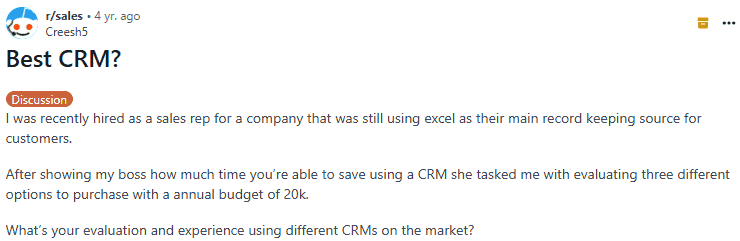
A screen shot of thread on Reddit discussing the best CRM

Theoretically, this makes Reddit a great place to put ads to reach your audience. And with so many buying journeys beginning or passing through there, it’s also a great place to openly (and transparently) share product information. But there is another use case that may prove just as valuable.

The importance of being a good listener

Reddit is where people go for expert advice on various subjects. (Or at least advice, you can’t always guarantee its quality because…well, it’s the internet.)

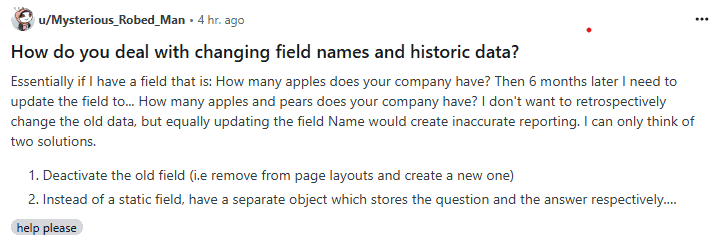
This can be anything from cloud technology to specific software solutions, with many products having their own dedicated subs. This makes it the ideal environment for learning about your customers’ or prospects’ challenges and needs.

A screenshot of a Reddit thread discusing field names and historic data

By monitoring these conversations, you open up a world of possibilities. Some of those stretch beyond marketing and are related to things like enhancing the customer experience. For instance, by having employees in Reddit subs, you can respond to queries or even inform product updates based on frequently asked questions or requests.

You can also learn something about how competitor solutions are performing. What’s missing from the latest iteration of their product? Is there an element of yours that solves this issue that you can promote in your marketing?

As a listening platform, Reddit offers many advantages. But pursuing those advantages does require a certain amount of dedication. There are no shortcuts. You can’t just post and run; you need to spend time listening, establishing yourself as a credible voice, answering community questions, starting discussions, and providing valuable tips.

And this might be one of the reasons many B2B marketers aren’t using it. It’s something that takes time – and we could all use a little more of that.

But there is another reason…

Authenticity is key

The USP of Reddit is the authenticity of its communities. And that’s great, but also problematic. Problematic because it means people don’t want necessarily want to be marketed to there. At least not beyond the ads we’ve all become accustomed to on websites. Instead, people want genuine answers, and there’s nothing less trustworthy than a sales pitch disguised as an answer.

That poses an interesting challenge for marketers. Because although the value of having communities full of your prospects is fairly clear, as is the ROI of any ads you place there, it’s very difficult to demonstrate the value of the hours you spend listening and engaging in conversation.

Welcome to the world of GEO

Perhaps one of the reasons we’ve heard so much about Reddit as a B2B channel in recent months is because of the rise of generative engine optimisation (GEO).

If you’re not familiar with GEO yet, it’s essentially SEO for the AI age. At this nascent stage of the AI boom, most of us are still trying to figure out what the inner workings of GEO mean for our content and how to get the best out of it. Much like SEO, it’s very likely that the rules around writing for GEO will continue to change, making keeping pace a Sisyphean endeavour.

What we can say for sure, however, is that Reddit has been very good at elevating GEO results, largely due to paid partnerships to feed  AI overviews and ChatGPT responses. These overviews are designed to summarize helpful, conversational, and community-generated content. And that’s Reddit in a nutshell. However, this isn’t without its problems.

The result of Reddit’s influence on AI has been ‘GEO stuffing’; people spamming Reddit subs with mentions of their product to rank higher in results. That, and the rather huge problem that information on Reddit often can’t be verified, has caused ChatGPT to draw from the site less and less in recent months.

What this means for the future as algorithms evolve is anyone’s guess. But finding a way to get the most out of the platform may still yield significant benefits when it comes to helping people find and engage with your brand.

Are you using Reddit?

It seems there are some clear benefits to Reddit as a B2B platform. But also some drawbacks in terms of the amount of time that must be invested for anything beyond just placing ads, and the difficulty proving the return on that time investment.

For most B2B brands, it’s hard to look past the mainstays of LinkedIn and Meta for marketing activities. After all, budgets aren’t infinite and change can be scary. However, there may be some value in experimenting on a small scale with something new.

What do you think? Are you using Reddit for your B2B marketing? If so, we’d love to hear your thoughts.