Eight ways to get other departments more engaged in marketing content | B2B Content Tuesday

Uncooperative departments and a lack of stakeholder alignment are among the biggest obstacles B2B content marketers face. Our Barriers to Great B2B Content study showed 86% have a problem with departmental co-operation – and that if your business isn’t working together, there’s every chance the content you publish will suffer as a result.

So it’s no surprise that the first topic we were asked to cover in our B2B Content Tuesday Q&A webinars was how to create a strong content culture and get your whole organisation engaged.

In this blog post, we’ve outlined eight engagement ideas for you to steal, adapt or ignore. We’ve either seen them work for B2B tech clients, or they’ve been suggested by experts like Maureen Blandford and Doug Kessler. We’ve also summarised some of the questions and answers from the discussion.

If you’d like to watch the session in full, you’ll find a video at the bottom of this post.

Eight ways to get B2B departments more engaged in marketing content

  1. When you talk to your subject matter experts, keep it focused. Many find marketing a bit vague (or even untrustworthy), and asking for a “chat” will add to that. Instead, give the expert a list of questions in advance, so they get the comfort of preparation and their time and involvement is clearly defined in advance.
  2. Make it part of a clear content plan. Establishing a well thought-out content initiative can help subject matter experts feel like they’re taking part in something concrete, and will help them stay on board.
  3. Treat stakeholders like customers. In our study, experienced tech marketer Maureen Blandford said she does her research, and when she approaches stakeholders, only talks about their business needs, values or interests – and how she can help.
  4. Ask subject matter experts questions you already know they’ll like. Experts like to share their knowledge – it might only be the marketing context that’s making them uncomfortable. So help them feel like they’re on their home turf, and you’ll likely get better answers.
  5. Find bright spots in each department. Not everyone distrusts marketing – so start by looking for quick wins. Find the people who like engaging with you, and you’ve hit gold. Plus, when their colleagues see how easy working with marketing can be, and all the good things that result, you’ll get more interest from them too.
  6. Be really, really (really) clear on what good content looks like. If you don’t have a clear standard in your organisation, everyone will nitpick everything. At Radix, we standardise content reviews using a B2B content checklist, which you can steal and adapt if you’d like to.
  7. Back up your content opinions with data. If you can show evidence about what content works, you’re more likely to keep the conversation in areas where other departments can really help.
  8. Use their time well. As much as possible, focus on making people do the bit that you can only get from them – the nugget of wisdom or viewpoint that only they have. Good research (and dare we say good copywriters) can fill in the rest.

Q&A: Establishing a B2B content culture

Q: How do I get colleagues involved while everyone is working remotely?

David: “Sensitively. It might be that people are feeling isolated, and would quite like a chat about something, but don’t assume that nobody is busy right now.

“If you’ve had to cancel a marketing event where subject matter experts were going to speak or run an exhibition stand, you’re handing them back a day’s worth of time. So that can be a really good point to ask to borrow half an hour, where you can find out exactly what they want to say and get them to brief a copywriter or in-house writing team.

“But unless you’re specifically giving them hours back by cancelling something, don’t assume they have loads of time.”

Q: People I need for content aren’t responding to email – how can I get through to them?

David: “There are just TONNES of emails around at the moment, and our inboxes are all full of companies emailing us about how they are there for us at this ‘difficult time’.

“So pick up the phone, or jump on a Zoom call. Being able to see people’s faces is really helpful when you’re trying to figure out what they’re dealing with.”

Q: At Radix, how do you define good content beyond achieving the client’s business goal?

David: “That’s the number one – the ultimate ‘did it work, yes or no?’ But unfortunately, we writers don’t always get to find out if our content achieved its goals. Clients are so busy that they often don’t circle back to us with the results.

“When we’re reviewing internally, we use a clear, 16-point quality assurance checklist. Before any content goes to the client, it is assessed by another writer, and we’ve tried to standardise that process as best we can – so we know we’ve covered aspects like readability, technical accuracy, and voice.”

(You can find the checklist here – feel free to steal it for yourself.)

Q: How do you reconcile different ideas of good content – data, emotional impact, and perceptions of what different audiences expect?

David: “Emotion is always important – but you do still need to be clear, and use data to your advantage.

“When someone says: ‘our technology is very complicated, our audience is very intelligent – why are you writing in a way that’s so simple?’ bring them back to the facts. Show them the number reading on a mobile device – with the extra cognitive load that entails – or the proportion of your audience reading in a second language. When you’re talking about what good content looks like, you need to have evidence.

“For example, case studies that specifically name the client and have a quote are statistically more successful than those that don’t. So if you’re talking to a salesperson who doesn’t want to put you in touch with a customer, your data can give them clear evidence that by getting that interview you can help them to sell more.

“When it comes down to defining good content, move away from your opinion vs their opinion – especially if there are good, data-driven reasons to do it your way.

“Remember, the stakeholder will usually last have had their content reviewed in school or university. So to them, the writing that got good marks involved passive voice, reeeeaaaally long words and generally showing off a bit. People internalise that as ‘good writing’, and when they go to work, they think their writing has to put a tie on. So your first job is to reset that – which is where data helps.”

Q: As a content writer talking to subject matter experts, how do you guide that conversation to make use of your storytelling expertise without getting bogged down in technical detail?

David: “One of the things that helps us, is that we work in specific, technical niches. So if someone wants to talk to us about a technology or subject, we’ll generally have a writer who understands the area. We’ll never be technical experts, but it gives us just enough to ask the right questions.

“But in that interview, the most important thing is to know and explicitly represent your audience. If the subject matter expert is talking about things your audience wouldn’t be interested in, it gives you licence to gently guide them away from that.

“That makes it essential to do your homework. Especially if they’re a technical expert writing to another technical expert.”

Thanks again to everyone who attended the webinar, and took part in the Q&A. Here’s the full discussion:

If you’d like more, we’re building a playlist of all our B2B Content Tuesdays webinar recordings on YouTube.

Four tips to help you write B2B case studies with impact | B2B Content Tuesday

Case studies are among the most powerful tools in your B2B marketing shed. They allow you to put your reader into the shoes of your most successful customers – and prove (rather than just claiming) how fantastic your product or service really is.

So when case studies were requested as a topic in our B2B Content Tuesday Q&A webinar series, we were excited to talk about them.

In this blog, we’ve unpacked four tips from that session, to help you create a compelling, informative and customer-focused case study: from subject matter to narrative and formatting. We’ve even suggested a few questions to ask your customer, so they give you the most human, relatable quotes possible.

We’ve also put together some questions and answers from the live discussion. If you’d like to see the session in full, there’s a video at the bottom of this post.

1. Don’t make your brand the hero

Your customer should always be the hero of your story. You don’t want your potential customers to identify with you; you want them to identify with the customer whose problems you’ve solved.

Instead, present yourself as a trusted guide or friend who helps the hero find their way and complete the quest. Basically, you’re Obi-Wan Kenobi. Maybe even Piglet.

Sharing how you helped the customer achieve the result is important. But remember: it’s “they achieved x by using product y“, not “product y achieved x for them”.

2. Help your reader to learn something of value

Give your readers a strong reason to read by providing clear value. Has the company you’re writing about achieved something that your next customer might want to achieve themselves? Tell the reader how, what the challenges were, or what the journey looked like.

A strong headline will make it obvious to the reader that your case study is helpful. “How this company achieved that” is always a great way to start – it promises value from the off and gives them a clear reason to read.

Boxouts can highlight key lessons from the story and provide them to the reader in easy, bitesize pieces that draw the eye if they’re not going to read in full. This could be something as simple as “Three key lessons this company learned along the way”.

3. Give the reader a figure to identify with

You want your reader to look at the customer at the centre of your case study and think “they’re just like me”. And that reader won’t be a company; they’ll be a human with thoughts and concerns.

The best way to appeal to that human is to talk about individual decision-makers – the real people whose working lives have been changed by your product or service.

But you’ll need to ask them right questions, to draw out the moments, feelings and images the reader can identify with. Here are some of our favourites:

  • Why is this outcome important to your business?
  • Was there a moment when you knew something had to change?
  • Could you tell me a little about your team?
  • When, and why, did you make the decision to buy this product in particular?
  • How much cheaper, faster or more reliable is this product?
  • What was the experience of working with us like?
  • What difference does this make to your job?

4. Make sure your reader can understand in five seconds flat

Ensure your case study is scannable. However well it’s written, most people simply won’t have the time or inclination to sit and read from top to bottom.

The company, challenges, solutions and results all need to be obvious. Use subheadings, bullet points and a standfirst to summarise these points before discussing in detail. And using customer quotes for subheadings is a nice touch – that way you’re summarising the point in your customer’s voice.

And once you’re finished, do the five second test. Give yourself (or a friend/colleague/random person from the street) five or ten seconds to read the story, and see if the critical points are clear.

Q&A: B2B case study questions, answered

Q: Is there a danger in making a case study too simple?

David: “Case studies shouldn’t be difficult to read, but you absolutely do have to speak the language your customers actually use. In the real world, your prospects likely use language that’s technically specific, but in a context that’s easy to understand. If you can do likewise, you can write something with real technical authority without overdoing the cognitive load. Headings should be clear and succinct, to set out the story and information clearly and effectively.”

Q: What do you do when you can’t use a company’s name or quotation?

David: “If you’re not using a company’s name, using their quotation probably won’t be a problem. You won’t be attributing it to them – although do always ask first. It’s also best to be as specific as you can, without giving their identity away or presenting any half-truths, to make it clear the story is obviously true. A case study is always better with all the names included – but the really important part is to help your reader recognise the situation the customer found themselves in at the start of the story.”

Q: Are there any ways to speed up the case study approval process?

David: “Getting in contact with your Account Managers can sometimes give you insight into the client’s internal marketing personnel, and if it’s appropriate you can approach them directly. From a writer’s perspective, it can make the process cleaner if we handle signoff on the customer’s behalf. It’ll save them time, and also gives a chance to build rapport and make any small changes that could help to secure agreement. It’s a good idea for the writer to include an introduction or rationale that explains the approach, choices, and language in the copy. That way, getting it signed off is more likely, because what you’ve written is more contextualised so they’re less likely to disagree.”

Thanks again to everyone who attended the webinar, and took part in the Q&A. Here’s the full discussion:

How can I make complex B2B content readable and compelling? | B2B Content Tuesday

Great B2B content is clear, understandable and engaging – however complicated the subject. But it isn’t easy to simplify technical content without losing technical authority. In fact, we’ve written this blog about readability scoring in B2B, this blog about readability techniques, and even recorded a podcast with readability professor Chris Trudeau on tackling the task.

So when we were asked to cover the topic in our B2B Content Tuesday Q&A webinars, we jumped at the chance.

In this blog, we’ve put together our top three tips to help you reduce unnecessary complexity, and answered some of the great questions we were asked during the live session about readability tools.

(And if you’d like to watch the discussion in full, you’ll find the video at the foot of this page.)

Three tips for simplifying complex B2B content:

Tip 1: Complexity and jargon are not the same thing

Understanding the difference between jargon and complexity is vital. Jargon is the technical language your audience uses every day in their jobs. But complexity can also include the overly long sentences or unnecessary buzzwords that creep in with technical specifics. And that’s the stuff you can do without.

Look out for passive voice, nominalised verbs or anything that could be considered marketing waffle.

And “use” is almost always better than “utilise”.

Tip 2: The water-cooler test

Imagine you are reading your copy, out loud, to a single reader in your target market. Does it make you cringe? Are you being patronising? Or feel like you should be explaining something?

Try running it through the water-cooler test (patent pending):

Two IT engineers (or whoever you’re writing for) are conversing by a water cooler. The language they use will be absolutely specific to what they do, and they’ll use the correct technical terms. But they won’t surround it with any really complicated stuff – or speak in a way that you need a degree to understand.

(They might well say something like: “This is the third time the nozzle-alignment flangelator has corrupted this morning. I think the embedded system needs an update.” They certainly won’t say: “I am experiencing significant downtime as a result of nozzle-alignment flangelator’s sub-optimal reliability. Surely we must acquire and implement an automated embedded system update solution without undue delay.”)

Ask yourself: can you imagine what you’ve written being said over the water-cooler?

Tip 3: Readability algorithms are helpful – but not the be-all and end-all

From Flesch-Kincaid to Gunning fog, each readability measure has its own nuances and measures different things. Indeed, tools like Readable will let you grade a piece of text against several scoring methods at once.

As a general rule, the more complex a topic is, the harder you should work to make the copy easy to read and understand. Because readability algorithms tend to measure combinations of word difficulty and sentence length, they can help you to retain this balance – forcing you to make your prose simpler to compensate as jargon increases.

Having an objective readability score can also help you to avoid disagreements over your copy’s style.

If you don’t write for a living, it can be easy to think that complicated writing is somehow “better” content – although in fact it’s quite the opposite. Using a readability measure can help you move away from subjective conversations about writing style towards concrete, objective criteria.

Remember, though, that calculations based on word count and difficulty are still a fairly crude measure of our content’s quality. Algorithms can be a useful guide, but don’t be too slavish about aiming for a particular number.

Q&A: Measuring readability in B2B content

Q: What readability scoring model is best for B2B?

David: “Flesch-Kincaid grade level is quite simple and user-friendly. However, the way it’s aligned to an educational grade system might prove confusing for some stakeholders.

“For example, I’ve seen pieces of content about managed IT services, that have a Flesch-Kincaid readability level of 21 – that’s incredibly difficult, post-doctorate level text for an eBook on managed services. But if you talk about it in those terms to a stakeholder, they may point out that your audience do have doctorates, and assume it’s fine. In fact, they might decide anything less is “dumbing down”.

“But the truth is, most of the content we read at work is much, much more readable than that. Broadsheet newspapers have a Flesch-Kincaid grade of around 9, and they’re hardly simplistic.

“In that case, a model that gives you a readability score rather than a grade level could be more useful.”

Q: What readability score should B2B content aim for as a general rule?

David: “That really depends on your audience. For example, you might think about how many of your readers will engage on mobile, or have English as a second language.

“But in the areas of B2B tech where we work, I commonly see Flesh-Kincaid grade levels of 15 and more. Some sectors, like consultancy, are higher still. So if you want B2B content that is more readable than most, but without ever appearing simple, a Flesch-Kincaid grade of around 10 or 11 will help you to stand out. At that level, you can include pretty much all the technical detail you need, without overcomplicating things.”

Q: What tools can I use to judge the readability for microcopy?

David: “Unfortunately, most of the algorithms need 100 words or more to provide you with a reliable answer, as otherwise one long sentence could throw it off.

“But there are a few that could be useful for judging its readability: take a look at Readable and Hemingway.

“And for conversational interfaces, or chatbots, you could take a look at the XKCD comic site. They have a text editor that will keep you to the 1,000 most common words in the English language. It’s surprising how much you can write within that limit.”

Thanks again to everyone who attended the webinar, and took part in the Q&A. Here’s the full discussion:

Four ways to find original B2B content ideas | B2B Content Tuesday

Few things in B2B marketing are harder than coming up with a genuinely original content idea. In our research report into barriers to great B2B content, just 43% of respondents said even their best content had a clever or original concept.

So it’s probably not surprising that one of the first topics requested in our B2B Content Tuesdays webinar series was “Where’s the best place to find B2B content ideas?”

Here are the four places we look first – or rather, where we see our clients looking; we’re just humble copywriters, after all.

(Later in the article, David answers some more detailed questions, and if you scroll all the way down, you can watch a video of the discussion in full.)

1. Find the real questions, that real people ask you, in the real world

We’re not talking about the neatly formed FAQs that you wish your customers would ask. We’re talking about the nitty-gritty questions they’re actually asking – whether directly, or through other means.

And there’s tonnes of places to look for prompts:

Every client, customer, or prospect conversation

Sounds obvious, we know. But anyone who talks to customers on a regular basis can deliver helpful insights. Just ask them to jot down questions they’re asked regularly, and pass them along.

Search engine data and tools

People don’t filter what they put into search engines. So looking through search keyword data can give you a great understanding of customer intent – and help you find out what people want to know.

Top tip: tools like Answer the Public are a really fun way to do this.

Your own website

If your website has a search box, start tracking the information people are searching for. These are the questions they wish you would answer, but you haven’t.

Forums and social media platforms

Anywhere people are having conversations can give you insight into what they know and what they need to find out (and how you can fill that knowledge gap).

2. Think about what you know, that nobody else does

It might be that you have a stack of data within your organisation that you can interrogate, to provide your customers with insights they never knew they needed.

Or maybe you have internal experts that can predict the next big industry trend, or the outcome of a certain event. Sure, it might not be a definitive answer, but if your expert can guess better than anyone else, you have the authority to discuss the future.

Even if you don’t have all the answers your audience needs, you can turn to external sources. Interviews, reviews, analysis, polls can all help spark new, fresh content ideas. Similarly, crunching publicly available numbers, or carrying out quantitative or qualitative research, will make your content highly shareable.

3. Zoom all the way in

One way to create compelling content, particularly in a crowded subject area, is to zoom right in – on the audience, or the subject.

If a subject has been done to death, try to think about a very close, specific angle that provides genuine insight without regurgitating old information.

Find an aspect that may previously have been one paragraph in a broader blog, then dig right in. This could be addressing a very specific part of your audience: a job role, an attitude, or even a particular challenge some readers may be facing.

4. Find places where your competitors are too afraid to go

What are the things in your sector that nobody wants to talk about? What are the problems, the challenges or the drawbacks that no-one has openly addressed yet?

Maybe it’s pricing, an obstacle, or a rumour that’s been circulating. But find out what the elephant in the room is, then talk about it – it’s a great way to spark cut-through ideas and establish yourself as a brand that’s straight-talking and honest.

(And if you need convincing, we once published a piece on why prices for blog writing needed to increase throughout the industry; it’s brought us leads ever since.)

Finding content ideas: your questions answered

Q: As a writer, where is the best place to find content ideas?

David: “At Radix, we find that the best ideas usually come from two places: the experts in the client’s organisation, and their customer base. But we’re not necessarily going to put ideas on top of what the experts already know; it’s all about teasing the best concepts out of them.”

Q: Beyond Answer the Public, what other social listening tools are useful for finding out what your target market wants to know?

David: “Anywhere people are talking about the subject you want to write about is a good place to look. Some people use tools like Sprout and Mention, which could help – but as a content writer, I don’t use them frequently myself.”

Q: How can I discover relevant customer conversations, without the help of social listening tools?

David: “There’s a simple Google trick. Search around the topic you’re interested in, but include the odd opinion word like ‘frustrating’, ‘annoying’, ‘enjoyed’ or similar. These are the words that will crop up in any chats your customers are having about their views on a topic or brand.

“Pulling on those threads can help you discover forums or social media discussions were people are engaged in conversations about the subject, or even just having a whine – which can be great for sparking content ideas and fuelling persona research.”

Thanks again to everyone who attended the webinar, and took part in the Q&A. Here’s the full discussion:

How original research can boost your B2B content | B2B Content Tuesday

As Andy Crestodina of Orbit Media notes, B2B research is the “one kind of content that crushes almost anything else you can publish.” Truly, words to live by.

At Radix, we can attest to this. Our Barriers to Great B2B Content survey of 105 B2B marketers is easily our most popular piece of content of the last year – followed by our Best B2B Content awards.

But not all research is the same. To have impact, you need to ensure yours is valuable, credible and substantiated.

As part of our B2B Content Tuesdays webinar series, David put together four steps to help your research-based content pack a punch. Some of them are from our own experience, and some insights we’ve shamelessly stolen from B2B research expert Simon Hayhurst, business consultant at Coleman Parkes, whose brain we were lucky enough to pick for our podcast.

Plus, we’ve summarised David’s chat with marketing consultant Luan Wise, who’s just completed an exciting new research project of her own…

Four steps to better research-based content:

1. Figure out what your audience wants to know – and what no-one else has answered

Whatever research you’re carrying out, it has to be relevant to your audience. Otherwise, no-one will want to spend their valuable time reading it.

Start by considering who your audience are, what content they might be interested in, and where knowledge gaps exist. Is there a particular stat missing they may want to know about, for example?

2. Devise a credible way to answer that question, based on the resources available

Although surveys are sometimes seen as the Holy Grail of B2B research, they’re not the only way to do it.

Once you know what gap your research is filling, think about the best way to get that information. Sure, a survey could work. But so could A/B testing, aggregating publicly available information, crunching your own numbers, or doing qualitative interviews with a small number of highly relevant people.

Bonus tip: when you’re thinking about which questions to ask, keep the end content in mind.

3. Test an attention-grabbing hypothesis

We asked 105 B2B marketers if they agreed with this statement: “If nobody else had to sign off our content, the results would be a lot better.”

Now, we can say that nearly 60% of marketers think their own sign-off processes make their results significantly worse. How’s that for attention grabbing?

4. Slice and dice your results every way you can

Once you’ve finalised your research, there are tons of ways you can atomise the results into smaller content assets. Take key data points and specific stats, and turn them into blog posts, infographics, LinkedIn posts, T-shirts – you name it. Each one leads back to the main report (except the T-shirts).

David talks to B2B marketing consultant Luan Wise about research

David: “Welcome, Luan! I hear you’ve been collecting data for a new research project. Do you mind telling us about your experience?”

Luan: “I’ve been working with Warwick Business School (WBS) on a piece of research, as part of their Marketing Insight Series programme. The programme aims to bridge the gap between academia and the real world.

“Following frequent discussions with lecturers and academics about the world of B2B social media, they suggested we do some research. And because it’s an academic study, I got quizzed on what I wanted to test, what I wanted to find out, and what I wanted to know.

“Our data collection questionnaire is 60 questions long, so it’s a chunky piece of research. But because we have the WBS name behind it, people know it’s an academic piece – and are happy to complete it.”

David: “Before the questions went live, was there a testing process – a control test for instance – or were they just internally reviewed?”

Luan: “Before the WBS would put their name to the research, it had to go through the WBS ethics committee approval process, so the questions were rigorously tested before we put it out. One of the challenges was balancing the non-academic and academic – and that requires a lot of testing – so I asked a few trusted friends to try the questionnaire out before publishing.”

David: “That’s a great process to go through, because it makes the final piece, and the end content, really credible and bomb-proof. Did you find that the things that were right ethically were also right for businesses?”

Luan: “Yes, it was really interesting to have that balance of ‘These are the questions that mapped to different studies, what do you think?’ But as a marketer, I have no way to answer that. So hopefully we’ve balanced the academic and non-academic well. And luckily for me as a marketer, I don’t have to do the data analysis – I can just come in and say ‘This means X, I’d advise Y.’

“And the collaboration with WBS is great, because they bring a level of academic credibility to the party that I, as an individual marketer, can’t.”

David: “Without giving away spoilers, have you got the great stories you need from a marketing POV?”

Luan: “We’ve got some great stories. Because the approval process was a long one, we thought we would be releasing it in February originally. Then something happened with the world!

“So when we sent it out, we had to add a disclaimer saying ‘We’d like you to answer this with a pre-coronavirus business mindset’, and include a final question on what had changed for them in the past few weeks.

“And actually, this turned out to be a quick win. What was going to be one white paper, albeit a chunky one, will now be two. The first will be based on the changes the coronavirus has bought about, almost as a teaser, then the second will be bigger and built out with interviews.

“I’ve already got my three key takeaways, and will be writing them up next week – so keep an eye out for when it’s published!”

Thank you, Luan, for your time. You can find out more about WBS Marketing Insight Series here, or watch the webinar in full below.

How to find the right voice and tone for your B2B content | B2B Content Tuesday

Whatever B2B content you’re creating, whether its a technical white paper or a chatty video script, you’ll likely find yourself making decisions around “tone of voice”.

But at Radix, we think “tone of voice” is a bit of a misleading concept. Because voice and tone are actually two separate (but related) concepts.

After all, your brand’s voice might be approachable, friendly or even fun. But it’s unlikely you’ll be cracking jokes in a legal contract. Nor would you pop a zinger in a letter of apology. (I mean, you could, but the outcome might not be fantastic.)

A clear personality is important. But brands that stick too rigidly to one “tone of voice” for all their content run the risk of sounding insensitive, monotone, or oblivious to the reader’s needs at key moments.

We went into more detail in our B2B Content Tuesdays webinar series – sharing how voice and tone relate to each other, with some tips to help you find an appropriate voice for your own B2B content. Here are some of the highlights – and you’ll find a video of the full discussion at the bottom of this post.

So, what is the difference between voice and tone?

There’s a clear way to define the two:

Your voice is how you express your brand’s personality to the world. Not necessarily information about your company history, but how you want to make customers feel about you. You voice is your character; it doesn’t change.

Your tone is how you talk to your reader once you’ve taken account of their situation, their state of mind and the intent of the content – so it’s going to change depending on the context.

Think about it like this: when you go to the pub, you’ll chat to your friends a certain way. And when you’re in a meeting with your boss the next morning, you’ll likely adopt a more professional manner – but you’re not going to develop a new regional accent. You are still you; your voice hasn’t changed. Only your tone has.

Three tips for finding your B2B voice

1. Get specific about your character

“We want to sound human.”

When we run our voice and tone messaging workshop, this phrase comes up a lot. But with nearly eight billion people in the world, it’s annoyingly vague.

So, think about the specific character your brand would play a story – and in this case, the story of your customer. Are you the loyal companion or the cheerleader? Are you the warrior fighting alongside them on the battlefield? Or maybe you’re the know-it-all – the unashamedly clever one your customers can’t live without.

2. Lean on your thesaurus

“We want to sound professional, but friendly – an approachable expert.”

This is another one we hear all the time. But what does “approachable expert” even mean? Arguably, Sir David Attenborough and Gok Wan both fall under that umbrella, but there’s a world of difference between how they sound.

This requires you to be specific in a different way. Think about what kind of professional you want to be: skilled, competent, experienced, methodical or something else. And there’s a multitude of ways to be friendly – are you chummy, neighbourly, cordial or helpful?

3. Opposites don’t attract; they confuse

“We want to sound reliable, but exciting.”

Values like these sit at opposite ends of the spectrum, which means it’s hard for your brand to convincingly evoke both emotions at once. You need to prioritise one over the other.

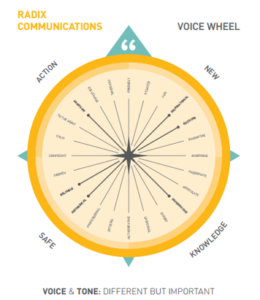
Drilling into what you think about your brand is critical. That’s why we’ve put together a prototype “voice wheel” to help…

The Radix voice wheel

Radix voice wheelThe voice wheel is a visual aid we’ve developed to provoke discussion in workshops and help marketers to make clearer choices about brand voice.

It works similarly to a colour wheel. Each word is subtly different from its neighbour – and it’s hard to embody two words that sit opposite each other.

The wheel can broadly be divided into four quadrants. The top-left reflects how you behave, the top-right suggests new ideas, the bottom-left is related to your trust and track record, while the bottom-right is knowledge-based strengths.

It should help you make some of the harder choices, and focus on what you want your brand’s voice to be (and, just as importantly, not to be). It works best when you use it as a team.

Here are a couple of exercises to try:

  1. Quickly circle three or four words that reflect how people might feel about your company. Then, compare results. Look for ones you agree on, ones where your views oppose, or any particular groupings that highlight a certain theme.
  2. Where there are some areas you’re not sure about, pick two word-pairs, and decide which quadrant your brand comes under. For example, if you highlight “methodical” and “inspirational”, as well as “informative” and “hands-on”, use those as X and Y axes, and ask where each person in the discussion would place you, and why.

(If you’d like a copy of the voice wheel prototype, feel free to get in touch.)

Here’s the webinar and discussion in full; thanks to everyone who attended. You can catch up on all our other B2B Content Tuesday sessions on our YouTube channel.

A quick guide to ebooks and white papers | B2B Content Tuesday

White papers and ebooks are a staple in every B2B content marketer’s repertoire. And although the two formats serve slightly different purposes, the terms are often used interchangeably. Our senior writer John Kerrison  memorably dubbed them “the content version of Nick Nolte and Gary Busey” – distinctly different, yet often confused.

(If you want to find out more about these formats, we’ve written a few pieces about their differences, how to write them, and where they should fit in your content marketing strategy.)

But with a host of new content formats emerging – from new PDF alternatives like Turtl to longer, more interactive blog posts – the role of ebooks and white papers are changing. Although still strong, they’re possibly not the catch-all choice they once were. And that has implications for content creators.

So, as part of our B2B Content Tuesdays webinar series, David shared his top tips for writing white papers and ebooks for today’s readers – highlighting what they expect, how to deliver it, and a few critical questions to ask yourself before you publish. Then he answered some popular questions on ebook and white paper writing.

You can watch the session in full at the bottom of this page, or read this summary…

A modern ebook, for a modern age

Once the prettiest sibling of the long content formats, the ebook is changing somewhat as new formats emerge. Attention is harder to come by – so to lock your readers in, you need to demonstrate clear value, right away.

The title and subheader will do a lot of that heavy lifting. If you introduce the value right from the off, it’s more likely the right reader will engage. They can see exactly what they will get from the resource, so will be happier to spend their precious time reading it.

The introduction is also a crucial time to build rapport with your reader. As formats become more interactive and engaging, there’s no room for stuffy writing (not that there ever was). Instead, stick to snappy, clear copy, which shows you understand their challenges and clearly sets out how they will benefit from investing their time.

As you continue, don’t make your sections daunting. Instead, move quickly through sections of around 300 words, perhaps across two pages, leaving room for the designer to implement boxouts, quotes and even videos.

Every section should be easily scannable and follow a linear story. After all, your reader may not have the time to commit to fully reading it. With clear sections – and headers that provide summaries and interpretations of the contents – even the quickest of flick-throughs can be valuable.

And if you can, think of each section as a story in its own right, which can be atomised into smaller content pieces. A big ebook, for example, could be the foundation for three or four spinoff promotional blogs. And rich media can be linked in and out – spreading across the internet a whole lot faster than a denser block of ebook copy.

The new rules of writing white papers

White papers have never been a format known for bold design choices, so they haven’t changed as significantly with the rise of new content formats. However, as content marketing has become increasingly popular, there’s a deluge of white papers out there now – many of them gated, and many not delivering value.

This combination has created a lack of trust for many readers. After all, no-one wants to sit down to read an in-depth piece, only to find it’s just repurposed desk research, or purely focused on selling them something.

So, you need to make it clear what your reader will learn from your white paper: the problem it will solve, and how it will help them to do that. Start by being clear and upfront, addressing a specific person, and their particular real-world challenge.

Then, make the information you’re offering easily accessible. Traditionally, white papers include plenty of statistics, advice and information, but this needs to be easy to get to – not hidden halfway down a paragraph. Once again, using informative, clear subheaders is vital, summarising rather than describing the content.

However, not all traditions are helpful. Where white papers are typically written in a very formal, academic way, this can turn your readers off. Although you may be writing about complicated technical specifics, there’s no reason for your writing to be overly complex.

Using the technical jargon of your reader – their language, if you like – is important, but using simple sentence structure, preferring the active voice, and avoiding buzzwords will make your content infinitely more enjoyable to read, and that’s never a bad thing. We’ve even written a whole blog about it.

And finally, three key questions to ask yourself:

What does my reader need?

Think about your reader. What do they need? What challenges are they facing? Are you being targeted and realistic about who your audience is? Will they have the time?

Is this the right format?

Take the time to consider your options. Will this be printed, or viewed online? Are you able to break down the information into scannable pieces? Can it be atomised into smaller chunks?

Am I providing value?

Make sure you’re producing something genuinely helpful, that delivers results. Can they find this out anywhere else? Do you need more research or subject matter expertise? What sections are most important – and what do you need to measure? Is it readable? Has it been reviewed thoroughly?

Your ebook and white paper questions answered

Q: How do I measure the success of my white paper or ebook?

David: “As a writer, finding out how successful your copy is can be a challenge. At that stage of the funnel, a lot of what we hear from clients is anecdotal. They’ll mention when the leads start coming through, or the white paper starts to play an active role in the sales process, as a conversation starter.

“There are likely plenty of other ways to measure how successful your work is though. If you have any suggestions, tweet us at @Radixcom – and be sure to use the #b2btuesdays hashtag.”

Q: How important is it that readers read the whole white paper?

David: “Let’s be brutally honest: even for a professional white paper writer, you’re unlikely to get people to read every word. But, from a writer’s perspective, being realistic about that fact is a really important part of the process, and a guide to how you should structure the piece.

“For example, because most readers will just skim through, your headers should help deliver the message. Subheadings shouldn’t just say ‘Conclusions’ or ‘Objectives’ – they should actually summarise the information.

“Then, your reader can get through the logical narrative quickly. Even without reading all the text, they can still find the resource valuable. You’re telling the story in the headers, then the dense stuff that makes up the content really acts as supporting information for each stage of the story.”

Q: Can you recommend any other platforms similar to Turtl?

David: “Turtl has been a real eye-opener. We used it ourselves for the Barriers to Great B2B Content survey we created earlier this year, and it was great – the process was really easy. I definitely recommend looking into it if your budget will allow it. And they’re lovely, helpful people.

“As for other platforms, SlideShare can still be useful. Embedding them on LinkedIn – portrait rather than landscape – can give your readers something to flick through with a clear narrative story.

“Velocity Partners have a content format called Velocity String, which I believe is HTML5. Again, it shows the importance of giving the reader a chance to navigate interactively through the story, and get the data about what they do.”

Thanks again to everyone who attended the webinar, and took part in the Q&A. You can watch the full discussion here:


And if that doesn’t fully sate your needs, there’s more. We’ve created a playlist of all our B2B Content Tuesdays webinar recordings on YouTube.