Podcast 66: is it ever OK to use comedy in B2B copy – and if so, how do you do it well?

Making people laugh is hard at the best of times – but when you’re writing in the guise of a brand, it’s even harder.

How do you know what your audience will find funny? And what if your audience doesn’t share your sense of humour, and it actively damages your brand’s reputation?

With the risks so high, you might think it’s best to avoid humour altogether in B2B copywriting. But is that really true – and if not, how do you go about getting B2B comedy right?

Three B2B comedy experts share their insights

In this special edition of Good Copy, Bad Copy, I talk to three people who know a thing or two about comedy and B2B copywriting.

The result: a full 45 minutes packed with expert tips on how to do B2B comedy well; what to avoid at all costs; and when it’s better not to try to be funny, even if you really want to.

Here’s the line-up:

Craig Beadle, comedy journalist-turned-copywriter at B2B content marketing agency Velocity Partners, gives us the lowdown on:

  • Which content formats work well for comedy – and which don’t (06:30)
  • How Velocity uses its own brand of humour to attract the right kind of clients (09:00)
  • The one time they took things too far – and discovered a line you can’t cross (13:21)

PLUS: Why this trio of ads by Sandwich Video for Wistia is his favourite bit of B2B humour.

Pauliina Jamsa, senior online marketing manager at Siemens and veteran of over 70 stand-up appearances, spills the beans on:

  • How she uses humour to liven up conference presentations (19:11)
  • Why B2B brands shouldn’t try too hard to be funny (22:52)
  • Why customers are your best source of comedy inspiration (just don’t make them the butt of the joke) (28:59)

Richard Preddy, comedy scriptwriter with TV credits including The Fast Show and Green Wing, and writer-for-hire on corporate video projects, gives us his two cents on:

  • When it’s appropriate to use humour in your content – and when it isn’t (35:04)
  • How to convince sceptical client stakeholders your idea is genuinely funny (36:38)
  • Why visual content lends itself better to comedy than text (38:23)

PLUS: Why this video earned Zendesk Richard’s vote for funniest B2B tech brand.

Thanks once again to our three fabulous contributors for their time, honesty and humour.

Want to contact the show?

If you have any questions for our contributors, or comments for us, fire away. You can reach us via @radixcom on Twitter or [email protected] (you can even email us a voice memo, if you like).

How to listen…

You can download the episode here (right-click and “save-as” to download). Or stream the episode in the player at the top of the page.

(Alternatively, you can subscribe to the podcast on iTunes here. Or maybe add our RSS to your preferred podcast player.)

Have you heard the one about… interviewing subject matter experts?

That’s the latest topic in our new, short-form podcast series, The B2B Content Audio Blog. Each one is a quick, easy listen on a specific aspect of B2B content writing – from writing for ABM to the evils of using the present participle in headlines. We’d love to know what you think.

Credits:

Podcast editing and music by Bang and Smash

The B2B Content Audio Blog #6: how to interview subject matter experts

Here’s a thing nobody tells you about being a B2B content writer: it’s not just about writing. You also need mad interviewing skills.

You see, most really good B2B content starts in the head of a subject matter expert. And it’s usually your writer’s job to get it out.

In this short audio blog (like a proper blog, except we read it out loud so you can do something more interesting instead), we reveal six surprising questions we use to get beyond the same-old content, and create something our client’s audience will really love.

When you’re ready, click play.

“Looks like we got ourselves a reader…”

If you’d rather read George’s questions for yourself, you’ll find them in his blog post 6 weird questions we ask subject matter experts (and why).

And here’s that guide to interviewing B2B experts that we mentioned in the recording.

Or, if you’re happy listening and you’d like some more, try our monthly discussion podcast Good Copy, Bad Copy: the B2B Copywriting Podcast. The next one’s a B2B comedy special!

How to listen

You can download the episode here, or stream the episode in the player at the top of the page.

(If you’d rather use your podcast app, you subscribe to us on iTunes, and there’s an RSS feed here.)

Get in touch

If you find the audio blog format useful (or if you have a way to improve it), we really, really, really want to hear from you. Email [email protected], tweet at us, or leave an iTunes review.

Credits

Audio editing: Bang and Smash

Title music: “Chinny Reckon” by the Nye Bevans

B2B Content Hall of Fame: the motor catalogue that repositioned a brand

Imagine you make the world’s best electric drives and motors. Your Swiss-engineered precision is legendary, and your powerful, high-value products are used everywhere a tiny motor must never, ever break.

Your customers make Formula One cars. Surgical robots. Sub-sea exploration drills. And you know that Mars rover that was supposed to work for 3 months, but lasted 15 years instead? Yup: loads of your kit on board.

Cool, huh?

But there’s a problem: legendary, Swiss-engineered precision does not come cheap. Or especially quickly. And sitting between you and every mouthwatering engineering project, there’s a purchasing person who doesn’t care two hoots about the longevity of your Neodymium magnets.

No, their KPIs are all about delivery schedules and cost – and there’s no shortage of bargain-basement competitors lining up to sell them an inferior product at a tempting price.

That’s pretty much the problem Maxon Motor faced. Right up until the company’s marketers did something really smart, that cemented the brand at the top of its market.

And at the heart of everything? A product catalogue.

Change the audience, change the outcome

The smart thing Maxon did was to stop trying to convince the purchasers, and talk instead to an audience that really does appreciate the value of a lighter, stronger, tougher motor.

Design engineers.

If you only engage with an engineering project at the buying stage, Maxon realised, a cheaper alternative will clobber you every time. But if you can convince an engineer to build you into their design? It’s a brave purchaser who’ll overrule the technical expert on such a crucial component for the sake of a few cents.

And even if Maxon is not specified overtly, a design based around the company’s motor specifications means that the purchaser now has to find a unit that can deliver this much power, in that tiny space, while reliably withstanding these conditions. Suddenly, you can count the competitors on one hand.

The trick is getting into that design phase – and that’s a content marketing challenge.

Enter the Maxon Motor catalogue.

Product catalogue as content marketing

The first thing you notice when you open a Maxon Motor catalogue (other than the terrifying thud as it almost crushes your desk) is just how little promotional product content there is – for a company with hundreds of thousands of modular combinations, anyway.

That’s because it’s not just a list selling products; it’s a selection guide. And it contains every formula, graph, schematic and circuit diagram a design engineer could possibly need when they’re specifying the right motor for their new product. Torque profiles are discussed. Thermal tolerances explained. Commutation options compared.

At one time, you’d barely see a product for the catalogue’s first 50 pages (Maxon has since shaken up the order a little, but the principle remains).

Because the second thing Maxon realised is this: Maxon’s engineers may live and breathe drives and motors every day, but a customer’s design engineer might specify a motor once a year; maybe less. They’ll have learned the theory at university, but even those who were paying attention will appreciate their memory being refreshed.

Picture the time-honoured content marketing Venn diagram: “stuff the customer is interested in” versus “stuff your brand knows about”. For Maxon, at the time a design engineer is specifying a high-precision motor (the key moment to influence), that diagram’s basically a circle.

You just have to get the content there at the right time. Which is why the format is so clever.

Content that pulls its weight

The Maxon Motor catalogue weighs a tonne. (I haven’t done the science, but I’m willing to bet it’s heavier than any of the products it describes.) For context, its page count is roughly the sames as Dickens’ Great Expectations.

That’s the genius.

Everyone hates to feel marketed to. And design engineers feel that aversion stronger than most. So when someone eschews a flimsy product showcase and sends you a big-off, serious-looking book, full of figures and diagrams? And it’s about something you need to know on a periodic basis?

First thing: the brand clearly gets you. These are people you can deal with.

Second thing: the book stays on your desk. There’s no way you’re losing something that useful. (Besides, think how many forests were beaten to death to bring it to you…)

The book’s size is precisely what enables it to put the content in the right place, at the right time. I have no idea how wince-inducing the postage is to send them out (not to mention the cost of translating 508 pages into eight different languages), but it’s worth every Euro.

And that’s not all. Maxon gives you the CAD drawing for every product in the guide. So when you know the specification you need, you pick up the file, drop it in place, and… BOOM. The design engineer’s life gets a whole lot easier, and suddenly the purchaser has to buy a motor the exact size, shape and capabilities of this Maxon motor. Neat.

You’d better believe this is great B2B content

The more B2B content marketing anchors itself at the mouth of the sales and marketing funnel, the harder it is for buyers to actually make a decision. That benefits nobody.

For years, Maxon Motor’s selection guide has quietly been aligning the brand with its most profitable target audience, by giving them the knowledge they most need, in a format that feels natural, and that customers are glad to receive and keep to hand. And Maxon has dominated its natural target market.

I can think of no more fitting nominee for our B2B Content Hall of Fame.

The B2B Content Audio Blog #5: the big mistake you’re making with titles

What is a present participle? Why are they overused? And what exactly is the difference between a gerund and a gerundive?

In this 9-minute audio blog, we look at the unexpected effect all those “-ing” words are having on your copywriting, and show how you can replace vague sentiments with clear, effective titles.

Give it a listen, to learn:

  • What a present participle is—and why you’re almost certainly using them too much
  • The best alternatives to woolly word choices
  • Why no one in their right mind cares what a gerundive is anyway

“Looks like we got ourselves a reader…”

If you’d rather read the full text of Fiona’s original blog post in all its unadulterated glory, here’s Death to the present participle, or why “-ing” is not your friend in B2B headlines.

Alternatively, if you prefer a longer listen, try our monthly discussion podcast Good Copy, Bad Copy: the B2B Copywriting Podcast.

How to listen

You can download the episode here, or stream the episode in the player at the top of the page.

(If you’d rather use your podcast app, you subscribe to us on iTunes, and there’s an RSS feed here.)

Get in touch

If you find the audio blog format useful (or if you have a way to improve it), we really want to hear from you. Email [email protected], tweet at us, or leave an iTunes review.

Credits

Audio editing: Bang and Smash

Title music: “Chinny Reckon” by the Nye Bevans

We need to talk: the power of a great briefing call

Even though we’re specialist B2B tech copywriters, briefing calls are essential to helping us create truly great content. It’s what adds that magic extra 10% that makes amazing content stand out from the crowd.

It’s our opportunity to talk to your experts – the people who live and breathe your story and what you’re selling. And it’s also your chance to provide us with extra nuggets of information we may not have had otherwise.

The result is a piece of copy that reads like the writer is indeed an expert in their field, which means a more interesting read, more captivated readers, and hopefully, more business coming your way.

Briefing calls take time and money. Can I avoid one?

The short answer is yes, of course. In many cases, there’s nothing wrong with writing a piece of copy without having a call first. Indeed, much of our regular work for long-standing clients and campaigns just needs a written brief.

But if you really want your content to be original and add value – especially if it’s a bigger project, or a subject uniquely discussed by your business – a briefing call can make the difference between good and great.

Often, once we start probing on a call, new themes and ideas emerge that maybe wouldn’t have seen the light of day otherwise. And it gives us a fresh, original angle that tells the reader something they didn’t already know, that’ll be of genuine use.

So, what do I (the client) get out of it?

Quite simply, it’s your chance to ensure we’re on the right track, and that we’ve got all those tasty nuggets of information that’ll help the finished piece cut through the noise and be heard.

We love to collaborate closely with our clients – it’s how we read between the lines, and ensure you get the copy back that you envisaged in the first place.

Especially for larger projects or projects with multiple stakeholders, there’s inevitably going to be lots of input which needs addressing. Close collaboration and communication keeps everything on-track.

What does it mean for a long-term relationship?

If we’re talking to you regularly, either on the phone or face-to-face, we’ll almost certainly build up a fantastic working relationship with you.

Simply, we’ll be able to understand the ins and outs of your solutions and how you make your customers’ lives easier. What’s more, our product knowledge will quickly grow, so it’s almost like having an in-house writer in your team.

Over time, briefing becomes quicker. And we become more able to suggest ideas and perspectives of our own to keep your content fresh.

Briefing calls: your ticket to truly well-written copy

If you like the sound of the way we work, take a look at some of our previous client work to see our capabilities.

The B2B Content Audio Blog #3: which B2B copywriter is best for you?

It’s rare to find one B2B copywriter who can do every kind of content well. So it’s important to understand how to match the right writer to each job.

In the third episode of our audio blogging pilot, David reads Radix’s most successful content of all time: Fiona’s wildly popular The seven types of B2B copywriter: which one is best for you?

As you’ll hear, choosing your copywriter depends on the challenge you are facing. The “creative copywriter” can come up with great campaign concepts, whereas the “explainer copywriter” will write you a stand-out white paper.

To discover the other five, and how to use them, click play.

Or, if you prefer a longer listen, like our monthly discussion podcast Good Copy, Bad Copy: the B2B Copywriting Podcast.

How to listen

You’re very welcome to use the player above, or download the episode here.

If you’d rather use your podcast app, you subscribe to us on iTunes, and there’s an RSS feed here.

Get in touch

If you find the audio blog format useful (or if you have a way to improve it), we really want to hear from you. Email [email protected], tweet at us, or leave an iTunes review.

Credits

Audio editing: Bang and Smash

Title music: “Chinny Reckon” by the Nye Bevans

Whatever happened to the content marketing heroes?

“Whatever happened to all the heroes – all the Shakespearos?
They watched their Rome burn.”

– The Stranglers: No More Heroes

It it just me, or are there fewer examples of brilliant B2B content marketing than there used to be? Am I imagining it, or has the discipline lost a little of its… zing?

I mean, it very well might just be me. I’ve had a long, long summer full of messaging frameworks and delayed trains to and from London. I could be projecting all of that onto the social feeds I’m reading and the work examples I see.

But if it is true, and people are less excited about content marketing, then it’s a problem. Because without advocates – without that fire of enthusiasm – great B2B content is almost impossible to create.

Is content marketing over?

Inevitably, there’s no shortage of contrarians lining up the obituaries for content marketing. Every “next big thing” has its backlash when marketers discover that, contrary to popular assumption, today’s hot tactic is (whisper it) not actually magic.

In case you haven’t been paying attention, here’s a quick recap:

You get the picture: it’s a regular Infinity War. Ironically, it seems the only tactic which isn’t currently dead, is publicly declaring things dead. (Oops, no: my mistake.)

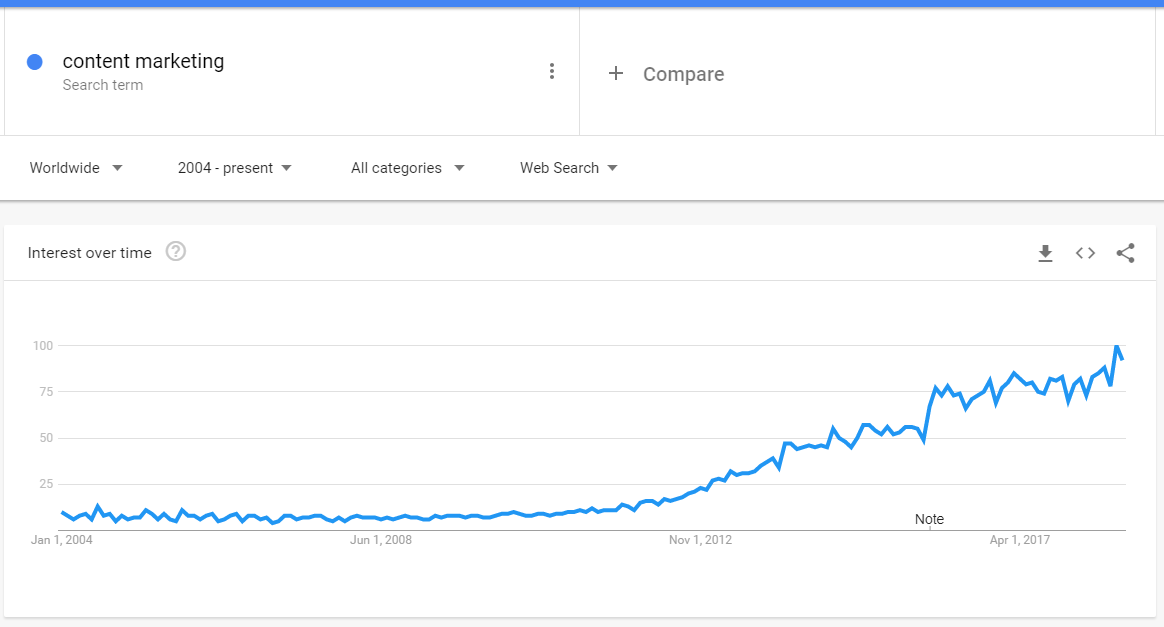
But if content marketing is on the way out, it seems nobody told the users of Google…

Content Marketing Google Trends

Lack of interest is not the problem. Every year, reports on Content Marketing show B2B marketers plan to maintain or increase their expenditure on the tactic.

So there are still loads of marketers, creating tonnes of content. No, the real problem is, how much of it will be great content?

Why “great” matters in B2B content (now more than ever)

It feels weird that I still need to say this. But somebody has to – and lately, it seems the traditional advocates for brilliant B2B content have been a bit quiet.

So here we go again.

If you’re creating B2B content, there’s no such thing as just “good enough”.

Not any more.

There’s a tonne of content out there, competing for your audience’s attention. And every tweak to Google’s algorithm tips the scales further in favour of quality. So assuming you want to be found, and read, and shared, your stuff needs to be different. More engaging. More relevant. More… amazing.

(And that’s backed by evidence, by the way. Orbit Media’s blogging research shows a clear correlation between time invested and strong results. Meanwhile, 83% of respondents in a CMI/Tomorrow People report attribute their increased success to better content production. This stuff works.)

Sure, there are people on social who will just share any old thing where the title looks halfway decent. And yes, you can take lazy aim at a keyword if that’s what floats your boat. But if those things move the needle on your KPIs, then I can tell you now you’re measuring the wrong stuff.

You don’t get “great” without a fight

So here’s the conundrum.

Now more than ever, successful B2B marketing depends upon outstanding, extraordinary, jawdropping content. The kind of content that takes heroes to deliver. What if it’s happening just at the moment those heroes have started to look elsewhere?

If you’re one of the brightest, boldest, most curious marketers, you’re always looking for the next new thing that can push things forward, and give you an edge. You’re naturally a bit bored by things you’ve done before. That’s what makes you tick. Content marketing isn’t shiny anymore.

But that restless streak – the willingness to challenge the status quo – is also an essential part of delivering truly genius content. Content that is…

Unflinchingly helpful, even when it hurts

Great content answers the questions your clients really ask; not just the ones you wish they would. But in They Ask, You Answer, Marcus Sheridan points out just how revolutionary that idea is, because it involves saying things that everyone in your market assumes are unsayable.

So targeted it’s actually a bit scary

In a content-saturated market, pieces that resonate deeply with a tiny, targeted niche will always beat the vague and generic. But convincing stakeholders to keep their focus that precise takes firm conviction, and nerves of steel.

Utterly, uniquely and unmistakeably yours

Fun Boy Three & Bananarama were right. Well, sort of – it’s what you say and the way that you say it. You should be able to cover up the branding on your content, and still know exactly whose it is – otherwise, why would you bother? That might mean pushing your content, or your voice, into territory it hasn’t been before. Speaking plainly. Sounding different from the crowd. Using a massive four-letter word for your title (OK, that last one’s already been done – but seriously, can you imagine anyone but Doug Kessler doing that back in 2013? That’s the point.)

Stuff like that works precisely because it’s a little rebellious. It goes against the grain, and that’s why you notice it. But it doesn’t just happen; it involves a degree of (somewhat calculated) risk. Somewhere along the line, a marketer needs to take a deep breath, and change something.

Can great content EVER be “business as usual”?

And that’s the rub. Content marketing needs rebels, while the approach itself is becoming ever more established. Maybe it’s no coincidence that this is the moment when  some of the biggest content evangelists have started to sell to big business, and enjoy a hard-earned step back.

So now B2B marketers face two choices. You can make your content “business as usual”, streamline your processes, and use efficiency gains to offset gradually diminishing returns. Or you can take that calculated risk, and shake things up.

Because even though content marketing is a mainstream tactic, the most effective B2B content is still a little subversive at heart.

What does that mean? If we can’t have our heroes back, we need some new ones to step up. Marketers who are willing to look at content in a fresh way. To ask what’s possible, and what customers really need, rather than just which boxes need to be ticked this quarter.

The stage is all yours.

“This is not the end. It is not even the beginning of the end. But it is, perhaps, the end of the beginning.”

– Winston Churchill