You mastered the full stop in primary school, and wielded the comma like a pro by secondary—but now, it’s time for you to master a new type of punctuation.
A versatile piece of punctuation that can give your writing far greater variety and impact, the em dash is the next best thing that will happen to your copy.
What is an em dash?
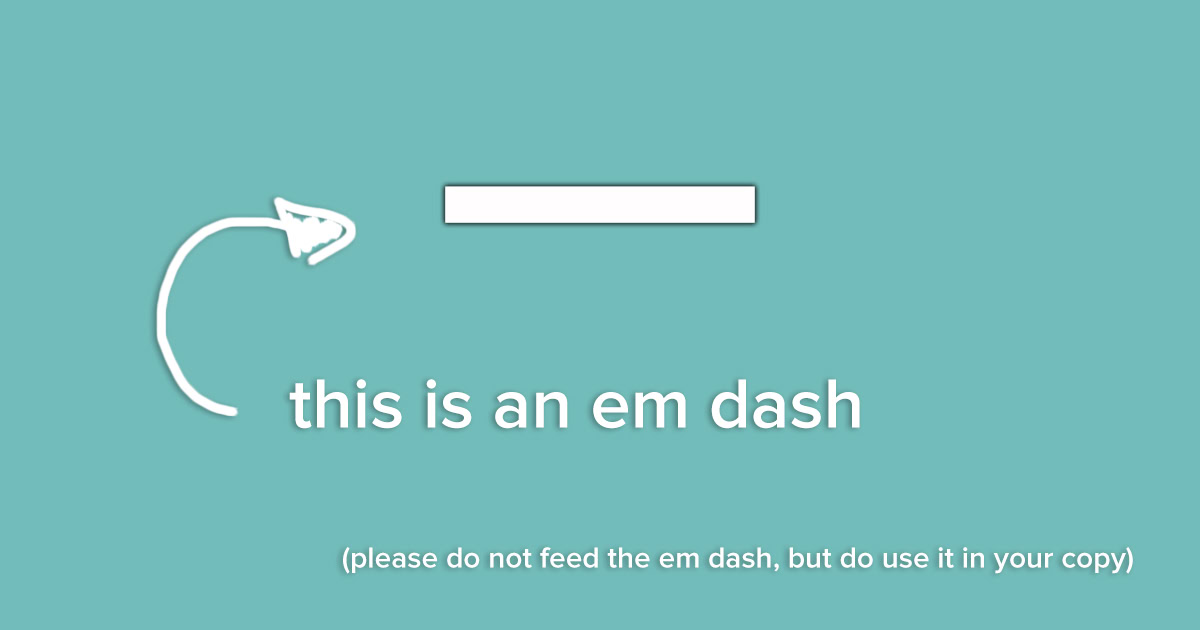
This:—
Longer answer, it’s a long dash that can take the place of commas, parenthesis or colons depending on the context.
To produce one in Microsoft Word, simply insert two hyphens between a pair of words without a space. So you’d type(–)like this, but without the brackets. (If that doesn’t work for you, check out this explainer from Punctuation Matters.)
What is an em dash not?
It’s important to clarify the difference between an em dash, an en dash and a hyphen.
- An em dash is a longer line, roughly the length of an ‘m’.
- An en dash is a shorter line – like this (it is roughly the length of an ‘n’). It represents a span of numbers or dates. In many cases it can be used similarly to an em dash if you are writing in UK English. You can produce it by typing a hyphen between a pair of words with a space either side( – )like so.
- A hyphen is an even shorter line that links two words for clarity. You’d use it to distinguish a cloud-ready platform (a platform that’s ready for the cloud) as opposed to a cloud platform that is ready for… something else.
You probably already know how to use hyphens and en dashes (even if you didn’t know it was called an en dash before), so I’ll just be sticking to talking about the em dash for now.
When can you use it?
You can use the em dash in a variety of ways: As a more impactful comma replacement, an alternative to parentheses, or a way to round off a sentence in a snappy, concise way.
Like a comma
“Product X can help you do stuff better—transforming the way you meet, greet, and treat your customers.”
Sentences like this, that use the rule of three, it can become a real comma overload if you have another clause in there. By using an em dash here, you can keep both clauses in the sentence without bringing the comma-pocalypse. A well-timed em dash can also help break up your sentences visually, making it easier and more appealing to read.
Like a pair of brackets
“Product X helps you do stuff better—and at a lower cost—than competing solutions.”
While brackets are a great way to include additional information without breaking the flow of the sentence, they often lead to that information feeling separate from your argument, and less relevant as a result. When you want to split your message away from the main sentence, but without detracting from its value, the em dash can help.
End a sentence with a bang
“Product X accelerates deployment times, helping you meet the needs of your customers—fast.”
Sometimes a bit of extra info at the end can of a sentence really ram home a key point in your argument. Em dashes can help emphasise these key points and bring them to life for your reader.
Why would I want to use it?
While there are some subtle nuances between using a comma or bracket and an em dash, it’s mostly best suited to adding variety to your copy.
Whether it’s avoiding overusing commas, stripping out repetitive brackets, or just making your copy look nicer and more varied—the em dash is a powerful tool that all copywriters should try and master.
One final tip
One final piece of advice for any future em dash users out there: double check your style guide before using them.
Most style guides I’ve come across ask for em dashes to be used without any spaces between—much like this. Newspaper style guides and others that follow AP style however, are likely to favour spacing em dashes — like this.
So, make sure to double check which one your client prefers before you start putting em dashes to use in their copy. If in doubt, you can normally tell which is preferred based on whether you are writing in UK or US English. UK English prefers a spaced en dash normally, while our counterparts over the Atlantic use the closed em dash as standard.