Podcast 89: B2B copywriting tools, tips and tricks

In this episode of Good Copy, Bad Copy, we’re talking about copywriting tools, tips and tricks to make you a better B2B writer.

Our guest co-host, Radix copywriter and content lead Katy Eddy, speaks with Julia Pierce from Literature and Latte about whether a writing tool like Scrivener might be a serious alternative to Word. And four writers share what they learned at this year’s Copywriting Conference.

Plus, a Deputy Chief Information Security Officer gets brutally honest in the Anonymous Five, and we need your help to find the best B2B content of 2020.

Where professional copywriting meets creative practice

What can creative writing pursuits teach us about professional copywriting? Lots, it turns out. And here’s the surprising thing: that learning flows both ways. The habits and disciplines of the day job can make creative work more effective too.

But when it comes to software, most B2B copywriters consider Microsoft Word as the de facto tool of the trade (in fact, we have a whole blog post about Word v Google Docs). Specialist writing tools like Scrivener can often be seen as the preserve of novelists, screenwriters, and other creative types. But in our feature interview this month, Julia Pierce explains why that might not always be true.

Especially if you’re writing an ebook, a white paper, or any other piece that involves organising multiple reference sources,  it a change of tool could be just the thing to help you see the big picture among the details.

(Also: if you’d like to know any more about NaNoWriMo, and how it can help you to write faster, you’ll find Katy’s blog about that here.)

What we learned at CopyCon: perfectionism, persuasion, reviews

Kudos to ProCopywriters for using the switch to digital events as an excuse to make the Copywriting Conference bigger than ever. At Radix, we got several writers involved in the training, as well as the day itself. Have a listen, and you’ll hear what they learned:

  • George shares how to harness systematic and heuristic decision-making
  • Lizzie reveals a coping method to overcome the perfectionist’s fear response
  • Ben muses on the importance of sharing with writers from other backgrounds
  • Kieran suggests you might want to ditch tracked changes, and have a call instead

The Anonymous Five: Deputy Chief Information Security Officer

In this month’s “Anonymous Five”, we get a brutally frank perspective from a Deputy Chief Information Security Officer (or DCISO for short), at a large US real estate firm.

Basically, if you write or commission cybersecurity content, you need to hear it.

(Thank you to our anonymous DCISO. We’ve donated to the charity of your choice: the mental health charity MIND.)

Here’s what you will find in this episode…

2.10 – Katy explains why everyone should be grateful to Goths

9.05 – Julia Pierce shares some of the more surprising uses for Scrivener

24.30 – Katy reveals which B2B content projects might benefit from new software

28.49 – Four Radix writers share what they learned at the Copywriting Conference

40:18 – The Anonymous Five: Deputy Chief Information Security Officer (DCISO)

Send us your thoughts, feedback, and favourite B2B content

Contact us through @radixcom on Twitter or [email protected] (if you’re up for it, email us a voice memo).

In particular, we want to know about the best piece of B2B content you’ve seen this year.

How to listen 

Credits 

Thanks to Julia Pierce for your time and insights. We’ll definitely be giving Scrivener a go in the office, and we’ll let you know how we get on.

Thanks also to our anonymous DCISO, and all the speakers and trainers at this year’s Copywriting Conference. In particular Tim Fidgeon, Jo Watson, Honor Clement-Hayes and Hinrich Von Haaren.

Podcast editing and music by Bang and Smash.

7 ways to write B2B marketing content that has real value

In B2B marketing, there’s almost always a vague urge to create a piece of content just because. Just because we need to fill out our blog. Just because one of our competitors is talking about this, and we’re not. Just because we’ve got a bit of budget left to see off before the end of the quarter.

It’s a hard temptation to resist. Often, businesses write something on the fly, and fill their websites with the content equivalent of used kitty litter. And that’s because creating content that’s actually valuable – something that hits a certain KPI, answers a burning question, or starts a promising conversation – takes work.

With that in mind, here are a few nudges to help you ensure every piece of content you produce offers value to your reader, and your business.

Define what “value” really looks like

The work starts with defining what “value” actually means. And it may feel a bit philosophical, but judging every piece of content by the same generic measure of value isn’t going to do you any favours.

Some content is designed solely to convert a reader into a prospect. Other pieces work best as an opportunity to raise your profile and show your company’s expertise in a particular area. Sometimes you want to share a new perspective on a current news item from your industry.

There are so many different ways content can function, and all of them bring a different kind of value. But if you know what you want a piece to achieve from the start, you can tailor it to that purpose.

Revisit your personas

Here’s a tip: the content with the greatest business value usually offers a lot to the reader too. If you’re giving them content that’s interesting, useful and compelling, they’re much more likely to follow your call to action.

But those needs vary. So to produce content that’s valuable to your business, you need to be certain you’re offering value to the right audience personas.

When you’ve had an established set of personas in your strategy for a while, it’s wise to go back and check on those profiles. If you haven’t revisited them for a few months (or even years), it’s easy to drift away from the key messages you want to communicate. In some cases, you might find those profiles just aren’t as relevant as they used to be.

Make sure you’re focusing on the right pain points and priorities and responding with something useful.

Align your priorities

In an ideal world, the Venn diagram of your internal stakeholder interests and your customers’ priorities would be a single, neat circle. But in reality, it tends to look more like two amorphous blobs that barely overlap – and that can make it difficult for your content to satisfy both.

It can be a fiddly business, but making valuable content relies on finding that sweet spot where the two blobs meet, and identifying the content opportunities that are hiding in that precious inch of overlap.

Stakeholders are far more likely to sign off on content – especially bigger pieces – if it reflects their requirements (and it’ll often benefit from their input too). On the other side, your audience won’t even consider spending their time on something that doesn’t talk about their challenges. By meeting them in the middle, you can get enthusiastic engagement from both sides.

Look for the unanswered questions

It’s getting more difficult by the day to create original content. When you’re looking at content put out by others in your market, it may sometimes feel like they’ve already answered every question or filled every niche.

But sometimes, all they’re really doing is papering over the cracks – answering top-level queries and offering generic responses. Dig a little deeper, and you’ll often find unique opportunities to add your own expertise, opinions and answers.

Primary research is your friend here; there’s no better way to identify your audience’s real, burning unanswered questions. A simple starting point is keyword research, to see which topics and queries people are plugging into Google, but you might want to dive into polls, surveys and social media too, for a more detailed overview.

Appease the gods of SEO

Once you have an idea that’s tailored perfectly to your readers’ expectations and interests, it’s time to pay your respects to the mighty SEO gods of the internet. By convincing the search engines that your content has value, your piece is far more likely to turn up in the top results, so you can see some real-world value in turn.

This is where that keyword research from earlier comes in handy – and an understanding of how latent semantic indexing (LSI) works.

Be warned: keyword stuffing is not the way to go. It’s ugly and doesn’t rank well with search engines anymore. With LSI, search engines also look for words that are contextually related to a particular topic. It’s rare to search using full, sensible sentences; we all use fragments and idiosyncratic phrasing, but by using words that frequently appear together in a sensible way, the search engine will recognise that you’re writing about a subject in depth.

So, you no longer have to squeeze an awkward sentence like “how to move to cloud” into your copy just because your audience types that into the search bar. The algorithm can also spot a combination of related terms like “public”, “hybrid” and “migrate”, which show you know about the subject.

Know where to share it

Getting that sweet, sweet ROI from your content means sharing it in the right places, so the right people read it. (Or hear it. Or watch it. I’m not the format police.)

Consider what you’re creating carefully. Does it work best on your own blog? As a guest post on someone else’s site? Are there industry publications that can lend your content an extra bit of heft? Is this a piece that would lend itself to being printed on heavy-weight paper stock and handed to your prospective customers in person?

Write copy that sings (very quietly)

Great ideas get lost in bad copy. Once you’ve identified your message, who it’s most valuable to share it with, and how to get it in front of them, you’ve got to write it well.

Whether it’s a blog, a video script, a SlideShare or a great big unit of a white paper, it’s all about clean and intelligent writing that supports your message without getting in the way.

And if the idea of actually doing that writing after all your prep work makes your fingers ache… Well, I know a few good writers who could help you out.

How to find the right voice and tone for your B2B content | B2B Content Tuesday

Whatever B2B content you’re creating, whether its a technical white paper or a chatty video script, you’ll likely find yourself making decisions around “tone of voice”.

But at Radix, we think “tone of voice” is a bit of a misleading concept. Because voice and tone are actually two separate (but related) concepts.

After all, your brand’s voice might be approachable, friendly or even fun. But it’s unlikely you’ll be cracking jokes in a legal contract. Nor would you pop a zinger in a letter of apology. (I mean, you could, but the outcome might not be fantastic.)

A clear personality is important. But brands that stick too rigidly to one “tone of voice” for all their content run the risk of sounding insensitive, monotone, or oblivious to the reader’s needs at key moments.

We went into more detail in our B2B Content Tuesdays webinar series – sharing how voice and tone relate to each other, with some tips to help you find an appropriate voice for your own B2B content. Here are some of the highlights – and you’ll find a video of the full discussion at the bottom of this post.

So, what is the difference between voice and tone?

There’s a clear way to define the two:

Your voice is how you express your brand’s personality to the world. Not necessarily information about your company history, but how you want to make customers feel about you. You voice is your character; it doesn’t change.

Your tone is how you talk to your reader once you’ve taken account of their situation, their state of mind and the intent of the content – so it’s going to change depending on the context.

Think about it like this: when you go to the pub, you’ll chat to your friends a certain way. And when you’re in a meeting with your boss the next morning, you’ll likely adopt a more professional manner – but you’re not going to develop a new regional accent. You are still you; your voice hasn’t changed. Only your tone has.

Three tips for finding your B2B voice

1. Get specific about your character

“We want to sound human.”

When we run our voice and tone messaging workshop, this phrase comes up a lot. But with nearly eight billion people in the world, it’s annoyingly vague.

So, think about the specific character your brand would play a story – and in this case, the story of your customer. Are you the loyal companion or the cheerleader? Are you the warrior fighting alongside them on the battlefield? Or maybe you’re the know-it-all – the unashamedly clever one your customers can’t live without.

2. Lean on your thesaurus

“We want to sound professional, but friendly – an approachable expert.”

This is another one we hear all the time. But what does “approachable expert” even mean? Arguably, Sir David Attenborough and Gok Wan both fall under that umbrella, but there’s a world of difference between how they sound.

This requires you to be specific in a different way. Think about what kind of professional you want to be: skilled, competent, experienced, methodical or something else. And there’s a multitude of ways to be friendly – are you chummy, neighbourly, cordial or helpful?

3. Opposites don’t attract; they confuse

“We want to sound reliable, but exciting.”

Values like these sit at opposite ends of the spectrum, which means it’s hard for your brand to convincingly evoke both emotions at once. You need to prioritise one over the other.

Drilling into what you think about your brand is critical. That’s why we’ve put together a prototype “voice wheel” to help…

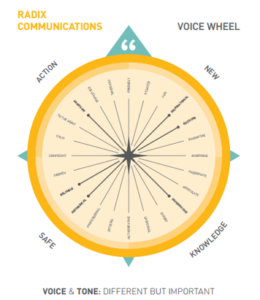
The Radix voice wheel

Radix voice wheelThe voice wheel is a visual aid we’ve developed to provoke discussion in workshops and help marketers to make clearer choices about brand voice.

It works similarly to a colour wheel. Each word is subtly different from its neighbour – and it’s hard to embody two words that sit opposite each other.

The wheel can broadly be divided into four quadrants. The top-left reflects how you behave, the top-right suggests new ideas, the bottom-left is related to your trust and track record, while the bottom-right is knowledge-based strengths.

It should help you make some of the harder choices, and focus on what you want your brand’s voice to be (and, just as importantly, not to be). It works best when you use it as a team.

Here are a couple of exercises to try:

  1. Quickly circle three or four words that reflect how people might feel about your company. Then, compare results. Look for ones you agree on, ones where your views oppose, or any particular groupings that highlight a certain theme.
  2. Where there are some areas you’re not sure about, pick two word-pairs, and decide which quadrant your brand comes under. For example, if you highlight “methodical” and “inspirational”, as well as “informative” and “hands-on”, use those as X and Y axes, and ask where each person in the discussion would place you, and why.

(If you’d like a copy of the voice wheel prototype, feel free to get in touch.)

Here’s the webinar and discussion in full; thanks to everyone who attended. You can catch up on all our other B2B Content Tuesday sessions on our YouTube channel.