7 ways to make your B2B writing more inclusive

The B2B tech industry isn’t run by robots (yet), but by actual, real people who exist outside of their offices and away from their laptops.

It can be easy to forget, but these people have interests, friends, and gender identities, as well as being executives and decision-makers at our favourite companies.

So if you’re a B2B marketer, inclusive language can play a huge part in ensuring your reader feels recognised and engaged.

To find out more, we spoke to Ettie Bailey-King, an inclusive and accessible communication consultant. Here’s what we learnt.

Why is inclusive language so important?

For starters, customer expectations have changed dramatically. The B2C market is rapidly adopting inclusive language, and it’s transforming the marketing industry.

If customers are used to respectful and inclusive communication in one industry, they won’t stand for less anywhere else – so B2B needs to keep up.

“We’re constantly surrounded by content – at work, at home, on social media,” says Ettie. “And thoughtful content makes us feel safe and welcomed. For example, an advert that says ‘everyone’, instead of the binary gender options of man or woman. Or an email that avoids gendered salutations like ‘Ms’ and ‘Mr’, and just says ‘Hi Ettie’. For many of us, those changes won’t feel like a big deal. But if you’re questioning your gender identity, for example, then those small changes can be the difference between a painful experience, and a safe and welcoming one.”

Even if you don’t think you’re talking to people who are trans, non-binary, or gender-nonconforming, that’s no reason to avoid using inclusive pronouns and language. According to Stonewall, around 1% of the UK population might be transgender, including non-binary people. Already, that’s roughly 600,000 people – but we’re a long way from knowing what the real figures look like.

“The comparison that activists always use is left-handedness,” says Ettie. “When left-handedness was stigmatised, numbers were around 2%. And when children were actually allowed to freely use the hand of their choice – if you look at the graphs, you’ll see an explosion in left-handedness.”

These days, around 12% of the UK write with their left hand.

There are so many reasons why inclusive writing is important – and they go beyond B2B marketing objectives.

“Inclusive writing is sometimes presented as a fun, happy add-on to make our businesses seem warmer. But it’s got a serious purpose. The world just isn’t safe for some people – for example, many transgender and gender non-conforming people are discriminated against, or at risk of terrible violence,” says Ettie. “It’s important to keep that in mind. So if we’re struggling to motivate ourselves to do the learning, we should remember that using LGBTQIA+ inclusive language has a real impact. For example, using someone’s correct pronouns can reduce their risk of suicide.”

As Ettie says, pronouns are incredibly important. To use them correctly, you’ll need to understand and be familiar with different types.

Let’s talk about chosen preferred pronouns

Pronouns are a big part of inclusive language and, for the record, they’re just that – pronouns. They’re not “chosen” or “preferred”, much like someone’s name isn’t “chosen”.

You might need to know your client’s pronouns (or your client’s client’s pronouns if you’re writing a case study about them). For example, “Matt’s Head of Copy at Radix Communications. He’s been in the role for 11 years.”

Or if you’re engaged in conversation and need to refer to somebody else: “Have you met Matt? He’s great.” Whenever you’re using pronouns, it’s important to do it correctly, even if they’re unfamiliar to you.

After “she/her”, “he/him”, and “they/them”, the most common member-defined pronouns on LinkedIn are:

  1. “she/they”
  2. “he/they”
  3. “they/she”
  4. “they/he”
  5. “any pronouns”

There’s a reason LinkedIn has counted “she/they” and “they/she” separately. For pronouns like these, you can’t assume someone has a preference, or what that preference is.

“Everyone’s different,” says Ettie. “When someone gives mixed pronouns, it might be because they strongly prefer the first one, they’re equally happy with each, or they’d rather you don’t use the second one and it’s just there as a backup (for example, for people who struggle to use singular ‘they’). If you can’t check with someone, I’d use the first pronoun. But if you can, take a few seconds to check which one they prefer.”

Neopronouns like “xe/xem/xyr” (pronounced zee/zem/zeer) or “ze/hir/hirs” (pronounced zee/heer/heers) are examples of popular gender-neutral pronouns, and are often used by non-binary or transgender people. You can practice using them and other gender-neutral pronouns using this tool, made 100% by gender-diverse and same-sex-attracted youth. This table published by the Office of Intercultural Engagement at UNC Greensboro might also be helpful.

But while understanding different pronouns and how to use them is crucial, it’s not the only thing we can do to make our B2B writing more inclusive.

7 ways to make your writing more inclusive

Ettie gave us advice on some of the current best practices for inclusive writing, and other things you can do to make sure all your readers feel recognised.

1. Shift your team’s mindset

A lot of us have been trained to write in a gender binary way – think “ladies and gentlemen, boys and girls” – and need to go on a learning journey to transform our writing.

If you’re part of a marketing team, this shift in mindset needs to be a collective experience. Start with sharing resources like podcasts, make or join a book club, and help others get exposed to stories and people outside the gender binary.

2. Always ask if you can

If you’re not sure of someone’s pronouns (and you have the opportunity to), ask. And if you can’t, then default to gender-inclusive language until you’re sure of someone’s pronouns – which could be after you’re expected to submit a first draft.

“In B2B, it’s less likely you’re going to be speaking and learning directly from people,” says Ettie. “But describing people accurately is so important. If you don’t know what pronoun someone uses, or how they describe themselves, always check. And if you can’t – they’re unavailable and no one knows the answer – then use gender-neutral terms like ‘they’. Or, you could just use their name instead, like ‘Ashley is Sales Director and Ashley will take over the new team.’”

Ettie’s default in her own writing is to use “they”, and it’s something people have been doing since the 1300s. You can then clarify and correct pronouns in the feedback process.

3. Why default to “they” when you can use “you”?

Defaulting to “they” is definitely an inclusive option when writing about people. But if you’re writing content that’s directed to someone, you can go one step further.

Using second-person address is not only inclusive – “you” knows no gender – but also a great tool for engagement. When you speak directly to your reader, they feel involved and engaged. In short, it’s good copywriting.

Second-person address helps to keep things simple, which is also more accessible. “If there’s one rule, it’s to not overthink it,” says Ettie. “Sometimes, by trying to be inclusive we end up with long and elaborate phrases, which can weigh our copy down. For example, if you’re trying to write a concise slogan, do you need to say ‘people who menstruate’ or ‘people with a vulva’? Maybe you can just say ‘you’.”

4. Treat pronouns like names

If you’re confused or in doubt about unfamiliar pronouns, Lal Zimman, a sociocultural linguist, says to treat them like they’re names. Here’s a rundown of what Lal says:

You can’t tell what a person’s name is just from looking at them, so if you want to know it you have to ask. And asking someone’s name is a totally normal question. In fact, it’s more likely to be considered rude if you don’t ask for someone’s name when first meeting them.

Names are treated as facts, and people don’t generally argue about them. It’s important to remember names, even if they’re unusual, or hard to pronounce or spell. And it’s important to get someone’s name right, even if you don’t like it or them.

People don’t insist that there are a limited number of names, and they know there are names they’ve never heard of. And sometimes people change their names, too – for example, when getting married – and that’s totally accepted.

5. And if you mess up…

Politely apologise, correct yourself, and move on. And don’t forget to be kind to yourself.

“We do need to gender people correctly, because it really matters,” says Ettie. “But while we’re learning, we should give ourselves permission to find it difficult and confusing. It really can be! Don’t panic or overthink it. Be firm but patient with yourself – you’ll be amazed how quickly you can learn.”

6. Be a role model

If you’re inclusive with pronouns in your everyday life, in your work and in your style guide, then it’ll translate into the way you write.

You can normalise talking about pronouns by including them in your email signature, your on-screen nickname, on social media profiles and business cards, or by advertising them on your person (think badges and stickers).

And you can go one step further by incorporating pronouns into your marketing. For example, include guest speakers’ pronouns on event invitations and web content.

By being open with pronouns, you’re helping to avoid potentially uncomfortable and awkward conversations. For example, if you’re meeting with someone virtually who has recently changed their pronouns, they can just change their on-screen nickname.

The same goes for people you’re emailing. There’s no need to use “Mr” and “Mrs”, or “Sir/Madam” as your default address. You can just say “hi”, “hello”, “good morning”, or use their name if you know it.

7. Be flexible

You’re not learning a set of rules once and forever. You’re learning something that may be true for now, and might not be true in a year, and that’s okay. Society is changing, and with it people’s pronouns and best practices.

“So you might meet Ashley now, with pronouns ‘they/them’. In a few years, Ashley might be ‘he/him’. That’s okay,” says Ettie. “Don’t panic if people change their pronouns or names. Be grateful that they share them with you.”

Flexibility is a big part of shifting your mindset and changing your patterns. It’s about always putting people before any set of rules or guidelines – including this one. Because for every rule you can come up with, there will always be people who don’t align with it (and that’s okay too).

Here’s where to learn more

Creating inclusive content can make all the difference to your reader feeling accepted, included, and recognised – which is good news for your people, your marketing, and the world in general.

If you’d like to learn more about inclusive communication, check out Ettie Bailey-King’s website Fighting Talk or sign up to her newsletter for quick, practical tips on how you can make your content more inclusive and accessible.

Reviewing B2B copywriting? Steal our 16-point quality checklist

In any industry where quality matters, there are a series of objective tests that a product has to pass before it’s released. But somehow, assessing B2B marketing content still seems to be a highly subjective process.

Maybe there’s a belief that creative work is exempt from objective judgement, or a fear of provoking arguments and resentment among writers and stakeholders. Still, nobody reviewing B2B writing seems to have a clear idea of what good looks like.

And that’s ironic. Because in most other contexts, a simple checklist of definable yes/no tests – making quality a little less subjective – is precisely the thing that prevents disagreement.

At Radix, we challenged the idea that evaluating writing is only ever subjective. So, we created a clear, 16-point QA checklist that’s inspired by the process we follow for all our internal reviews – the ones our content leads do before the client sees the work.

Our QA process helps to safeguard quality, but it also improves consistency across our writing team by highlighting areas for development in both writers’ work and client briefs.

And it works so well that we want to share it with you.

B2B Content Marketers checklist for assessing quality technology copywriting

A 16-point quality check for your B2B content

The questions you can use to guide your reviews are grouped into five tests, reflecting the five key B2B copywriting competencies: accuracy, clarity, authority, empathy, and wizardry.

Test A: Accuracy

Q1: Is the copy free from factual errors?

Readers won’t take your content seriously if it’s littered with factual inaccuracies or (worse) straight-up lies. This is basic integrity.

Q2: Have you screened for typos, grammatical errors, and spelling mistakes?

Writers and marketers are only human, and typing is hard. But your reader may not be forgiving, so take the time to proof thoroughly.

Note: If you’re using the QA checklist to identify issues for development, you’ll need a scoring threshold that separates consistent errors from occasional slips. If you’re interested, our wording is: “Are there two typos or fewer per 500 words AND is the copy free from grammatical and spelling errors (that aren’t obvious typos)?”

Q3: Does the piece meet the technical requirements (word and character count limits, templates, style guide, SEO)?

This might seem niche, but it’ll save a lot of headaches when you come to upload documents into your CMS or pass your copy on to designers. The point to take away is that the copy needs to meet the technical requirements of the format.

Plus, adhering to file-naming conventions makes managing content easier for everyone.

(So far, so good. The first three questions should ensure your copy is error-free. But we’re just getting started…)

Test B: Clarity

Q4: Does the copy have a logical structure that presents a compelling argument?

Usually, a B2B decision-maker isn’t interested in reading meandering walls of copy or navigating subversive storytelling approaches. Your content can be long, but you must take your reader with you. That means you need a strong structure that always makes sense.

Q5: Is the point of the piece obvious – from the start and throughout the narrative?

If you’ve got to the end of the introduction and aren’t sure why you should continue reading, or if the piece completely tails off towards its conclusion, the result is the same: you’ve lost your reader. (And your mark for this question.)

Q6: Is every sentence easy to read?

If you find yourself rereading sentences, tripping over grammar, or referring to Google to understand the language, the piece won’t work. If your reader is a senior decision-maker, time-poor, or reading on a mobile device, that only adds to the pressure to ease the cognitive load.

The “every sentence” part of the question sets an incredibly high bar – B2B tech can be complex – but this is important, so we make no apologies for that.

Test C: Authority

Q7: Is there appropriate use of technical or industry terms that are relevant for the intended audience?

There’s no point claiming expertise if you don’t speak your reader’s language. If the content is for a specialist B2B audience, the writer will likely need to use relevant technical jargon where appropriate. And they’ll need to handle it correctly – too much B2B content sprays industry terms around to mask a lack of confidence, and it always shows.

Q8: Are the claims supported by evidence and specific details?

Talk is cheap, so ensure every claim is specific and appropriately sourced. Don’t just say it’s fast; say how fast. Don’t say a viewpoint is widely acknowledged; link to an example. If there are references to studies or ongoing news stories, ensure the sources cited are the most recent available.

Q9: Is the copy free from waffle, hyperbole, clichés, and overly formal language?

Hyperbole fails when it promises the impossible (inflated language makes you less believable). If the writer seems too in love with their thesaurus, they might be making up for lack of relevant knowledge.

“If you care about being thought credible and intelligent, do not use complex language where simpler language will do.” Daniel Kahneman, Thinking, Fast and Slow

Test D: Empathy

Q10: Is there evidence that the writer understands the target audience?

This is fundamental to effective B2B marketing content. If the brief failed to define the audience, the writer should’ve pushed back before they even got close to writing.

Q11: Does the piece avoid making assumptions about the audience?

This is a tricky one. When you’ve done your audience research, it’s easy to go too far and lapse into telling the reader what they must think. Some writers will do this without realising, but making ill-advised assumptions only alienates the audience or dilutes the piece’s credibility.

Q12: Are the content and tone appropriate to the audience’s interests, priorities, and knowledge level?

How many B2B content pieces aimed at a particular sector start by defining the market or saying why it’s important? Newsflash: if you work there, you already know.

You need to understand your audience’s knowledge and awareness level. This is partly about the language, of course. But it’s also about being excited by the right things and going beyond features and benefits to understand the real difference a product, service, or idea will make to someone’s working life.

Test E: Wizardry

Q13: Does the piece offer original insight and value to the reader?

Not every piece needs to reinvent the wheel, but it does need to offer tangible value to the reader – and more content pieces fail on this count than any other. It might be new primary research, an original point of view, or a handy 16-point checklist (ahem), but the reader needs to gain something in return for their time.

Q14: Is it written in the right voice?

This is a little easier if you only write for one brand, but still, the piece needs to sound right. If you cover up the branding, is it still clear who’s speaking? Whether you’re writing on behalf of a brand or by-lining to an individual, reading should feel like the client is sitting in your head, dictating it to you.

Q15: Is it engaging and enjoyable to read? And is it likely to incite readers to action?

Place yourself in the reader’s shoes. Does the end arrive quicker than you thought, or does it seem like hard work? Do you naturally want to take the next step, whatever that may be?

What interests this audience may bore you to tears, but if a piece is well written, you should be able to get to the end and say, “Yes, that would work for me if I was a slurry engineer.” If that’s the case, then hey, good stuff.

Q16: And most importantly… Does the piece meet the brief and reflect the right messaging?

After meeting all the points above, it’s important to consider whether the piece reflects the initial brief. If your answer is no, you must take a few steps back and identify where you went wrong.

Even if you’ve produced the most well-written blog post of the year, it won’t be useful to your client – or your campaign – if it doesn’t reflect what you set out to achieve.

If your content scores 16/16, it’s ready to go…

Having reviewed thousands of pieces of content to date (from individual emails to messaging frameworks and entire websites), we find that this checklist works pretty well as a scoring tool.

Your needs might differ; some questions could be more relevant than others. You may also have technical requirements that require greater nuance.

If that’s the case, feel free to download our B2B content scoresheet and make your own version. Maybe you’ll want to change the questions or weight the scoring somehow. Get creative.

But the point is this: asking clear, objective questions makes it much easier to tell whether your content works and reduces the number of arguments you’ll have about preferences. It can help you spot issues and change how you brief, write, and review. And ultimately, it’ll stop you from rushing out weak content.

If it helps to improve the quality of B2B tech content overall, then by all means, steal away. We’ll be delighted.


How to review B2B marketing copy from ChatGPT

Generative AI can take on simple writing tasks and produce readable copy. But just like any copywriter, it needs expert oversight to ensure its writing is fit for purpose.

No writer is infallible. But ongoing issues like hallucinations and outdated training data mean you need to check especially carefully before staking your reputation on AI – as Google found to its cost.

So if you’re one of the growing number of marketers tempted to publish AI-generated content, it’s important to have a clear, repeatable review process – and enforce it rigorously. (Studies at Chicago’s Quest Academy revealed that the greater the role AI had in producing a piece of work, the less engaged the humans involved were in checking it.)

Also, there’s a lot more involved in an effective piece of copy than just reading well.

At Radix, we use a 16-point checklist to assess each piece of our writers’ work before we send it to a client; it keeps our quality high, and it’s a great way for our writers to learn from each other. If you’re planning to experiment with ChatGPT or its competitors, it could come in pretty handy (you can get a copy of your own right here).

Here, I’ve whittled down our content quality checklist to the five big questions to ask when you’re reviewing generative AI outputs.

Question 1: Is it accurate?

The most basic requirement of any piece of B2B content is that it’s correct.

It’s tempting to assume that computer-generated output will at least be factually accurate, but that’s not always the case. Although new-gen algorithms like GPT-4 are ironing out some of the creases, generative AI is still prone to making up “facts” that have no basis in (or even contradict) the training data. So, you’ll need to go through its copy with a fine-toothed comb to make sure it’s not invented things.

You’ll also want to double-check grammar and spelling. Despite the hype, AI isn’t yet intelligent in any meaningful sense; ChatGPT doesn’t understand what it’s writing, it just mimics things it’s read. AI outputs are only as good as the inputs – which is why it also repeats common grammatical errors and widely misused phrases.

Question 2: Is it clear?        

I’ve never yet heard about a B2B decision-maker who has tonnes of spare time to read marketing content. That means your copy needs to make a compelling, logical argument – and do it in prose that’s quick and easy to read.

At first glance, AI-generated copy often appears to make a plausible case. But, as we discovered in our ChatGPT copy experiment, the logic of the argument doesn’t always stand up to scrutiny.

A combination of not wanting to admit it doesn’t know the answer, not understanding the things it writes, and a tendency towards verbose and repetitive prose can lead AI to generate meandering arguments that end up in a logical tangle.

And because so much B2B content is needlessly complex, AI risks mimicking this flaw too. As Doug Kessler put it: “The point is not whether Generative AI is good enough today. The point is that most B2B writing isn’t.”

Question 3: Does it speak with authority?

Not only does AI not understand what it’s writing, it also doesn’t understand the audience it’s writing for.

That’s a problem, because it can undermine the authority of your piece. It’s pretty clear when you’re reading something if the writer doesn’t have a strong grasp of the topic and understand which aspects are most relevant to you. That’s why professional copywriters interview subject matter experts and work hard to understand the critical pain points and priorities – and the existing knowledge level – of the target audience.

Pre-trained models like GPT also rely on old data, so they’re not up to speed with the latest developments in fast-moving industries, making it very difficult for them to sound authoritative.

Another thing that instantly torpedoes authority in B2B marketing copy (whether human or AI-written) is cliché. And that’s a problem for large language models like ChatGPT, because they’ve been fed a solid diet of the cliché and banality that constitutes most writing on the web. A marketer recently told me that their agency is using ChatGPT to help rule out hackneyed phrases in headlines; AI writes the crap, so they don’t have to.

So, when you’re reviewing AI-generated copy, be ready to make heavy edits to give the writing the sense of authority, credibility, and authenticity it needs to be effective.

Question 4: Does it demonstrate empathy?

Again, AI is fighting a losing battle here. With no understating of what they write or the audience they’re writing for, and no lived experience to draw on, machines are a long way from being able to empathise with human readers. And without the human connection that empathy brings – that sense of a shared understanding of the world – marketing copy sounds very hollow and won’t engage its audience.

Another thing to watch out for is that AI can’t apply critical thought to assess the validity, authority, and relevance of its sources. That absence of critical thinking also means AI can’t understand that just because something has been said often, doesn’t mean it must be said again. Nothing displays a lack of empathy quite like telling people things they already know – or worse, things they don’t even care about.

Question 5: Is it insightful, engaging, and compelling?

It’s impossible to offer original insight if you’re just mimicking things you’ve read. So for thought leadership pieces, you’ll need to add that insight to the copy the AI generates, which will probably involve extensive rewriting.

Alternatively, you could try being very prescriptive in your prompt about the points you want to make. This might mean you need an interview with a subject matter expert before you set the AI to work. But, however you do it, you’ll need to do the legwork to ensure your reader gets some original, unique value from your piece – that’s not something ChatGPT can help you with.

Finally, remember that AI’s tendency to use repetitive phrasing and cliché means its writing can be quite dull to read. B2B marketing copy must be engaging to achieve its objectives, so you’ll need to spend some time polishing whatever the AI comes up with to give it a bit more sparkle.

Progress is good – but check, check, and check again

Generative AI is getting better at completing low-value writing tasks, like simple emails (although they still need to be reviewed and edited by humans). But it’s nowhere close to delivering high-value content like lively, well-researched ebooks and white papers that put an original spin on a topic, or video scripts that strike an emotional chord with the audience.

In the future, it’s likely that professional copywriters will use AI tools to do the heavy lifting before applying their craft to create content that helps marketers achieve their goals. But until then, use our content quality checklist to help ensure whoever (or whatever) writes your copy is doing the best job possible.

Does your B2B tech copy pass these five tests?

Let’s cut to the chase: reviewing someone else’s writing – and especially giving objective feedback – is hard. Really hard.

That’s why, right now, copywriters all over the world are doing their best to action feedback like “this needs rewording”, “it just needs more… oomph”, and even make it a bit more sparkly”. And not just from clients; even those of us who write for a living can find it tricky to put our finger on the thing that isn’t quite right.

It’s especially tricky here in the B2B tech sector, where the writing chops to hold your audience’s attention and explain things clearly are pushed to their limit – particularly when you need to write about some pretty niche subjects, in a way the audience will find authentic. You can find yourself reading a piece and thinking “It doesn’t quite work – but I don’t know how to make it better”.

The truth is, it’s not always easy to understand what good B2B copywriting looks like.

A pyramid of copywriting skills

Recently, a discussion in the Content Marketing Institute’s LinkedIn Group highlighted the issue again. A copywriter asking about clients’ expectations when hiring a writer drew such varied responses that it made one thing clear: there’s no consensus about what to look for.

One marketer argued writing with proper grammar was the most important thing… and yes, that’s pretty fundamental. But clearly, there’s more to great copywriting than just that.

So which is the most essential copywriting skill?

Actually, for B2B, I’d argue there are five core competencies – and importantly, each one builds on the one before, a bit like Maslow’s Hierarchy of Needs (note: the version near the bottom of the article is the one I consider most accurate). The basic three levels make for pretty dull writing on their own, but the exciting stuff is useless unless you also get the fundamentals right.

“A fine sentence is just the veneer on the credenza.”

Doug Kessler

So, next time you’re evaluating some B2B tech marketing copy (including some of ours), ask yourself these five simple questions – and remember to ask them in order. It’ll help you to give much clearer feedback, and choose the best writer for the job.


Test #1: Is it free from obvious mistakes?

Harsh as it sounds, even the most brilliant, inspirational writing can be brought down if it’s full of basic errors. That’s not saying the grammar always needs to be fiddly and formal – that depends on context – just that things can’t be obviously wrong. It’s hard to take any content seriously if it confuses your with you’re, or losing with loosing.

So do check spelling. Check grammar. And, while you’re at it, check facts too.

Accuracy is the foundation on which everything else stands. Fortunately – unless a whole piece is based on obviously incorrect information – it’s also the easiest thing to fix.

(Naturally, this means you will now spot a horrendous typo within the next five seconds. Even the most fastidious proofing is no match for Sod’s Law.)

So in a way, the marketer from LinkedIn was right. Good English (or whatever language you’re using) is where we start. But we don’t finish there.

Test #2: Did I have to read anything twice?

A good writer needs to think clearly – and you should see signs of that in the way they put a sentence together. Explanations need to be logical, and it ought to be obvious what the point is (in an individual sentence/paragraph, and the piece as a whole).

If you find yourself re-reading a section (even if, when you eventually decode it, it makes sense), that’s often a sign that the writer is struggling, or that they haven’t really thought about what they’re saying.

Good copy is easy to read.

Test #3: Does this ring true?

Especially in B2B and tech, you need to get the feeling that the writer really knows about the subject. If they sound like a newbie, the piece won’t have authority with decision-makers in that sector. (At best it will fail to be read – at worst, it can undermine your brand.)

Using sector jargon is not enough; it needs to be used the right way – the way your customers do. Dropping sector buzzwords willy-nilly can make you sound stupid, if it’s clearly blagging. Do you feel like the writer really gets what those terms mean?

You can also test for understanding by looking at which points the writer has chosen to emphasise. If you know your subject, you’ll generally get a good feel for which bits are most exciting for the target audience. (Oh, it comes with a USB port? How interesting for you…)

Test #4: Who cares about this, really?

You can write as much accurate, clear, authoritative copy as you like… if the response is still “so what?” then you’ve probably failed. So be brutally honest: did the writer make you care enough to read to the end? More importantly, will your target audience feel that way?

For the best writers, this is not about the persuasive force of their prose; it’s their empathy with the reader… and good old-fashioned research. If you understand your audience, you can develop a keen instinct for what will appeal to their hopes, or what keeps them awake at night. If you can keep a sense of their context – when, how and why they’re reading – that’s better still.

If you’ve got all this, you’re almost there.

Almost.

Test #5: Is this extraordinary?

Your copy is no good if it’s humdrum.

And that’s no less true just because it’s B2B tech. In fact, it’s more so – wherever you put your marketing message, it’s competing for attention with a million others. Everyone’s making more content. Sending more emails. Creating more STUFF.

In this climate, OK gets you nowhere; you need to be, literally, outstanding.

This is where great copywriting really pays off. But it’s also the part that’s hardest to quantify, or to be objective about. That turns into feedback like “make it more sparkly”.

So start by asking yourself whether it surprised you. Whether it stirred an emotion of some kind (joy, anger, humour, disgust… something). Ultimately, whether it would make you take action.

(Please note: surprise is a good thing – so if the piece isn’t at all what you were expecting, don’t be too quick to judge. It might be brilliant.)

“Brilliant” is the price of admission

None of this is about different types of copywriter (Fiona’s already covered that in meticulous detail, here). And it doesn’t vary depending on the format. These are the five core competences every B2B copywriter should be showing, on a regular basis.

At least, on a good day.

In reality, the best writers get there most of the time. But it’s certainly what you should expect from every piece of B2B copy and content you see… and hopefully, on those rare off days, these five tests will help you to zoom in on exactly where the problem lies.

(And naturally, this post will now be quoted back to me, at length, by my own clients. Well, bring it on. Life’s too short for copy that isn’t amazing – whether you’re reading or writing.)

4 places to look for inspired B2B content ideas

It’s Friday, somewhere around 2 pm. You hear the Zoom ringtone. It’s your boss calling. “Quick, I need you to whip up some new content ideas – original ones that are going to get people excited about this new product. And have them on my desk by the end of play.”

You think: “New content ideas that are going to appeal to our audience’s interests, provide a solution to their challenges, keep them engaged, and I’ve got less than a day to come up with them?”

It’s a challenging brief – and on any other day, you’d go to an experienced B2B copywriter to help. But in this case, there’s no time.

Even worse, you already used your best ideas in a previous campaign, and the cogs in your brain have seized up after a long week. Inspiration has well and truly left the building.

So, what do you do? How do you find the spark again? Where is inspiration hiding? Here’s where to look.

1. AnswerThePublic will tell you what your audience is thinking

AnswerThePublic is a search listening tool for market and customer insights that pays attention to autocomplete data from search engines. It provides a direct line to what your customers (and admittedly, everyone else) are thinking.

Use it to track trends, and generate content ideas that reflect what people might want to know based on what they’re already searching.

2. Your team are the experts – make the most of their insights

If you want to produce more targeted content that will speak to your specific market, you need to look closer to home. As far as we know, Google processes at least 2 trillion searches a year. That’s around 3.8 million searches every hour. But these searches won’t all come from current or potential customers, or from folks with a robust understanding of the hot topics in your industry.

Your team are experts about your products and services, the industry, and current trends – and they might have ideas of their own to contribute. Your salespeople, in particular, are talking to customers all the time, determining their interests and challenges. So get in touch with your team and use their expertise to fuel your creativity.

3. See what generative AI has got to say

We’ve already investigated if generative AI can write like a B2B copywriter (spoiler alert: not quite yet), but how does it fare at generating content ideas?

With a well-thought-out prompt, AI solutions like ChatGPT can churn out a lot of ideas in seconds. But these chatbots are designed to borrow and collate ideas from other sources, which means they’re unable to produce unique ideas. (Plus, you don’t know how many other marketers are asking for the same thing and receiving very similar results to you.)

It’s not all bad news. The AI-generated content ideas might just be the thing to get your cogs turning again, and give you a starting point where you can add your own personal touches.

4. Don’t do anything at all – not a single thing

Really, I mean it. I’ve stolen the idea from Andrew Boulton, freelance copywriter, lecturer and brand language consultant. In Andrew’s list of 99 ways to have more fun as a copywriter (and possibly get a bit better at it), he says:

  • “Let yourself be idle – your brain will thank you, and reward you.”
  • “Treat your imagination like a puppy – feed it, walk it, let it snooze, clean up its poop, treasure it always.”
  • “Don’t type a thing until the words are bursting out of you.”

These ideas might feel counterproductive, but sometimes the best thing you can do for yourself and your brain is just to take a break. You never know what ideas might come to you when you’re not even trying.

Okay, let’s replay the scene…

It’s Friday, somewhere around 2 pm. You’re full of excitement for the weekend when you hear the Zoom ringtone. It’s your boss calling. “Quick, I need you to whip up some new content ideas – original ones that are going to get people excited about this new product. And have them on my desk by the end of play.”

You think: “New content ideas that are going to appeal to our audience’s interests, provide a solution to their challenges, and keep them interested? I know exactly where to start.”

And, hey, if there’s a twist of fate and the deadline gets pushed, leave it up to the experts.

How to write an ebook for a B2B audience

If you’re responsible for B2B marketing, you’ll probably have been asked at least once to write an ebook. And no wonder; they’re useful top-of-funnel and middle-of-funnel content pieces that can educate potential buyers about issues they’re not currently aware of, or to show them how to tackle an issue they are aware of.

But with so many ebooks competing for attention, how do you write a good one? Here’s a guide to help you produce a strong first draft.

What is an ebook?

Ebooks are often confused with B2B white papers – and that’s understandable. They’re both substantial, informative content pieces that sit in the middle of the funnel – where they’re occasionally gated for lead generation. John wrote a whole blog post about telling the difference, but in short an ebook is generally a little less detailed, with fewer words on the page (and they look prettier).

In B2B marketing terms, an ebook is usually around 2,000-2,500 words long, with artwork and graphical elements that break up the text. And the tone is usually lighter than a white paper: accessible, fun, and conversational, with snappy headlines and subheaders to introduce the key sections and points.

Three hallmarks of a great ebook

59% of companies created an ebook (or white paper) in 2022, so writing one that stands out from the crowd can be difficult. But it’s not impossible.

There are three things that characterise a great ebook – and only one of them is down to the writing itself.

Hallmark #1: Audience insight

The first hallmark of a great ebook – and any great B2B content piece – is that it shows an understanding of your audience, what matters to them, and what they need from your content.

To make an impact, the ebook should pack an emotional as well as a rational punch, and it’s hard to make an emotional connection with your reader if you don’t know who you’re writing for.

This is especially important if it’s a top-of-funnel ebook. Here, you’re trying to make your reader aware of a problem or opportunity they don’t currently know they have. To do that, you need to be able to relate your subject to something the audience does know and care about. That takes research, careful questioning of subject matter experts, and (ideally) a persona or avatar to work from.

Hallmark #2: Genuine usefulness

A great ebook also brings the reader useful, practical, actionable, and unique information they can’t get elsewhere, which genuinely helps them do something they want or need to do.

Ideally, this information should be so useful (and hard to find elsewhere) that the reader will feel compelled not just to act on it, but to share it too.

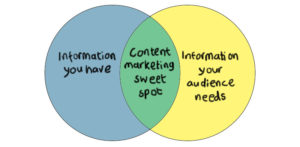
Getting to that level of usefulness and uniqueness is extremely hard, but if you can find your content “sweet spot” – the intersection of “information you have” and “information your audience needs” – it becomes easier to do.

ebook image diagram showing blue and yellow circles crossing in the middle to form a green segment

Hallmark #3: Great writing

The third and final hallmark of a great ebook is the writing itself. Reading it should be an enjoyable, enlightening, and inspiring experience – not a slog.

If you write as if you’re having a great conversation with your reader, about a subject you both care about, you can’t go far wrong.

How to approach the ebook project

At Radix, we have a process for writing a great ebook, which all of our writers follow. If you’re a marketer who has to write content, this could be a good process for you too.

  1. Read the brief. If you’ve been given a written brief, read it thoroughly and note anything you’re unsure of. Then have a call with your client to clarify those points. It’s always better to clarify upfront than to second-guess what the client meant and have to rewrite your draft when it turns out to have been wrong.
  2. Do your research. Your ebook needs to be convincing, which means you’ll need to include stats, figures, and quotes that support your argument. You should also interview subject matter experts to add credibility – these are the people who have the ‘sweet spot’ information that will make the ebook genuinely relevant and useful to your reader. Gather all the supporting information you think you’ll use in the ebook, so you won’t have to break off to look things up after you start writing.
  3. Write an outline. This is an essential part of getting the ebook right. It’s a chance for your client and stakeholders to review what you propose to write and make any corrections or suggestions before you go too far down the route of writing it. A section-by-section structure with bullet points is ideal: think of it as a synopsis document, as if you were pitching your ebook to an editor or literary agent.
  4. Write the first draft. Much of the legwork has now been done, so you should find it relatively easy to write the first draft. A word of caution, though: as you write, don’t be tempted to stray from the outline; it’s been approved, and it’s what you’ve agreed to deliver. Save any new ideas for another piece of content down the line.
  5. Review your first draft. If your deadline allows, don’t send the draft off to the client as soon as you finish it. If possible, ask someone else to take a look (they can even use our content review checklist checklist). Alternatively, put it aside for a few hours – ideally overnight – and come back to it with fresh eyes. You’ll almost certainly spot things that could be phrased better, and these relatively minor tweaks can go a long way to strengthening your first draft. (And the stronger the first draft, the less rework you’ll have to do later.)

Now let’s look at the writing itself. How should you actually write your first draft?

Writing the introduction

The introduction is a crucial part of the ebook. It’ll make people decide whether to keep reading – which you want them to do, because there’ll almost certainly be a call-to-action (CTA) coming that you want them to reach.

So what should a great intro do?

  1. Create an immediate rapport with the reader. The intro is where you show you understand your reader’s world, their professional goals, and their personal aspirations. You’ll mirror the language they use, and set their expectations for the rest of the ebook. (Will it be fun to read, for example, or will it be matter-of-fact but brimming with useful information?)
  2. Frame the problem – and your ebook as the solution. Articulate the main issue your ebook addresses, and clearly show how the ebook will help the reader overcome it. Right out of the gate, you need to make your reader aware that you have something important to tell them about something they care about, and that this ebook will help them to tackle the issue to their advantage.
  3. Define who will get value from the ebook. Showing you know who your audience is – both professionally and psychographically – allows the reader to decide whether the ebook is for them before you’ve taken up too much of their time.

For example: “This ebook is for contact centre managers in consumer-facing organisations who want to improve customer retention rates and aren’t afraid to try radical new ways of working.”

You could even use reverse psychology (respectfully rather than in a snarky way) by defining who won’t get value from it, such as: “This ebook is not for people who shy away from radical new ways of working.

  1. Make it clear what they’re going to learn. Every B2B decision-maker is busy – so they need to know your ebook is a worthwhile investment of their time. So use your intro to set out clearly what they’ll learn, and how they can use it to their advantage.
  2. (Optional:) Show the reader why they should listen to you. Generally, an ebook is not a hard-sell piece of content, so it’s not usually appropriate to go overboard with the sales pitch. But you do need to convince the reader your ebook has something credible and relevant to say. A brief statement about the client’s credentials in dealing with this topic can help to establish that authority and justify the reader’s time.

A good ebook introduction might go a bit like this, for example:

Introduction: The Problem with X

Your situation is like X today, and because of that, you’re not achieving Y. This ebook will show you how to escape X and achieve Y.

It’s for X type of person, working in X type of organisation, with aspirations to achieve Y and/or avoid being X.

Over the following xx sections, you will learn A, B, C, D, and E. You’ll be able to use this information to do Y.

Plus, it will be super fun. Let’s go!

[Optional box-out feature: This ebook distils our experience from helping 10,000 companies in this area to achieve Y over the last Z years. We hope you’ll find it useful.]

Writing the sections                                  

You’ll already have structured the individual sections of your ebook in your outline, so now it’s just a case of fleshing them out. Here are a few pointers to help:

  1. Make your sections roughly the same structure and word count. This will give all the sections equal weight of authority and make the ebook feel satisfying and professional. It’ll also help the designers to lay out each page consistently.
  2. Stick to your word count. A typical ebook is around 2,000-2,500 words, which probably only gives you 300-350 words per section. Get the key points across crisply and succinctly.
  3. Pay attention to headlines and subheads. Make them enticing and appealing. You want your reader to enjoy reading the ebook and feel like they’re chatting with someone who’s interested in them and telling them valuable stuff.
  4. Think about how your copy will look on the page. What design elements will there be? Are there elements of your copy that would work better as a visual or graphic? If so, provide basic suggestions for a designer to create the image. (PRO TIP: To help with this, some ebook copywriters like to write the copy as it will eventually be laid out – in landscape format with text boxes and spaces for graphics.)
  5. Bring your copy to life. Reading lots of abstract, theoretical stuff can be boring. Show how the point you’re making works in the real world and directly impacts the reader. Did your subject matter expert use nice analogies or catchy phrases to explain the topic? If so, work these in.
  6. Back up your points with credible statistics and quotes. You’ll have gathered these in the research stage, so all you need to do now is drop them in (don’t forget to attribute them to their original source). Suggesting pull quotes and breakout stat boxes can also give your designer plenty to play with to make the finished book look interesting and engaging.
  7. Link to other content pieces. If you (or your client) have produced other content relevant to any of your sections, include a link to it. Even if the reader doesn’t make it to the CTA at the end, your ebook can still provide value.
  8. Include a key takeaway or recommendation at the end of each section. What’s the one thing you want the reader to remember about this section? Make it easy for them to remember it!

Writing the summary

This is where you sum up the key points of your ebook in the form of a handy list that will help your reader to achieve Y or avoid X (refer back to the intro at this point).

If you’ve included takeaways throughout the ebook, you can list them again here, so your reader has a summary of the key points to remember. And if your ebook is designed to be actionable, including a checklist can work well.

A nice touch is to include links to further resources – either the client’s own content or (if you want to be really helpful) industry-wide content that adds relevant and interesting new perspectives on the topic you’ve discussed.

And if you haven’t already set out the client’s credentials in the topic area, there’s another chance to do that here.

Writing the call to action

In B2B tech, sales cycles can be long – so your ebook likely plays a specific role in guiding the reader along their “buyer journey”. To do this, your CTA at the end should encourage the reader to take a sensible next step – whether that’s to read another piece of content, book a demo, or get in touch.

You can measure the ebook’s value by the number of people who follow this CTA, which means you need to make it as persuasive as possible. So don’t leave writing this until you’re exhausted and can’t wait to type the final full stop.

Instead, write the CTA early on – ideally in your outline – and make sure you assess it thoroughly when you come back to your draft with fresh eyes before you send it off.

…and that’s it!

There’s much more we could say about ebooks – but this getting started guide is already approaching ebook-style length.

If you’re looking for help creating a really great ebook, find out more about our services or get in touch – we’re always happy to help!

Note: this blog post was originally written by Radix’s founder, Fiona Campbell-Howes, in 2015. It has since been updated to keep up with evolving practices among our ebook clients, and changes to our writing process.

Research report: barriers to B2B marketing content

In November 2019, we invited B2B marketers to tell us, anonymously, about the problems that prevent them creating the content they’d like. We write B2B content, so we thought we might learn something useful.

The response was so surprising, and so vehement, that we turned it into a full research report – and we asked leading B2B marketers from the US, UK, Germany, and the Netherlands to share their commentary and advice.

It reveals six problems shared by at least 75% of marketers, as well as six ideas to break the cycle. If you want to dive straight in, you can do so here…

Click to read Barriers to Great B2B Content 2020: Survey Results and Analysis

Big surprises in the survey results

The response to the survey shocked us, in a whole bunch of ways.

Responses from all kinds of B2B marketers, everywhere

First, the number and variety of marketers who took part. We’d anticipated that maybe a few dozen would be disgruntled enough to use our survey to let off steam. In fact, we attracted 105 responses – B2B content marketers of all levels, from all round the world. CMOs and marketing directors to content writers and agency types, working in all kinds of B2B: tech, engineering, SaaS, legal, manufacturing, and more.

B2B marketers are really, really angry about this stuff

Second, the sheer vehemence of the answers. These aren’t just small frustrations; B2B content marketers are angry. And when you think about it, it’s hardly surprising; marketers are being prevented from doing their best work, and then being talked down to by content experts who only see the content, but not the struggle behind it.

Maureen Blandford has experienced this in previous roles, and says the results are “the reality for most marketers”.

Imagine having people screwing your work up, and then being blamed by the market when your content sucks. It’s like: “If you only fuckin’ knew.”

– Maureen Blandford, VP of
Marketing, Community Brands

Pretty much everyone is dealing with the same crap

Third, the fact they’re largely angry about exactly the same things. Irrespective of seniority, business size, sector or location, there are issues that seem to affect everyone. Specifically, six challenges were rated as a problem by 75% or more of our respondents:

  1. Conflicting and changing priorities, and unclear briefs
  2. Stakeholder interference
  3. Limited budgets and resources
  4. Too much work, and not enough time
  5. Lack of co-operation from other departments
  6. Problems getting access to customers

All the assumptions about B2B marketing are wrong

Fourth, the challenges that aren’t on that list. We often read that B2B content is not engaging because the subject matter is complex and dry, B2B buyers are conservative, or marketers lack creative skills. None of those things made the list. Instead, we see a picture of B2B marketers who have plenty of good ideas, but are prevented from executing them by their own organisations.

And finally, a lot of the findings are shocking in their own right. For example…

Just 32% of B2B marketers are proud of most of their content.

Many of the critiques of B2B content seem to assume that marketers don’t know their content could be better. This result – in response to the question “How much of your published B2B content makes you proud?” – proves that’s a huge mis-assessment.

Out of 105 respondents, not one could say they’re proud of all the content they produce; only 32% could even say “most of it”. By contrast, the most popular response was “a handful, ever” (37%). 28% went for “less than half”, and 3% said “none”.

It’s a worrying state of affairs, replicated in every group we spoke to. CMOs and marketers in North America were slightly more positive, but there was no category where “most of it” scored higher than 45%.

81% of B2B marketers have to fight hard for their content.

And the issue certainly isn’t that stakeholders don’t care. 81% agreed with the statement, “I sometimes have to fight hard to publish content I’m happy with.”

That’s a global issue, and the scores were fairly uniform. There was no category where fewer than 73% agreed (the UK, followed by tech marketers with 76%), and for marketers working in enterprises and on mainland Europe, the figure was 100%.

Just 14% of B2B marketers say their organisation agrees on what good content is.

Conversely, no enterprise or European marketer agreed with the statement, “In my organisation, everybody agrees on what good content is.” Overall, the figure was just 14%.

The fact the figure is almost an exact mirror image of the “I sometimes have to fight…” question could suggest that a lack of stakeholder alignment could be one of the root issues revealed in this report. If the organisation cannot agree what good content looks like, then the marketer will always face a fruitless task trying to create it.

In the report, Doug Kessler talks about stakeholder alignment as “the number one job” for B2B marketers. And he explains the importance of taking that alignment work outside of the daily process of content approvals.

If your stakeholders are not in alignment, nothing is possible. And if they are, almost anything is.

– Doug Kessler, Creative Director, Velocity Partners

One way to address the issue is to draw up a clear, agreed specification for your content, and base each point on data (whether from research or, better still, your own A/B testing). If you can use independent metrics like content readability scoring, better still. This makes the conversation less subjective, and more aligned to the pass/fail quality tests in other areas of your business.

If you like, you’re more than welcome to steal the B2B content quality checklist we use for our own internal reviews, and adapt it for your own purposes.

There’s evidence these content barriers really do hurt business results.

As we looked at the research, it quickly became clear that B2B marketers aren’t lacking inspiration for their content; they need evidence to help them fight their daily stakeholder battles. So we went back to the data, to see what we could find.

We cross-referenced some of the bigger problems marketers were reporting with the answers to the question, “What is it about your best content that makes you proud?”

It’s not absolute proof, but we can show the impact of each problem on marketers’ perceptions of their own content, based on whether they were more or less likely to be proud of that aspect, compared to the average.

And this is where things get really interesting:

Excessive stakeholder interference makes B2B content 26% less likely to get good business results.

Ever thought that all that micro-management from stakeholders was actually making your content less effective? Turns out, you were quite possibly right.

Respondents who reported stakeholder interference as a big problem were 26% less likely to be proud of their content’s business results than the overall average.

Tight marketing budgets make content less effective. (Heavy workloads makes it less creative.)

The theme continues among marketers who said lack of budget and resources were a big issue; they were 18% less likely to be proud of their content’s business results.

There was also a marked decrease in pride about original concepts, and quality of copywriting – which suggests that cheap content has a knock-on effect on business outcomes.

A similar pattern occurs among people who said workload is a big issue: they’re 25% less likely to say they’re proud of their best content’s originality, with a commensurate impact on results. It suggests that having insufficient time ties marketers to tried-and-tested concepts, at the expense of cut-through.

B2B marketers who can’t talk to customers are 27% less likely to be happy with their content’s business results.

Our sixth barrier was possibly the most surprising: marketers around the world are being kept away from customers, meaning they don’t have a clear view of their priorities, needs, and language.

This is obviously a painful issue, as the respondents overwhelmingly believed that giving the reader value, and reflecting the customer’s point of view, were the most important aspects of good B2B content.

As you might expect, marketers who say this is a big problem are 24% less likely to be proud of their content’s customer alignment. But here’s the surprising thing: the impact is even greater on business results (27% lower).

That’s reflected in a comment from Intel content marketing and automation analyst Shaema Shazleen Katib, who says: “Our best-performing content has that credibility factor, things like statistics, customer success stories, and testimonies. These things have always performed the best on a global scale.”

What’s important is finding the right format, length, structure, and tone – and that’s a matter of knowing your audience well enough.

– Shaema Shazleen Katib, Intel

59% of B2B marketers say their own signoff process makes results worse. (And the really shocking part? They’re right.)

Here’s a crazy thing: almost 6 out of 10 B2B marketers think their organisation’s own signoff processes actively impairs content outcomes. In fact, 59% agreed with the statement, “If nobody else had to sign off our content, the results would be a lot better.”

And here’s a crazier thing: the research agrees with them. People who agreed with the statement were less likely to be proud of their content, right across the board:

  • Writing quality: -8%
  • Business results: -8%
  • Customer alignment: -6%
  • Marketing prestige: -15%
  • Emotional impact: -19%
  • Value for reader: -5%

Time to break the B2B content cycle.

Sooner or later, the six barriers to B2B content come down to a single fact: in many B2B organisations, marketing does not get the respect it needs to work effectively.

The irony is that good content can be part of the solution: 86% of respondents agree that “Great content makes the marketing team look good”. But until marketing gets that respect, that content can’t happen: just 20% say their best content reflected well on the marketing team.

In the back of the report, we discuss six approaches which might help. First among them is getting away from the idea that good content and effective content are two different things.

56% of respondents disagreed with the statement “The best content usually gets the best results”, and Doug Kessler thinks this is the heart of the problem. Marketing will continue to be underestimated until marketers’ objectives align with the rest of the organisation. As Doug says: “What’s great, what’s effective, and what’s wonderful should be the same thing.”

There shouldn’t be this tension between the well-crafted, beautiful content and the effective content. If we don’t start by defining great content as that which has the most impact, we’re never going to succeed.

– Doug Kessler, Creative Director, Velocity Partners

Ultimately, the fight is yours.

Please feel free to use this report however best helps you to win the argument for good content. Share it with stakeholders, write blogs, whatever works.

Because unless we can change the conversation around B2B content and what good looks like, marketers will continue to have to fight their own organisations, just to get effective work done.

(And selfishly, as B2B content writers, that’s no fun for us either.)

We should be shouting these results from the rooftops. Because if marketers aren’t delighted with the work they’re doing, we need to show why.

– Maureen Blandford, VP of
Marketing, Community Brands