The B2B Content Audio Blog #2: how to write the perfect B2B case study

B2B case studies are enduringly popular for one simple reason. They work.

In the second episode of our audio blog, putting our best content into an easy, listenable format, David reveals Kieran Haynes’ magic case study formula, recapping his definitive guide Everything you need to know about writing a B2B case study.

It covers everything from the research to the writing, and even handling feedback:

  • How to interview the customer to get useful background information
  • What structure you should use for a great case study
  • How to deal with amends from your client

If you prefer a longer listen, like our monthly discussion podcast Good Copy, Bad Copy: the B2B Copywriting Podcast.

How to listen

You’re very welcome to use the player above, or download the episode here.

If you’d rather use your podcast app, you subscribe to us on iTunes, and there’s an RSS feed here.

Get in touch

If you find the audio blog format useful (or if you have a way to improve it), we really want to hear from you. Email [email protected], tweet at us, or leave an iTunes review.

Credits

Audio editing: Bang and Smash

Title music: “Chinny Reckon” by the Nye Bevans

Podcast 65: handling feedback on your writing, and how to proofread well

Every copywriter dreads getting a document back from a client covered in red markup and sharp comments.

But how do you deal with that feedback constructively? And how can you change the way you work to avoid getting more of it?

In our latest episode of Good Copy, Bad Copy, David sits down with pro proofreader Lorraine Williams of Lighthouse Proofreading, to talk about why proofing is so important, her tips for checking your own work, and why proofing isn’t a reliable way to make friends – though it is sort of useful for influencing people.

(Also, here’s Louise Harnby’s proofreading companion document, which Lorraine mentions in her interview.)

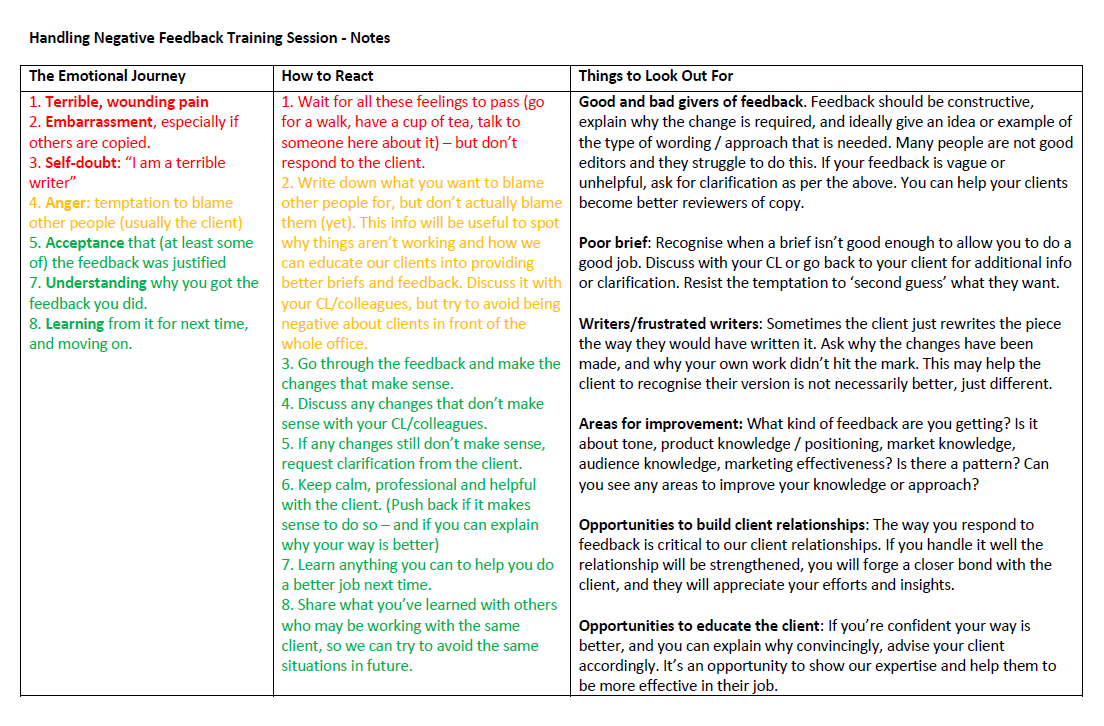
Then, David and Fiona delve into why we copywriters dread negative feedback so much, how to handle it, and why it’s so important to take it on the chin sometimes. They discuss:

  • Why you should be looking for patterns in your feedback
  • What you can do to mitigate imposter syndrome and assorted other reactions
  • How the stages of grief apply to copywriting feedback (they do, we promise)

And the training notes Fiona mentions? They’re here:

8 Stages of copywriting feedback

Finally (and most importantly), I’ve finally added my own nomination to our B2B Content Hall of Fame. Tune in to hear me wax lyrical for a few glorious minutes about Drawbotics’ wonderful 3D floorplans of TV’s most famous offices.

Thanks once again to Lorraine Williams, both for joining this episode and for being one of our favourite contributors to date.

Announcement: new podcast ahoy…

We’re piloting a new podcast series, called The B2B Content Audio Blog. It’s a short, easy listen, and we’d love to know what you think.

Want to contact the show?

Comments, questions and ideas from our esteemed audience are always welcome. You can send them our way via @radixcom on Twitter or [email protected] (you can even email us a voice memo, if that floats your boat).

How to listen…

You can download the episode here (right-click and “save-as” to download). Or stream the episode in the player at the top of the page.

(Alternatively, you can subscribe to the podcast on iTunes here. Or maybe add our RSS to your preferred podcast player.)

Credits:

Podcast editing and music by Bang and Smash

Disclaimer: since this podcast is about proofreading, there will *obviously* be errors in this blog post. This is sod’s law.

The B2B Content Audio Blog #1: B2B blog length and pricing

In recent years, changes to search algorithms have started rewarding quality. That’s just one reason why blog posts are getting longer, better researched… and more expensive.

This is the first of our new audio blog series, putting some of our most popular, interesting and useful content into an easy, listenable format.

In it, David recaps his 2017 post: Good news for clients: we’re raising our blog writing prices.

It explains why we’ve added new, longer blog options, and built in extra time to our other posts too. Now that search algorithms reward quality, we want to spend more time creating better thought-out posts.

You’ll also hear about:

  • The six kinds of blog post we write most often
  • The benefits of longer, better-researched content
  • Why the average blog just keeps getting longer

You might also like our longer, monthly discussion podcast Good Copy, Bad Copy: the B2B Copywriting Podcast.

How to listen

For now, you can use the player above, or download the episode here.

UPDATE: you can now subscribe to us on iTunes, and there’s an RSS feed here.

Get in touch

If you find the audio blog format useful (or even if you detest it), we really want to hear from you. Email [email protected], or tweet at us.

Credits

Audio editing: Bang and Smash

Title music: “Chinny Reckon” by the Nye Bevans

B2B Content Hall of Fame: Drawbotics’ hyper-detailed TV office floor plans

Everyone plays The Sims a little differently.

The Sims, if you’re not familiar, is one of the most popular video game series of all time. It’s a life simulator that lets you create your own people and live vicariously through them as they master skills, start families, become neurosurgeons in a few short minutes, flirt with the Grim Reaper (literally), and do lots of other totally normal human things.

For some people, The Sims is an opportunity to build a sprawling family tree. For others, it’s about finding creative ways to kill your digital darlings – perennial favourites include removing the swimming pool ladder or leaving ‘em in a windowless room.

For people like me, though, the real joy of The Sims is in the gently jazz-soundtracked build/buy mode, where you can pretend you’re on Grand Designs and create an obnoxiously high-spec home for your Sims.

The thing that’s always fascinated me about building in The Sims is the level of detail you can achieve. And so, by way of long, tangential introduction, we come to my nominee for the Radix B2B Content Hall of Fame: real estate marketers Drawbotics’ 2017 blog post, “Your Favorite TV Shows Brought to Life with Amazing 3D Floor Plans”.

The Drawbotics 3D floor plans bring together two of my greatest loves: procrastinating by creating opulent yet impractical buildings in The Sims, and procrastinating by ploughing through an entire season of a TV show in a weekend.

And from a marketing perspective, it does something many brands try – and fail – to do: sell you a product without you even thinking about it.

Marathon-based marketing

Drawbotics’ 3D floor plans of seven of TV’s most famous offices are what you get when you combine countless hours of marathon TV-viewing with over 200 hours of modelling work. They include advertising agency Sterling Cooper of Mad Men fame, and everyone’s favourite NYPD precinct from Brooklyn Nine-Nine.

So, what makes this great B2B content?

Firstly, this isn’t out-and-out marketing – which is refreshing – but it does function as a truly excellent showcase of one of the company’s premium services. Each floor plan is an example of the “Shoebox”: a 3D model of an office, shop or home, which companies can commission to show off their new developments before they’re committed to concrete. As you scroll through the blog, you’re learning about the product without even having to think about it.

It’s all in the detail

Let’s not forget, the good folks of Drawbotics not only dedicated over 200 hours of extracurricular 3D work to this project – they also had to sit through some telly of… shall we say… variable quality. (That first season of Parks and Rec was a little rough around the edges.)

And that commitment is entirely the point.

When I was building my houses in The Sims, the most important thing was the detail inside. The wallpaper, the soft furnishings, even the light fixtures had to be perfect. I used to have so much custom content installed that it took ten minutes for my game to boot. I even had a dedicated folder of carefully curated clutter. Clutter.

The Drawbotics floorplans aren’t just accurate and hyper-detailed; they have loads of easter eggs scattered around the offices for eagle-eyed fans to find, with a couple signposted in the description for the less observant. Notice little details such as Captain Holt’s pride flag from Brooklyn Nine-Nine, Leslie Knope’s framed photo of Hillary Clinton from Parks and Recreation, and Harvey Specter’s array of signed basketballs from Suits – and that’s just at a glance. It’s encouraging – and rewarding – engagement on a deeper level than simply scanning the blog, muttering “Huh. Neat.” and going about your day.

Plus, if they’re putting this much work into a side project, it’s probably a fair bet they’ll make the effort for their everyday work, too. And really, what’s a better advertisement for your work ethic than that?

continues below

Who should write your B2B copy? Hiring freelancers vs using an agency vs doing it yourself

At this very moment, a triple-threat brawl is breaking out in meeting rooms across the globe.

With huge campaigns looming on the horizon, the world’s marketing teams need to answer an important question: “Who on Earth is going to write this thing?”

Who indeed?

In most cases, there are three contenders:

  • Someone in your organisation
  • A freelance copywriter
  • A copywriting agency

Each option comes with a very different set of pros and cons. Stick around, and you can see how they weigh in – and which one should win for different project types.

The DIY approach

Doing it yourself (or at the very least, getting someone within your organisation to do it) is a very attractive prospect. After all, you and your people already know your business inside out, you (hopefully) know what you want to say, and not spending money is, well, ideal.

There is a huge downside here though. Controversial opinion alert: not everyone is a writer. I know, shocking.

Yes, most of us can write. But writing something that’s compelling, exciting, and readable – and will convince readers to take action – is a totally different skillset.

There’s a small chance one of your product experts is a genuine polymath, who can write marketing copy with the best of us. But that introduces another problem: good writing takes time. For every hour that technical expert spends writing a blog, ebook, or press release, it’s one less hour they have to do the parts of their job that only they can.

Simply put, the do-it-yourself approach to writing is a useful fall-back if you’ve in-house writing skills, team members with available hours, and – frankly –  no spare time or budget to hire an external writer.

DIY copywriting: pros

  • Saves time as there’s no need to brief an external writer
  • Saves budget as your people are already on the payroll

DIY copywriting: cons

  • The copy might not be especially compelling unless you have writing skills in-house
  • Takes up valuable time your people could be using elsewhere

Finding a freelancer

If your in-house teams aren’t comfortable taking on the writing, freelancers can be a very useful resource.

Offering deep expertise in specific areas, and often charging less than their agency counterparts, freelancers can offer a strong balance between quality and price.

But as the old saying goes, you can have something quick, cheap or good – pick two.

While a good freelance writer will, of course, do their best to get things done efficiently, they are only one person. Diary clashes, long wait times and delays aren’t uncommon – especially if it’s a large project. And the better a freelancer is, the busier they’ll be – making it even harder to find time with them.

And because your eggs are in one basket, you also increase your risk. If it turns out the writer isn’t a good fit for the job, or something unavoidable comes up that takes them off the project, you have to start the briefing process all over again with someone else.

If you’re taking on a job that has roomy deadlines, or if you want to bring in external skills and knowledge while still keeping costs low, freelancers can be a really good fit. But if deadlines are tight, if there’s a lot of writing to do (say, a website or ABM campaign), or if it’s a high-profile project where you can’t risk anything going wrong, you may want to go with a copywriting agency.

Freelance B2B copywriter: pros

  • May offer deep knowledge in particular areas of expertise
  • Can often be cheaper than going to an agency

Freelance B2B copywriter: cons

  • Need to book projects in early, especially for highly sought-after freelancers
  • Can have long turnaround times for larger projects, or if your freelancer has a lot of work on the go
  • Risk of having to brief someone else if something comes up and your freelancer isn’t able to complete the job

Article continues below.