B2B Content Hall of Fame: Drawbotics’ hyper-detailed TV office floor plans

Everyone plays The Sims a little differently.

The Sims, if you’re not familiar, is one of the most popular video game series of all time. It’s a life simulator that lets you create your own people and live vicariously through them as they master skills, start families, become neurosurgeons in a few short minutes, flirt with the Grim Reaper (literally), and do lots of other totally normal human things.

For some people, The Sims is an opportunity to build a sprawling family tree. For others, it’s about finding creative ways to kill your digital darlings – perennial favourites include removing the swimming pool ladder or leaving ‘em in a windowless room.

For people like me, though, the real joy of The Sims is in the gently jazz-soundtracked build/buy mode, where you can pretend you’re on Grand Designs and create an obnoxiously high-spec home for your Sims.

The thing that’s always fascinated me about building in The Sims is the level of detail you can achieve. And so, by way of long, tangential introduction, we come to my nominee for the Radix B2B Content Hall of Fame: real estate marketers Drawbotics’ 2017 blog post, “Your Favorite TV Shows Brought to Life with Amazing 3D Floor Plans”.

The Drawbotics 3D floor plans bring together two of my greatest loves: procrastinating by creating opulent yet impractical buildings in The Sims, and procrastinating by ploughing through an entire season of a TV show in a weekend.

And from a marketing perspective, it does something many brands try – and fail – to do: sell you a product without you even thinking about it.

Marathon-based marketing

Drawbotics’ 3D floor plans of seven of TV’s most famous offices are what you get when you combine countless hours of marathon TV-viewing with over 200 hours of modelling work. They include advertising agency Sterling Cooper of Mad Men fame, and everyone’s favourite NYPD precinct from Brooklyn Nine-Nine.

So, what makes this great B2B content?

Firstly, this isn’t out-and-out marketing – which is refreshing – but it does function as a truly excellent showcase of one of the company’s premium services. Each floor plan is an example of the “Shoebox”: a 3D model of an office, shop or home, which companies can commission to show off their new developments before they’re committed to concrete. As you scroll through the blog, you’re learning about the product without even having to think about it.

It’s all in the detail

Let’s not forget, the good folks of Drawbotics not only dedicated over 200 hours of extracurricular 3D work to this project – they also had to sit through some telly of… shall we say… variable quality. (That first season of Parks and Rec was a little rough around the edges.)

And that commitment is entirely the point.

When I was building my houses in The Sims, the most important thing was the detail inside. The wallpaper, the soft furnishings, even the light fixtures had to be perfect. I used to have so much custom content installed that it took ten minutes for my game to boot. I even had a dedicated folder of carefully curated clutter. Clutter.

The Drawbotics floorplans aren’t just accurate and hyper-detailed; they have loads of easter eggs scattered around the offices for eagle-eyed fans to find, with a couple signposted in the description for the less observant. Notice little details such as Captain Holt’s pride flag from Brooklyn Nine-Nine, Leslie Knope’s framed photo of Hillary Clinton from Parks and Recreation, and Harvey Specter’s array of signed basketballs from Suits – and that’s just at a glance. It’s encouraging – and rewarding – engagement on a deeper level than simply scanning the blog, muttering “Huh. Neat.” and going about your day.

Plus, if they’re putting this much work into a side project, it’s probably a fair bet they’ll make the effort for their everyday work, too. And really, what’s a better advertisement for your work ethic than that?

continues below

Who should write your B2B copy? Hiring freelancers vs using an agency vs doing it yourself

At this very moment, a triple-threat brawl is breaking out in meeting rooms across the globe.

With huge campaigns looming on the horizon, the world’s marketing teams need to answer an important question: “Who on Earth is going to write this thing?”

Who indeed?

In most cases, there are three contenders:

  • Someone in your organisation
  • A freelance copywriter
  • A copywriting agency

Each option comes with a very different set of pros and cons. Stick around, and you can see how they weigh in – and which one should win for different project types.

The DIY approach

Doing it yourself (or at the very least, getting someone within your organisation to do it) is a very attractive prospect. After all, you and your people already know your business inside out, you (hopefully) know what you want to say, and not spending money is, well, ideal.

There is a huge downside here though. Controversial opinion alert: not everyone is a writer. I know, shocking.

Yes, most of us can write. But writing something that’s compelling, exciting, and readable – and will convince readers to take action – is a totally different skillset.

There’s a small chance one of your product experts is a genuine polymath, who can write marketing copy with the best of us. But that introduces another problem: good writing takes time. For every hour that technical expert spends writing a blog, ebook, or press release, it’s one less hour they have to do the parts of their job that only they can.

Simply put, the do-it-yourself approach to writing is a useful fall-back if you’ve in-house writing skills, team members with available hours, and – frankly –  no spare time or budget to hire an external writer.

DIY copywriting: pros

  • Saves time as there’s no need to brief an external writer
  • Saves budget as your people are already on the payroll

DIY copywriting: cons

  • The copy might not be especially compelling unless you have writing skills in-house
  • Takes up valuable time your people could be using elsewhere

Finding a freelancer

If your in-house teams aren’t comfortable taking on the writing, freelancers can be a very useful resource.

Offering deep expertise in specific areas, and often charging less than their agency counterparts, freelancers can offer a strong balance between quality and price.

But as the old saying goes, you can have something quick, cheap or good – pick two.

While a good freelance writer will, of course, do their best to get things done efficiently, they are only one person. Diary clashes, long wait times and delays aren’t uncommon – especially if it’s a large project. And the better a freelancer is, the busier they’ll be – making it even harder to find time with them.

And because your eggs are in one basket, you also increase your risk. If it turns out the writer isn’t a good fit for the job, or something unavoidable comes up that takes them off the project, you have to start the briefing process all over again with someone else.

If you’re taking on a job that has roomy deadlines, or if you want to bring in external skills and knowledge while still keeping costs low, freelancers can be a really good fit. But if deadlines are tight, if there’s a lot of writing to do (say, a website or ABM campaign), or if it’s a high-profile project where you can’t risk anything going wrong, you may want to go with a copywriting agency.

Freelance B2B copywriter: pros

  • May offer deep knowledge in particular areas of expertise
  • Can often be cheaper than going to an agency

Freelance B2B copywriter: cons

  • Need to book projects in early, especially for highly sought-after freelancers
  • Can have long turnaround times for larger projects, or if your freelancer has a lot of work on the go
  • Risk of having to brief someone else if something comes up and your freelancer isn’t able to complete the job

Article continues below.

Podcast 64: data v creativity, and SEO copywriting for B2B

Technology and data are sometimes accused of killing creativity within B2B copywriting, but is it a wrongful conviction?

In the newest episode of Good Copy, Bad Copy, SEO expert Tom Telford from 3WhiteHats explains how search engine data can be a helpful content creation tool, and what copywriters can gain when they keep search engine optimisation in mind.

You’ll also hear Fiona and David talk about their experiences balancing data and creativity. Key discussion points include:

  • What is the real killer of creativity?
  • Has creativity declined since the golden age of advertising?
  • Can technology help us to be more creative?
  • What does SlideShare have in common with skateboarding?

Finally, Fiona introduces her newest addition to the B2B Content Hall of Fame. It’s Salesforce… for everything they’ve produced.

Thanks again to Tom for talking with us.

Links to stuff we talked about:

SEO things:

Data v creativity things:

Want to contact the show?

We want to hear from you. Find us on twitter at @radixcom, or email your questions, voice memos, thoughts and ideas to [email protected]

How to listen…

You can download the episode here (right-click and “save-as” to download). Or stream the episode in the player at the top of the page.

(Or you can subscribe to the podcast on iTunes here. Alternatively, add our RSS to your preferred podcast player.)

Credits:

Audio editing and music by Bang and Smash.

B2B Content Hall of Fame: Salesforce’s labours of love

My nomination for Radix’s B2B Content Hall of Fame isn’t a single content piece or campaign. It’s literally everything produced by the one global tech giant that I think gets content absolutely right.

A 20-year success story

In my two decades in B2B tech, I’ve watched Salesforce.com grow from a scrappy startup into the world’s fifth-largest software company, and the first pure-play SaaS vendor to pass the $10bn revenue mark.

In that time, it’s also expanded its software platform far beyond basic sales force automation, to encompass everything from low-code development tools to AI image recognition.

Lots of things have played a part in that success: the SaaS model, the platform approach, the quality of the software, the dynamism of the people, the company’s genuine determination to give back to society.

To that list I’d also add Salesforce’s focus on creating quietly brilliant marketing content.

(Full disclosure: The Radix team has had a tiny role in creating a minuscule proportion of that content, but that’s not what I’m here to talk about.)

Salesforce: Dreamforce

Content that avoids all the usual traps

As a giant global tech firm with a ton of local offices and many marketing teams and agencies scattered around the world, Salesforce could easily fall into any number of traps.

Big B2B tech brands are very prone to all manner of content faux pas: bland content aimed at “everyone”; cheap, jargon-laden pieces churned out for clicks; random acts of content committed by people far removed from Brand HQ; wild inconsistencies in voice and messaging; disengaged briefers and uninspired writers.

But no. Somehow, Salesforce manages to make thoughtful, targeted and consistent – but also lively, engaging and human – content, every day, on an industrial scale.

Four things that make Salesforce content great

Here are four things I think Salesforce content gets right:

1. It’s human

Salesforce content puts people first and technology second. The brand voice is warm and conversational. The brand language speaks to human feelings of aspiration and belonging: Ohana (“family”), Trailblazer, Campground, Dreamforce. Customer stories celebrate real people who are achieving great things – for their employers, for themselves, and for society.

Just look at how this customer video about KONE, the lift manufacturer, focuses not just on the people behind KONE, but also on what the company does for the people who use its products.

https://www.youtube.com/watch?v=_cxq7y6zrVU

2. It’s thoughtful

Salesforce content always feels like it’s been crafted for other people to enjoy. That might seem a weird thing to say, because what content hasn’t been created for human beings? Old-school SEO aside, we aren’t yet at the stage where bots are writing content for other bots to read.

But there’s a difference between “creating content” and “crafting content for other people to enjoy”.  Some brands – some writers – just churn stuff out, giving zero thought to the experience of the person at the other end. The result: dull, lifeless content that’s a slog to read or watch.

With Salesforce, I always get the feeling that someone has thought about their audience, and worked hard to create something that will be useful and rewarding for them. The result is content that’s always full of stories, anecdotes, quotes, examples, useful facts and supporting evidence.

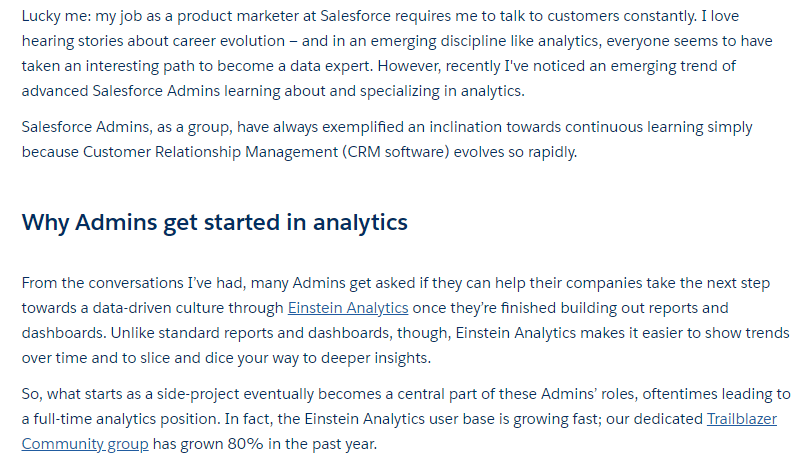
Here, for example, is a post I just opened at random off the first page of the main Salesforce blog (which manages to publish around three posts a day, incidentally):

Get the Edge: Why So Many Admins Learn Analytics

Blog excerpt from SalesforceIt’s clear who it’s for (Salesforce admins); it’s focused on people; it talks about the audience’s own professional aspirations, backed up with evidence, and it gives specific, relevant tips to help them achieve it, in a friendly, conversational voice. It’s even formatted considerately, with short paragraphs, bullets, signposting and bolding that makes it easy to read and digest.

Even though this blog is ostensibly about a product (Einstein), this is really content for people, by people, about people. B2B marketers and writers, take note.


How to get value for money from your copywriter

Let’s face it, few businesses can afford to hire a copywriter to bring every idea they have to life. But when an idea is just too damn good to let sit on the back burner, our clients seek copy that’s both of a high quality and value for money.

But unlike shopping around for say, insurance, diving into the digital murk for a great copywriter can be a long, laborious experience – and as of 2018, there is no ‘comparethecopywriter.com’.

It may be tempting to seek a writer who works fast, and while it may save you money, it’s doubtful they’ll be using that time to really understand your audience. What marketers need is great content that hits the mark every time, without having to pay over the odds to get it.

Not sure how to make that happen? Here are our top tips…

Confirm quality control

As marketers scramble to position their brand as thought leaders in their respective industries, quality content has (quite rightly) become hailed as ‘king’. For example, where blogs were once seen as a cheap and easy way to hit the front page of search, today, they’re home to some of the most engaging B2B content you can find online.

And as Fiona noted at the end of 2017, blogs are increasingly seen as high-value content that can directly engage prospects and customers, and even spark actual buying conversations. The result of that? Blogs are getting longer, more in-depth, and most importantly – better.

So, what does this mean for you? Settle on a writer that values quality control and is willing to allow for ample amends time to ensure the copy you publish is the best it can be.

A good briefing saves time (and money)

As a writer, there’s nothing better than receiving a clear, succinct brief with all the copy essentials, including:

  • Target audience
  • The background to the campaign
  • Brand tone, voice, and story
  • Content formats and structure

And if you think we’ll need it, links to supporting content to get us up to speed (and save us some time doing avoidable desk research) are always appreciated. The sooner we’re clear on what it is you want, and how you want it, the faster (and better) we can deliver it.

Onboard properly

Copywriters are a flexible bunch, and in most cases – if we can learn about it, we can write about it. But first, your writer needs to know what makes you tick: your values, tone, voice, concerns…. Who are you really?

When approaching a copywriter, spend some time getting them up to speed on your company and if possible, provide examples of your existing copy for reference. It’s a bit like method acting – the sooner they can get inside your head, the sooner they can emulate you on the page.

Listen to the copywriter and balance expectations

They say the customer is always right… There’s truth in that, but just remember: if you’re paying for a writer’s services, you should listen to their thoughts on your projects. They know about this stuff, and if they offer advice – chances are it’s good.

You might have a very clear idea of how your content should look, sound and read, but if your writer tries to nudge you in a different direction, hear them out. Their advice could offer a whole new perspective on things that takes your content to the next level.

Hear us ramble

To hear Fiona and David discuss this topic in greater detail, check out our February 2018 podcast ‘How to Get Value for Money from Your Copywriter’.

Five ways to write a convincing call to action

All marketing content has an agenda or objective. Sometimes it’s just contributing to a discussion or trying to make audiences think and feel in a certain way. But most of the time, there’s a concrete action we want our audience to take.

This call to action can often seem like an afterthought, a tiny “get the ebook” at the end of the email that doesn’t require a second glance. But these few words can have immense power, and can even mean the difference between a conversion and a missed opportunity.

Here are five frameworks you can use to create compelling calls to action with a whole range of different impacts.

1: The command

This is the most direct, and probably most common CTA you’ll find in content marketing. It keeps things simple by telling your audience exactly what they should do next: “read the ebook”, “take the survey”, “get your white paper”.

Pros: Direct, straight to the point, and easy to create

Cons: As the most common of CTAs, it doesn’t stand out

2: The question

Sometimes the indirect approach is best. Instead of telling a reader to do something, leave a lingering thought in their minds. Something that stays with them long after they’ve finished reading: “what could you achieve with [product]?” “what other challenges can we help you solve?”

Pros: Intriguing and can often stand out

Cons: Can come across as condescending or vague

3: The negative

This often crosses over with the question CTA, but with the negative CTA you focus more on what the reader will be missing out on or risking, rather than what they stand to gain: “don’t miss out”, “what’s missing from your data centre?” “does your solution stack up?”

Pros: Can be eye-catching and provocative

Cons: You risk coming across as smug

4: The benefit-led

Similar to the command CTA, this method involves recommending an action – but not one around the specific content. Instead of “download the asset”, you tell the reader to “explore your cloud potential,” “see what you could achieve with [product]”, “start your transformation”.

Pros: Flows better in-text and stands out

Cons: Can come across as vague

5: The in-text CTA

Why use a CTA button at all? Some calls to action work better when flowed directly into the text. So instead of “get in touch”, you’d tell the reader: “our cloud experts are on-hand to help you get the most out of your migration. Get in touch today to kick-start your journey to the cloud.”

Pros: Flows well and offers more detail

Cons: Less punchy than shorter CTAs

Super-charge your CTAs now

These are some of the common ways you can approach your CTAs. While I’ve tried to give the general pros and cons of each, your approach will always need to match the type of content you’re writing, your audience, and your brand’s voice.

Whether you need to be direct, inquisitive, or lead with the benefits, there’s a way to spice up your CTAs and make them work even harder.

For more copywriting tips and tricks make sure you subscribe to our delightful newsletter.

B2B Content Hall of Fame: making dry subjects engaging at Air Charter Service

Aviation. It’s not everyone’s cup of tea, but for my turn nominating a piece for the Radix B2B Content Hall of Fame I just had to focus on a 2017 blog post from Air Charter Service.

Bear with me. Because Private Jets of World Leaders perfectly encapsulates how to make a niche product accessible and less intimidating to a wider audience.

What’s more, the blog’s full of plane-pedantry. *Rubs hands*

So here’s why I think it’s a truly great piece of content, and why it works on so many levels. Buckle-up.

Leaders and dictators: they’re just so this year

Take a moment to consider the past 12 months – eventful huh? And at the centre of most stories in the news is a fearless leader, despot, or a mixture both.

Whatever your political views, they’re undeniably captivating. They’re megastars in the world’s most convincing (and terrifying) soap opera. And the way they go about their unusual, high-security lives is – for most people – fascinating.

Take Trump’s Presidential inauguration in 2017. Among the sea of general reporting, there were some interesting articles that surfaced about Air Force One (actually the call sign for the President when he’s airborne, but it generally refers to his aircraft). And even “the Football” (the briefcase containing the nuclear launch codes which never leaves the President’s side).

This is all really interesting stuff. And for me, it broke the monotony of reporting and speculation. But more importantly, people actually learn something about how their democracy works, without feeling like they’re cramming for a test.

So using world leaders as an window into aircraft chartering, is in my opinion, a stroke of genius. And a really effective way of turning a potentially dull subject into excitement, coupled with current affairs.

Missile detection systems? That’s James Bond stuff

So when the writer put Vladimir Putin, Donald Trump, and Xi Jinping at the start of the blog, this was no accident. These fun-loving chaps are regularly in the news – almost like a boy band or super-group. Except Boyzone never had weapons of mass destruction…

[Um, have you *heard* “Love Me for a Reason” lately? – Ed]

But seriously, give your tech a human or emotional side, it’s guaranteed to grab attention.

When you’re talking about a leader’s plane for instance, you’re not going to bang on about the size of Trump’s 747, because after all, it’s just a converted airliner. But what you are going to talk about are the anti-missile systems, and the fact it doubles-up as a flying White House during a crisis.

That’s where the key to truly engaging content lies. Tell people something different about a common product – and crucially – something they didn’t previously know.

Close-guarded secrets are fascinating

And it’s at that point where you really draw people in.

If you give people well-researched facts or information they didn’t previously know, or that you really had to dig deep for (like detailed insights), it’ll compel them to read to the very end.

I mean, why does Angela Merkel need a soundproofed negotiation room onboard her Airbus A340-313X VIP? We may never know. But as someone with an interest in aviation, that nugget of information compelled me to find out more, even if it was a quick scan of Wikipedia.

Some people love a chassis number

And some people don’t.

So before you start writing, you need to decide who your content is for. For example, you could write an entire blog post containing acronyms, technical language, and product numbers. But if you’re target audience aren’t engineers or developers, it’ll fail to captivate, no matter how good your writing.

Likewise, if you produce a high-level overview when your audience are product experts, engineers, or general techies, you’ll likely be telling them what they already know and will come across as patronising.

In the case of this piece, they’ve aimed it at quite a high-level audience, presumably to make it easily shareable on social media.

And guess what? That’s exactly how I found it.

Technical writing: it doesn’t need to be dry and boring

Sometimes technical writing needs to be on the less interesting side of content marketing. Indeed, it’s often one of the best ways to get across incredibly in-depth subjects in the most efficient way.

But that’s not to say some of it can’t be fun and engaging. In fact, in a world of content noise that’s notoriously difficult to break through, having a quirky twist on a serious subject may just be the thing that gets your writing noticed.

In the case of Air Charter Service, they’ve clearly realised that writing content solely about their product won’t necessarily attract the attention of their big-bucks target market.

But throw in some tongue-in-cheek current affairs? You’re onto a winner.

Can I make my tech writing fun and engaging?

Of course you can – we’re dab-hands at making tech copy stand out. If you want something special and out of the ordinary, head over to the rest of our blog for more copywriting tips.

The Radix copywriting process: how do we work with our clients?

Entrusting your marketing copywriting to an external party is a big decision – and it’s only natural to have lots of questions about how the work is going to get done, and how the relationship is going to work.

One of the most frequent questions we get asked is about our process for producing a piece of writing work from start to finish. And that’s exactly what I’m going to outline in this blog…

Getting a quote

Before you work with us, you’ll usually want to know how much the work is going to cost. To make that part easy for our clients, we have fixed price lists for frequently-requested content formats like blogs, ebooks, and video scripts. We have one price list for clients that come to us direct, and another for agencies that are looking to get us on board as part of their client work.

As senior account manager Chloe Tidy explains:

“While our price lists don’t offer an exhaustive list of everything we do, they do offer an accurate idea of the content we can produce. If there is something that a client would like us to produce that isn’t on our price lists, we can always create a bespoke quote.”

All of our quotes reflect the time we expect to spend on a project. As standard, this’ll include time for:

  • A briefing call (where required)
  • Any additional desk research to inform the piece
  • A first draft (and, for longer-form pieces, an outline)
  • Review and proofing
  • Two rounds of reasonable amends

The briefing process

How do we get the information for the work we’re going to do? For the sake of narrative convenience, jump into the shoes of one of our regular clients. You’ve worked with us before – on a range of projects from ABM campaigns to web copy – and today, you need a blog for your website.

The blog, which has a working title of ‘The State of Cloud-Native Adoption in Fishmongery’, needs to be written – but to ensure we get it right, you’re going to need to brief us.

In classic ‘choose your own adventure’ style, you have two paths by which you can proceed:

  1. Provide a working title and a description of the desired outcome by email and/or a phone call, asking your dedicated account manager if they have the time to fit the piece into an appropriate writer’s diary. A briefing call will be arranged if there is not sufficient information provided, or the brief is particularly dense.
  2. Use the Radix briefing template to provide a full, written brief for a writer. When you are happy with it, you can send this to your dedicated account manager, who will assign it to the best writer for the job. A briefing call will be arranged if the writer has any questions about the project, preferably with a project lead at your end.

In cases where we are engaging with a new client, or it’s simply our first time tackling a project type, the process is a little more complex.

Senior Account Manager Sarah Gray explains:

“If it’s a complicated topic, or a new client, we’ll run the project by a senior writer to evaluate. If needed, we may also arrange a briefing call with the client before booking in time with the writer. Then, all that’s left before jumping into an outline or a first draft is to send the client a quote and confirm the timeframe for delivery.”

The first draft

So, where are we at? Let’s recap. So far, we’ve:

  • Received word of your new brief
  • Nailed down (figuratively) a writer for the job
  • (Maybe) had a wee briefing call to make sure we have the right info
  • Agreed on a quote and timeframe for delivery

Nice. Everything’s looking good. Now it’s time for our writer, depending on the outcome of the briefing, to either whip up an outline or jump right into the first draft.

With blogs, it’s likely our writer will have everything they need from the briefing (and maybe a little desk research) to begin the first draft. But with other projects – such as case studies or whitepapers – we often write an outline first.

…*Intermission*…

Shiba Inu Dog GIF

Internal quality control

On completion of the first draft, the writer will pass their copy to a content lead or another expert peer to review. This is where the amends process begins (and, in the best-case scenario, ends).

The content lead is one of the most important roles in our entire process. Think of them as your brand guardian, the final hurdle which our writers must leap before the copy lands in your inbox. Internally, we always allocate a content lead for each client. This way, they can build up a wealth of knowledge about you and apply it to the reviewing process, ensuring everything hits the mark.

In our role-play scenario, let’s say the reviewer spotted a non sequitur in the blog’s third and final act. Nothing critical, but enough of a reason to send it back to the writer with comments on how to amend the issue. With the amends made and the reviewer happy, the account manager will send the copy off for you to review.

Reviews and approvals

If the copy hits the spot, what happens next is up to you. If you think it needs some further work, or if the scope of the project has changed, you can let us know and our account manager will arrange for the writer to return to the piece. We can also set up a call with you to clarify the changes required.

As standard, we always include up to two rounds of copy amends in the quote – this way, writer and client alike are guaranteed leeway to tweak the first draft. When it comes to the amends process, we recognise that we’re delivering a product, and as they say in retail: ‘the customer is always right’. While that’s true *most of the time*, we prefer to see our work as a collaboration in which both parties learn from each other (and in turn, get the best outcome possible: damn good copy).

Once the copy is finished and approved, our account managers will send you the finished piece. And from there, hopefully the copy can do its thing!

Working with Radix

I hope this blog has answered any questions you may have had about the way we work with our clients, but if there’s anything you’re unsure about (or you have any other questions), please do get in touch on 01326 373592.


B2B Content Hall of Fame: the humour and humility of IBM’s Watson

AI has an image problem. Between the evil robots that permeate pop culture (thanks, Terminator and 2001: A Space Odyssey) and the likes of Elon Musk regularly reminding us of the dangers of AI, many see artificial intelligence as a source of fear rather than a useful tool.

This is just my (un)professional opinion, but this AI fear-mongering is far too often based on the fiction of AI rather than the fact. Ask anyone who’s spent some time with today’s AI and voice assistant tools, and they’ll quickly remind you that these things aren’t exactly equipped to enslave humanity.

While these technologies can (and certainly will be) very useful, they can also be downright comical. Whether it’s a lack of common sense, or their no-nonsense monotone, AI has a funny side that businesses shouldn’t be afraid to embrace.

That’s exactly what IBM has done with some of its Watson content, and its humorous, humble approach to marketing Watson makes it deserving of a place in the Radix B2B Content Hall of Fame.

From Jeopardy to comedy

Watson made a big debut in 2011, storming through a round of Jeopardy and dismantling its human competitors. So far, so scary AI. Though even in this early marketing stunt, we see a humorous – even human – side to Watson. Who doesn’t get a chuckle out of Watson’s monotone voice asking for a question from the “chicks dig me” category?

This humorous streak continues in a series of videos where Watson interviews a range of celebrities. Each one takes a different slant, both highlighting Watson’s unique capabilities, but also poking fun at the cognitive bot in a box.

“Today on the Watson show”

During an interview with Bob Dylan, the tables are turned on Watson’s usually monotone demeanour, with Dylan’s canned and repeated responses sounding more robotic than Watson’s line of questioning. There are also the less-subtle jabs at Watson’s singing voice; don’t worry vocalists, AI isn’t coming for your jobs just yet.

When interviewing Serena Williams, Watson is quick to point out its ability to rapidly analyse William’s match performance. When it gets a bit too big for its boots though (Watson is the “Serena Williams of cognitive computing”, apparently) the tennis superstar is quick to put Watson in its place. There’s a humility here you seldom see in traditional technology marketing.

When discussing empathy, love and storytelling with Steven King, the horror author extraordinaire urges Watson to “try writing a book. Find a remote hotel… bring the family.” And in a non-celebrity interview that explores its nicer streak, Watson assures young Annabelle that she is in good health based on her records – despite her being too sick to have cake at her birthday last year.

Out of the boardroom, into the zeitgeist

I’ll admit that the series does lean a bit too hard on showing what Watson can do, with jarring interludes from Watson that read more like a dry product brochure than an engaging repartee between interviewer and interviewee. This rubs against the grain of the otherwise light and enjoyable humour in the videos.

But despite some flaws, the Watson conversations do two very important things:

  1. They disarm Watson. Whether through humour or humility, Watson is clearly not an evil AI overlord. It works with people, discussing their problems and proposing solutions.
  2. They move out of the realm of marketing material and into general culture. By bringing in recognisable cultural touchstones like King and Dylan, the series pushes beyond the walled garden of B2B marketing content and into the mainstream.

Both of these are done with the concept alone. But the execution brings the wry humour that wraps it all together as a genuinely engaging, enjoyable piece of content.

IBM’s general approach to Watson marketing has provoked the ire of some critics, with commentators noting that – whether due to overexcited journalists, or IBM itself – much of the discussion around Watson is unrealistic and focusses on capabilities that are very much the future of Watson rather than the present.

This all comes back to the problems AI solutions must overcome as they shift from a cultural mainstay into an actual tangible product or service. AI must prove it can really do the things it says it can do, and that it will do them in a way that works with humanity rather than against it.

But if IBM keeps marketing Watson in this way – through videos that demonstrate humility, humour, and empathy – I think Watson might have a fighting chance of entering the public consciousness as a force for good rather than SkyNet coming to life.

Want to write great landing pages? Follow these three simple rules…

Here at Radix, we write a lot of landing pages for clients. And yet, after five minutes of Googling “landing pages”, I noticed that every link had something in common: they all focused on design – and not the copy.

To me, this is alarming because it means there are countless people creating landing pages based solely on design, and not giving a fig about the content that’ll actually drive people to take action. You know, the stuff that people actually read once they land on your page.

I’m not saying design isn’t important, but with a landing page, you have 200-300 words (and very little retail space) to get your message across well enough that someone will click on your call to action.

Design alone won’t create conversions, no matter how great it might be.

What can create conversions is asking these three essential questions before writing (or briefing a writer on) your landing page.

1 – What’s the purpose of your page?

The sole purpose of a landing page (in B2B marketing at least) is to act as a portal for what you actually want a user to do.

This could be a simple call to action for a bigger piece of content or a gated contact form that’s the barrier between customers and assets.

All too often though, brands send people from an email or advert to their homepage, or worse, a page that has nothing to do with what they clicked on. And the result? Users will simply drop off your site without a second thought.

The reason? You didn’t deliver what you promised.

Getting a user to click through to your site is difficult – I mean really difficult. So if they’ve given you the time of day to hear what you have to say, you need to make sure it matches up with what you do next. You need to actually send them to the content you promised, preferably hosted on a clear, concise landing page.

Do this, and you’re more likely to keep your audience on your website, and capture their contact details.

2 – Where does your traffic come from?

You now need to consider how people will land on your page. There’s two reasons for this: the content needs to reflect where they’ve just come from, and it also tells you how committed and well-informed your reader is when they arrive.

The two main types of page we tend to write are for email campaigns and advertising/pay-per-click campaigns.

Email landing pages

Generally speaking, an email campaign will consist of many different levels, depending on where the buyer is in the funnel.

More and more emails are using call to actions as a way of driving people to a specific landing page. But this click is like gold-dust. So once you’ve captured people, you need to do your very best to prevent them dropping off your website.

Adverts/PPC

This is where many brands fall foul. If you’re not pointing your adverts towards relevant landing pages, you’re not just going to get high drop off, but you’ll also likely annoy a lot of people.

And they might need more information and persuasion than an email landing page, because ad copy is generally a lot shorter. As a rule of thumb, an ad landing page does the heavy lifting… an email landing page mostly needs to avoid getting in the way.

Remember: if someone’s keen enough to click on your advert, the least you can do is tailor your landing page.

3 – What do you actually want to say?

This is the bit where you keep your copy brief. Usually, the bulk of what you want to say is contained in the asset you’re promoting, so you simply need to give teasers here and point people towards it.

Here, a snappy title that lures the reader in is key. It doesn’t need to be clever or a play on words – in fact, the quicker it gets to the point, the better. Your messaging needs to be engaging enough to pull the reader towards your call to action, but brief enough to keep their interest.

Help your customers land feet first – every time

Ask yourself these simple questions, and you can save yourself a lot of stress with your landing pages.

As long as you nail your title, keep it brief, and treat every click with respect, you’ll be driving shed loads more traffic deeper into your website in no time.

As it happens, we do this content wtiting every day, and we’re pretty good at it. So, if you’d really like to take the stress out of your landing pages, feel free to get in touch. We’ll happily chat through your options.