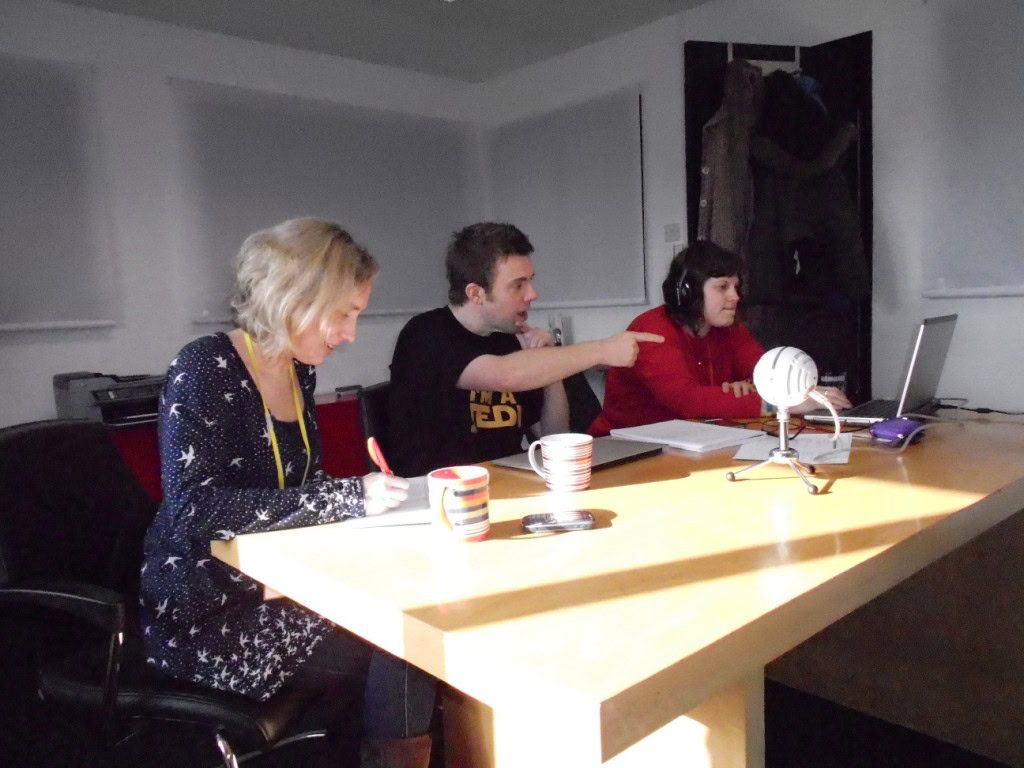
Three people your B2B copywriter definitely needs to meet

This is a plea.

It’s on behalf of B2B copywriters everywhere, to you, as a marketer. And quite simply, it’s this:

Let us talk to your people.

Don’t get me wrong; we love it when you’re organised, help us with our research and provide a clear brief for the work you want. But give us direct access to a few people from around your organisation too, and you’ll be rewarded with stronger, more compelling copy.

And let’s be frank: you need better copy. Look at almost any survey of B2B marketers’ top challenges, and you’ll find creative engaging content is there or thereabouts. If you want engagement, this is how you get it.

(By the way, if you’re an agency marketer, the same thing goes for letting your copywriter talk directly to the client.)

Why? because a direct conversation will give us three essential ingredients your briefing document (helpful though it is) usually can’t:

  • It lets us hear how people really talk, and use your sector’s terminology, in the real world – which helps your copy to sound authentic.
  • It gives us an insight into attitudes, and how people think about concepts (the bad as well as the good) – which enables your copy to be honest, and deal with people’s real issues.
  • It presents an opportunity to ask questions, and listen out for angles, ideas and hooks you might have missed – which means your copy might surprise you.

That makes for copy that’s informed, engaging and resonant.

Horrifying thought, isn’t it? Putting an external writer in direct contact with the assortment of oddballs, nerds and outspoken critics who reside in the dark recesses of almost every B2B-focused company. Who knows what impression we might get of them (or they might get of us)?

But relax; we’re B2B copywriters. Talking to geeks, digging into technical subjects, and finding the story in something dusty and dull is simply what we do every day. But more than that, we chose this line of work. We enjoy it, we’re good at it, and crucially we’re on your side.

So your office characters don’t need to be polished before they talk to us; polishing is our job.

And if you want your copy to really speak to your customers in a language they’ll recognise, there are three people above all others you should introduce us to…

1. That “challenging” salesperson

You know the one. They get great results, but they’re impossible to satisfy – always negative about your latest marketing work, dismissive of new product releases and outraged at production lead times. If you squirm inside at the thought of what they might say, they’re the one we need to talk to.

Why we want to talk to them: they’re our quickest way to find out why grass roots customers really buy from you. They’ll also probably be completely blunt about what’s bad about your product or service, where your competitors have an edge, and where they’ve seen marketing materials miss their target audience.

2. Your biggest product geek

Oh yes, the enthusiast. The one who – irrespective of your market research – thinks the new triple widget flangelator is really what you should be promoting, because it could revolutionise the whole flugelbinding process. If they read product catalogues and instruction manuals for fun, they’re perfect.

Why we want to talk to them: this is where your deep content comes from. The actual insights that customers can really use are currently lurking between your expert’s ears, and we’re experienced at mining them out. Also, it helps us to know not just that it’s faster, but *why* it’s made that way.

3. (Deep breath…) your customer

Yes, it’s a bit scary. But as writers we’re acutely aware that when we talk to your customer, we’re holding your baby – so we’re always on our best behaviour. Case studies are a great way to make this happen (while making the customer look clever and feel important to boot), but even helping you on a trade show exhibition stand can do the trick.

Why we want to talk to them: to find out exactly what’s important to people in your sector and – crucially – how they speak in the real world. One we’ve met a typical customer, it’s easier for us to picture them, and write compellingly to that kind of person. (They might also say things to a third party they wouldn’t tell you – giving you extra insights when we report back.)

You need engagement, we need access

For years, B2B marketers’ biggest problem has consistently been producing content that really engages. As external copywriters, the more we can immerse ourselves in your world, the better our chances of picking up on real, current concerns, unearthing fresh insights, and finding the right language to cut through the noise.

Please do continue to give your copywriter a full, detailed brief – but please, trust us talk to your characters too. Often, that’s where the gold is.

Fancy reading B2B copywriting tips and ideas on a regular basis? Our email newsletter is perfect. Try it for yourself…

The Periodic Table of B2B Marketing Clichés

The-periodic-table-of-B2B-marketing-cliches-small-sized-1-1.png

Oh no, I hear you groan.

Not *another* tired list of “business buzzwords that should be BANNED”. Can’t you think of anything more original than that?

But wait, people!

I know that, at first glance, this looks like one of those “bullshit bingo” cards transposed on to the Periodic Table of the Elements.

And if you look more closely, especially towards the right-hand side, you can probably spot a number of the usual suspects, like “blue-sky thinking”, “end-to-end”, and everyone’s perennial favourite, “solutions”.

But look again, and you’ll see that some of your other love-to-hate buzzwords are absent. There’s no “leverage”, no “synergy”, no “reach out”, and no “bandwidth”.

That’s because this isn’t yet another list of annoying corporate buzzwords. This is VERY different.

Well, OK, a *bit* different.

This is a Periodic Table of B2B Marketing Clichés.

It’s a premium collection of all those over-used words and phrases that B2B marketers use when they write stuff about their business, their products and their people.

And it’s not just the old-school clichés, like “end-to-end”, “leading provider”, “passionate” and “world-class”. Oh no. B2B marketers have a whole new set of clichés to play with now.

Everything is awesome

Anyone who’s worked in the B2B tech sector for a while will know that the vocab we use in marketing copy has undergone a huge shift in the past few years.

Almost to a man (not to mention a woman), we’ve ditched dry, polysyllabic, Latin words for perky, Valleyspeak-style language.

If I were being (slightly) academic about it, I could trace this to three things:

1) As buyers now spend 67% of the buying process looking at digital content, that content now has to do the work of a salesperson, which means it has to talk like a human being.

2) A huge proportion  of business software still hails from America, where “talking like a human being” is perhaps more likely to involve terms like “awesome”, “super-fun” and “uber-amazing”.

3) A growing proportion of B2B tech buyers are not IT people, but business people. And it’s well known that all business people spend all of their time getting uber-excited about awesome productivity hacks, but have zero tolerance for tedious chat about open APIs, back-office integration and tiered storage.

The upshot of all this is that where once we wrote about “delivering enterprise-grade end-to-end solutions”, now we write about “making kickass apps that just work”.

Which, for a goodly while, was super-fun. Instead of writing like corporate copy-bots, we got to write like Cher from Clueless. It was totes amaze, B2B was sexy for the first time in, like, ever, and we all got to go to Cannes and hang out with Idris Elba, like, all the time.

But then, inevitably, everyone started writing like Cher from Clueless, and now every B2B blog post, ebook and promo email is all like “check out this super-amazing ROI calculator” or “Fifty epic ways to make over your data centre – before lunch!”

So now the new stuff is pretty clichéd too.

As, to be honest, is this whole Periodic Table of the Elements trope.

We’ve had the Periodic Table of Storytelling (actually v. good, it has “story molecules” and everything), the Periodic Table of Swearing (not for the faint-hearted), and even the Periodic Table of DevOps Tools (for hardcore periodic table fans who also love a nice bit of continuous integration).

So where better to house a collection of new-school (and old-school) B2B marketing clichés than inside a clichéd new-school content container?

(Yes, that’s a container that contains content, what of it?)

Feast your eyes on it, and while you’re doing so, revel in its time-saving possibilities.

Why waste time thinking up perky B2B blog post titles, when the Periodic Table of B2B Marketing Clichés practically writes them for you?

Fifteen Epic Near-Real-Time Insights to Transform Your Productivity, for example.

Why spend hours thinking up a strapline for your timesheet-app startup, when you can just pick off a few choice words and phrases from the “explosive” side of the table?

For example, Kieran and I spent literally seconds developing this zingy new strapline for Radix:

Radix: Story at the Speed of Fucking Powerful

Like it.

But if old ways of writing and new ways of writing are now equally clichéd, how can anyone hope to “stand out” and “cut through the noise”, I hear you ask.

Good question.

When compiling the table we did manage to identify a few words that we don’t think have yet – yet! – become clichés.

We’ve helpfully arranged these not-yet-clichés along the bottom row, from where you may pluck them for use in your next blog or email.

If we open our inboxes tomorrow to find a hundred promo emails inviting us to check out your fierce dramaturgy or become a bare-knuckle productivity seraph, we’ll know the game’s up.

Have we missed your favourite cliché? Let us know in the comments.

UPDATE: For more cliché joy, I recommend the following:

Pro Copywriters Network: The Copywriting Hype Cycle – Lungfish’s David McGuire on how a perfectly good word becomes a B2B cliché.

Stein IAS: 101 Clichés – Images can be just as clichéd as words, and Stein IAS feels so strongly about it, they’ve created an entire site dedicated to stamping out lazy B2B artwork. Raw props to you, Stein IAS.

Thanks to everyone who contributed to the table, including Matt, Kieran, Steve, John, George, Emily, and our badass copywriter bros Rod Hirsch and David McGuire. And extra kudos to our fierce Illustrator sensei Emily for conceptualising the table and making it an actual real thing.

Creative Commons License
The Periodic Table of B2B marketng clichés by Radix Communications Ltd is licensed under a Creative Commons Attribution-NoDerivatives 4.0 International License.

How to brief a B2B copywriter

Brief even the world’s greatest copywriter badly, and they won’t deliver what you need.

The words they tap out won’t appeal to the right people. Or talk about the right thing. Or fit where you want to put them.

You might as well scrape them off your homepage and replace them with some significant-looking geometric shapes, or vaguely aspirational go-faster stripes. If they’re for a standalone content piece – like an eBook, or a SlideShare – there’s every chance it’ll end up languishing among the estimated 60+ percent of B2B content that gets created, but never actually used.

And yet… a lot of the briefs a B2B copywriter receives are woefully inadequate.

At a recent Twitter chat, we asked the assembled copywriters (TM pending) to share the biggest issues they have with the briefs they receive. Here are two representative responses:

And these are not lone voices in the wilderness. These are the cries of an army of professionals, desperately wanting to do a good job – so they can earn your repeat business, sure, but also so they can take some genuine pride in their work.

So, how do you brief well, and give a huge boost to both your marketing efforts and your copywriter’s self-esteem?

Here’s my take on the absolute fundamentals.

1. Help us understand who we’re writing for. (The audience.)

You know the kind of person you want to reach:

  • Where they work
  • What they do
  • What keeps them lying awake at night
  • What makes them gaze droolingly into the middle distance
  • What job title they’d ultimately like to call their own
  • What they already know (and don’t know) about your product or service

So, tell your copywriter. It’s a lot easier to be persuasive when you know who you’re talking to.

If you don’t know who your audience is, or you genuinely think your audience is ‘everyone’, you’re talking to a copywriter too early. Instead of rushing to produce content, you should be working to refine your marketing strategy.

In our Twitter chat, Dave Harland ‏@wordmancopy succinctly summarised the kind of brief that’s guaranteed to make a copywriter’s heart sink:

(Even better than telling us about your customers, you could introduce us to them.)

2. Tell us where the audience will read our copy.

That ‘where’ is both physical – on this blog, in an email that follows this template – and metaphorical. If you’re mapping your content to the good old sales and marketing funnel model, or it’s part of a larger campaign, let us know where it’s going to sit.

That way, we can make sure our copy forms a neat, logical journey, and even helps you effectively qualify leads along the way.

3. Explain how you speak, what you want to say, and why your audience should care.

Whether you’re producing a series of thought-leadershippy blog posts, or a thoroughgoing product guide, you’re producing it to engage your audience, and tell them something.

All you need to tell your copywriter is:

  • How you speak – if your company has a tone of voice guide, share it with us now
  • What you want to say – whether it’s ‘Hey, have you thought about how you’ll handle all the data from the Internet of Things?’ or ‘This is how our software helps businesses hire faster’
  • Why our audience should care – which of their challenges, worries and dreams does your message speak to?

4. Tell us what you want the audience to do next.

Thanks to the multiple teams, stakeholders and pressures involved in the creation of most marketing content and campaigns, it’s all too easy for the ‘call to action’ – what you actually what your audience to do after reading the copy – to be finalised very late in the day.

Ideally, however, it’s there from the start, front-and-centre in the brief. That way, your writer can create copy that carefully builds towards it – until taking that next step seems like the only natural thing to do.

5. Lay down the briefing law.

As our Twitter chat revealed, different writers like to be briefed in different ways. You could ask them for their preference. But you’re probably better off covering all bases:

  • Put together a written brief. This needn’t take long. The stuff you’ll want to include – from who the audience is, to how the copy is going to be used – is all stuff you should know already. Putting it in a Word doc will help you nail it down, and highlight any gaps or issues. (And once you’ve written your first brief, you’ve got a template you can use again and again.)
  • Arrange a briefing call. It doesn’t matter how comprehensive your written brief is, a good writer will relish the chance to hear you explain the project—and to ask questions.
  • Arrange further calls, if necessary. Some projects will require your writer to understand and convey complex ideas, others to present genuinely expert advice. If that’s the case, give us a chance to quiz the people with the ideas and/or knowledge. (Often, this means product experts.)

6. Give feedback.

If you’re working with a writer on a series of projects, the feedback you offer becomes a crucial part of the briefing process. Tell us if we met the brief. Tell us if you felt you had to tweak the tone of voice, or cut our hilarious play on words. Tell us if a project has met its targets, and if not, where it’s failed.

This is the kind of information copywriters thrive on. It helps us correct, perfect, and ultimately do an even better job next time.

Here’s the simple truth, and one that few will be honest enough to tell you.

Great copywriters can use their skills in two ways.

If you brief us badly – something the best of us will fight tooth and claw to stop from happening – we’ll reluctantly use our writing prowess to paper over the cracks in our understanding. We’ll produce words that read just fine, whoever’s reading them, and neatly fill some space. But that’s all they’ll do. They won’t hit home with your audience. They won’t make them sit up and take notice – and action.

And we’ll feel bad about it, even though we’ve done a bloody miraculous job under the circumstances.

But if you brief us well, it’s quite literally a different story.

We’ll use our skills to engage the people you’ve told us you want to engage. We’ll have the grounding and the confidence to write with genuine authority, find resonant narratives, and bring the full force of your expertise and our creativity to bear.

We’ll make any organisation look as clever as it is – if not more so – and its products or services look as invaluable as they are. Which is, after all, why you went looking for a great B2B copywriter in the first place.

All I’m saying is this. Let us show you what we can do.

For more B2B content tips…

Subscribe and listen to the Good Copy, Bad Copy podcast.

RIP: the B2B infographic (2012-2016)

When was the last time you saw a B2B infographic?

We haven’t seen one for a while. In fact, we’ve seen so few in the last 12 months, we’re ready to call the format’s time of death – placing it among the biggest content casualties of 2016.

The unexpected demise of the infographic is just one of six major B2B marketing trends we’ve spotted over the last year.

Trends you’ve spotted?

Yes indeed. As copywriters to over 60 of the world’s leading B2B tech brands, we work on hundreds and hundreds of marketing projects annually, across tens of industries.

And as good business people, we track those projects to within an inch of their boxy little lives. The result is stacks of seriously interesting data.

Each January, we see what this data (and the latest research from analytical pros like CMI and MarketingProfs) can tell us about the current state of B2B content marketing. The results are never less than fascinating.

Like our discovery that B2B case studies – no longer counted as content by the CMI, and as a result, effectively invisible to causal trend-watchers – experienced a huge leap in popularity in 2016. Or the revelation that social media content took a staggering nosedive.

As is rapidly becoming traditional, David and Emily have pulled together the biggest talking points, adding their expert analysis along the way. And this time, our new writer Katy has designed* the hell out of them, creating the handsome SlideShare you’ll find below.

Click away – and see whether our findings echo your own adventures in the world of B2B content creation. (When you’re done, be sure to share your thoughts. We love discussing this stuff, and readily respond to comments, tweets, and invitations to the pub.)

*Yes, designed. Many of our writers have hidden talents. You should see Steve in a rap battle.

Everything you need to know about writing a B2B case study

The written case study is the WD-40 of B2B marketing tools.

It’s been around forever, it’s not exactly glamorous, and it’s popular for one simple reason. It works. (Regularly lubricating those narrow few inches at the base of the sales and marketing funnel.)

The power of the case study is easy to understand. What’s more persuasive than learning how a company has helped someone just like you? And helped them so much, they’ll sign up to tell the world about it?

But some case studies are way more powerful than others. Because – let’s be clear about this – writing a genuinely brilliant case study is tough.

You need 100% commitment from your company and the customer. You need above average interviewing and writing skills.

And, of course, you need the magic formula…

Prologue: the case study formula

Unlike a can of WD-40, what goes into a case study is far from a trade secret. As Radix’s glorious leader explained in a recent B2B Copy Chat, the basic formula is simple:

You can mess with the order of these elements, but unless you’re writing for a particularly iconoclastic brand, you’ll save yourself both time and trauma by leaving well alone.

This flow is natural and chronological, and provides a solid structure for everything from your interview questions to your first draft.

Chapter one: getting the background

Track down the best person talk to about the case study. This will usually be the customer’s main point of contact with your company.

Arrange a quick call with them to discuss:

  • What the customer does
  • What the customer bought
  • What they think the case study should focus on
  • Who you should talk to at the customer company, and what their job entails
  • Where the case study will be published
  • If there’s an existing template you need to work to

You’ll also want to establish who’ll attend the call with the customer, and who will lead.

Your ideal scenario is as follows:

  • You will lead the call. You’ve a short time to get all the information you need to write this thing. Plus, it’s important to have the freedom to go off-script if you suddenly spot a great new angle on the story.
  • Only the customer (and you) will attend. In our heart of hearts, we all know the quality of a telephone call is inversely proportional to the number of people on the line.

By the time you’re done, you should have a basic understanding of the ‘solution’ part of your case study – i.e. what was sold, when, and how, be it a product, service, or combination of both.

This won’t just help you prepare for the customer call, it’ll let you focus on the stuff that only they can tell you.

Chapter two: writing your questions

Remember the other three bits of the formula? The challenge the customer was facing, the benefits (how the solution solved those challenges – and then some!) and the customer’s overwhelmingly positive feelings about the whole experience?

Put together a list of open questions, designed to give the customer ample chance to talk to each of these subjects.

Always prepare more questions that you think you’ll have time for, and always prioritise, aiming to cover the most essential points early on. (If you need extra inspiration, my colleague George has some excellent advice on weird-but-powerful questions, many of which can be used to great effect in a case study interview.)

Chapter three: talking to the customer

Yes, Jason. A thousand times, yes. In these thirty or so minutes, the case study’s potential for greatness will be decided.

The material you gather from the customer will dictate how much – or little – you can achieve at your keyboard later on.

Here’s how to run the call.

  1. Arrive first – you’re representing yourself and the brand, if you work for an agency, and leaving a customer hanging is always less than professional
  2. Greet the customer warmly when they join, and introduce yourself
  3. Recap the purpose of the call
  4. Check how long the customer has (and reprioritise your questions accordingly)
  5. Ask if you can record the call, and assuming they agree, set your recorder rolling
  6. Work through your questions – keeping an ear open for answers that suggest further questions, and an eye on the clock
  7. Mentally – or literally – tick off the formula elements as you cover them
  8. Press for concrete results (e.g. how much money has the solution already saved the customer? How much faster, in hours, days or weeks, can they now do the thing they do? How many extra people would they need to do this stuff manually? Etc.)
  9. Ask any bonus questions that have occurred to you during your conversation
  10. Wrap things up by thanking the customer for their time, and assuring them they’ll get to review a draft of the story before it’s published

(If you want more interviewing tips, you’ll find plenty here.)

Chapter four: writing the damn thing

You know how you work best. I always create an outline of the case study first – with sections based on the magic formula – and listen back to my recording of the call, filling in the gaps as I go.

Here are some classic best practices to guide you as you type…

Lead with your biggest result

Your headline has to capture attention, and sell the rest of the piece. Unless it really doesn’t fit with the story you’re trying to tell, be sure to put your most concrete, most impressive result front and centre. (e.g. ‘How Radix learned to write blinding B2B copy 160x faster.’)

Make the customer the hero, but keep the business case clear

A great case study pulls of the deftest of balancing acts.

It tells a hugely relatable story about human beings, but it also keep the one thing the reader really needs to know – the incredible business results – front and centre.

Write from the heart, but use subheads, box-outs, pull quotes – essentially, every trick in your pencil case – to make the those cold hard benefits leap out to someone scanning the page.

Make everyone look good

Your interviewees will often trust you with information that could be used to show their business in a bad light. When this happens, tread extra carefully.

Your job, more than anything else, is to make everyone look good. If you don’t, you risk damaging the customer’s trust in the vendor – and landing yourself with hours of major amends.

Don’t be scared to edit the customer’s ramblings

Few people train to be copywriters. If they did, there would be the same beautiful moment on every course, a couple of weeks into the first term.

The lecturer would leave the whiteboard and its arcane hieroglyphs – MOFU, CMO, ROI – turning slowly to face the hall. They’d pause just long enough to win the attention of its fifty, wide-eyed undergrads, and in a slow, patient voice, gentle as a hand placed on a shoulder, they’d say:

‘It’s OK. You can rewrite what your customer said to make it read well. They won’t sue you. If anything, they’ll be pleased.’

Do strive to keep the customer’s voice

The fact you’ve actually spoken to the customer automatically elevates your case study above a lot of the case studies already sent out into the world.

So when you add their glowing testimonial, be sure to preserve their more interesting turns of phrase and speech patterns. It’ll add life and authenticity to the finished piece.

(Frankly, I always aim to keep as much of the customer’s voice in there as humanly possible. If you can tell their story almost entirely in their own, neatly quoted words, so much the better.)

Remember the call to action

What should the reader do when they’ve finished reading? Since most case studies are designed to sit at the bottom of the funnel, the call to action will often be to get in touch with your company.

Make your call flow neatly out the story – e.g. ‘See how much faster you could write blog posts…’ – and add a placeholder until you’ve identified the best link, phone number, or email address.

Chapter five: acing the amends

Sharing the first draft of a B2B case study is a good feeling. But it’s rarely the end of the story.

Be ready to tackle amends from stakeholders at your company, then amends from the customer, then extra amends from either. Or both.

This (probably) isn’t your fault. It’s just what happens when you’re trying to please different parties, with different agendas. But if you’re charging for the work – say you work for a marketing agency, rather than the vendor itself – be sure to factor this time in when giving your quote.

Epilogue: I could drink a case of case studies

When everyone involved is fully engaged, the case study is easily one of the most rewarding content pieces to write.

You get to talk to a real human being, who daily uses the thing you’re trying to sell – giving you invaluable insight for future projects.

And you get to make a lot of people feel good about what they do.

Which, you know, is nice.

Use your new power wisely. And have fun along the way.

Three ways AI is helping improve animal welfare

As a longtime fan of dystopian science fiction like The Matrix and Metal Gear Solid, I’ve always found AI to be a compelling, if somewhat unsettling, concept. That’s why, despite those cautionary tales, AI is consistently surprising me as a force for good.

Whether it’s generative AI being used to enhance medical research or computer vision helping athletes track and analyse their performance, I currently spend a lot of time writing about how AI can help people work smarter, and more safely and efficiently.

While it’s all fascinating to learn about, for me, here’s one application that resonates much more than the others. It may not seem like the most obvious use case, but AI is already playing a key role in humanity’s efforts to improve animal welfare – and the more I learn, the more it makes sense.

In this blog, I’ll look at three ways AI is helping make life a little better, if not more dignified, for wildlife and livestock. But before we dive in…

A quick guide to the tech

Were you confidently nodding along when I mentioned generative AI and computer vision? If those terms make sense to you, feel free skip to this section. If not, then read on.

Generative AI refers to models that can learn from existing content – like the collected works of William Gibson, or the films of Ridley Scott – to create new text, images, video, and synthetic data.

Computer vision (CV) is a field of AI in which algorithms are continuously trained using visual data to recognise objects and people. This helps it spot and respond to pre-defined patterns and behaviours.

Eager to learn more about AI? Be sure to read my colleague George’s blog about synthetic data, and Katy’s deep dive into AI’s applications in healthcare.

Use case #1: Protecting British wildlife on Network Rail

Network Rail (NR) and the Zoological Society of London (ZSL) – a science-driven conservation charity – are working with Google Cloud to identify, monitor, and learn more about wildlife living in and around the 52,000 hectares of land owned by NR.

Together, ZSL’s Machine Learning (ML) image processing systems and Google Cloud’s advanced data analytics enable NR’s ecologists to rapidly survey wildlife, map their behavioural trends and take protective action at scale.

Connected sensors capture huge amounts of audio and visual information in key wildlife areas. AI tools are then used to analyse the data and inform decisions regarding how to best protect different species.

So far, the initiative has helped track and protect endangered hazel dormice living along the edge of railways in the south of England, and many bat and bird species in and around London – including the rather lovely Eurasian blackcap. It’s also helped NR identify the best places to create “hedgehog highways” on its lines, helping the spiky lads cross over safely.

As climate change drives many species to find new habitats, ZSL and NR plan to use AI to monitor and safeguard their migration without disrupting railway operations. The project’s conservationists also expect AI will soon help them better manage vegetation alongside railways and on road verges to encourage biodiversity.

It’s nice to see organisations working together to protect these creatures, and it’s sure to help boost NR’s reputation with some passengers and investors. You can learn more about the initiative here.

Use Case #2: Observing livestock welfare for healthy herds

The National Farmers’ Union says animal welfare is a high priority for all British farmers, and while there are many RSPCA-assured farms, less than 3% of UK farms are inspected by official Government bodies each year.

There are also more than 1,000 “US-style mega-farms” in the UK, and they can become extremely crowded. These are the most likely candidates for animal mistreatment, given the aggressive turnaround on production and limited space.

It’s often difficult for vets, cattle consultants, and farm advisors to tell what’s happening behind closed doors. Plus, even with the best intentions, farmers may struggle to keep manual track of every animal’s wellbeing.

This is where computer vision and AI-powered analytics can help. Automatic image detection and analysis solutions can provide remote, AI-enhanced livestock surveillance 24/7 – to everyone who needs it.

Non-intrusive cameras are installed in strategic farming areas, providing a live video feed  augmented with on-screen visuals that indicate each animal’s current status, behaviour, and risk level.

Machine learning algorithms continually monitor and analyse the footage, including user responses, to more accurately identify when an animal is at risk or action must be taken to optimise their environment. To achieve this, the AI is taught to recognise and assess the environment’s brightness and humidity, and even animals’ faces and vocalisations.

Users can pre-define scenarios that they want the AI to alert them to, such as abnormal animal activity, whether cows are lying down enough, if their stalls are comfortable, and when food or water is running low.

AI-powered monitoring solutions can also help farmers and vets identify sick animals, predict emerging health issues, and analyse behavioural patterns that are indicative of an animal’s wellbeing. This information can improve farming productivity too, ensuring animals are kept in conditions conducive to safe and efficient pasture and growth.

Use case #3: Reducing avoidable animal suffering in slaughterhouses

Animal welfare organisations The Dutch Society for the Protection of Animals and Eyes on Animals, meat producer Vion, and professional services giant Deloitte have teamed up to develop AI4Animals – an intelligent animal surveillance system.

Their mission is to “significantly reduce avoidable and unnecessary animal suffering through innovative technology”. The solution uses AI to continuously monitor how animals are being handled in slaughterhouses, and alert those in charge of animal welfare to any signs of mistreatment or deviation from regulated protocol.

AI4Animals says many major slaughterhouses lack the time and resources to assess footage captured by traditional camera monitoring solutions. With AI, every frame is analysed in real-time using a rules-based criteria to detect handling issues, such as:

  • People causing stress by walking directly against the direction of the pigs
  • Animals remaining idle due to possible exhaustion or injury
  • Inappropriate use of mobile stunners as defined by regulatory protocol

There are other issues it can detect, but they turn my stomach – so I’ll leave those out for both of our sakes. Should the AI detect an issue, users can manually review any flagged footage to confirm mistreatment or a false positive. The AI will also compile regular reports to help outline deviations in behaviour over time, and inform decisions at a more strategic level.

Will this technology catch on?

During my research for this blog, I came across an article exploring the use of AI to detect distress in pigs. It’s already able to do this with 92% accuracy compared to human assessment.

While it’s true that happy animals tend to be more productive, and calmer animals are easier to handle, it’s questionable whether all producers of animal products are ready to embrace such technologies. By monitoring the emotions of livestock, you also acknowledge their existence and importance. Some industry commentators believe producers will resist this shift, fearing the imposition of new regulations that diminish the profitability of their operations.

It’s grim to think that people may ignore such promising technology because it risks humanising animals and harming profits, and I can only hope it does inspire more meaningful change across the industry.

In the meantime, the solutions explored in this blog are already driving meaningful change, and while I may not like industrial farming, if AI can help the animals live out happier, more dignified lives – I’m all for it.