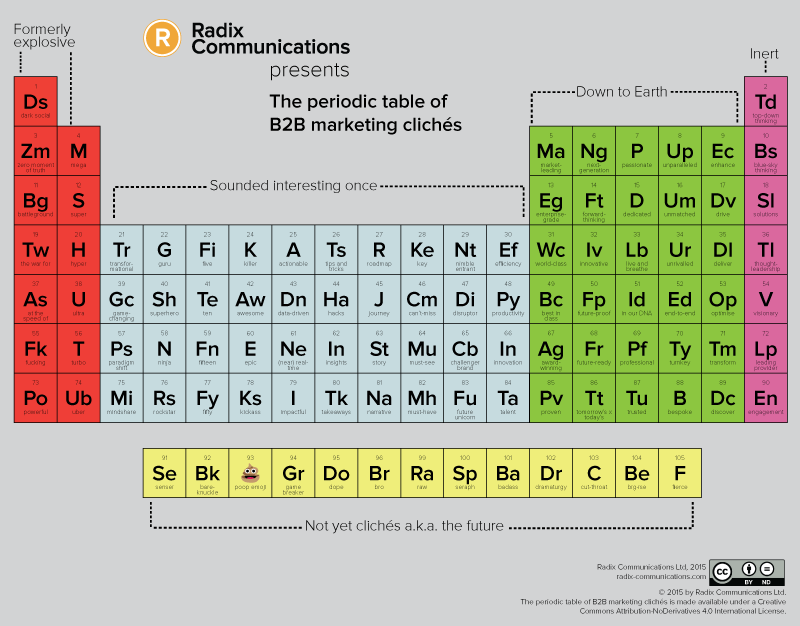
The Periodic Table of B2B Marketing Clichés

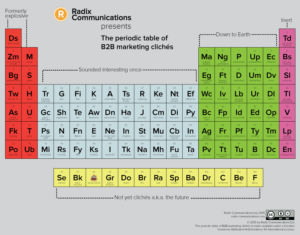
The-periodic-table-of-B2B-marketing-cliches-small-sized-1-1.png

Oh no, I hear you groan.

Not *another* tired list of “business buzzwords that should be BANNED”. Can’t you think of anything more original than that?

But wait, people!

I know that, at first glance, this looks like one of those “bullshit bingo” cards transposed on to the Periodic Table of the Elements.

And if you look more closely, especially towards the right-hand side, you can probably spot a number of the usual suspects, like “blue-sky thinking”, “end-to-end”, and everyone’s perennial favourite, “solutions”.

But look again, and you’ll see that some of your other love-to-hate buzzwords are absent. There’s no “leverage”, no “synergy”, no “reach out”, and no “bandwidth”.

That’s because this isn’t yet another list of annoying corporate buzzwords. This is VERY different.

Well, OK, a *bit* different.

This is a Periodic Table of B2B Marketing Clichés.

It’s a premium collection of all those over-used words and phrases that B2B marketers use when they write stuff about their business, their products and their people.

And it’s not just the old-school clichés, like “end-to-end”, “leading provider”, “passionate” and “world-class”. Oh no. B2B marketers have a whole new set of clichés to play with now.

Everything is awesome

Anyone who’s worked in the B2B tech sector for a while will know that the vocab we use in marketing copy has undergone a huge shift in the past few years.

Almost to a man (not to mention a woman), we’ve ditched dry, polysyllabic, Latin words for perky, Valleyspeak-style language.

If I were being (slightly) academic about it, I could trace this to three things:

1) As buyers now spend 67% of the buying process looking at digital content, that content now has to do the work of a salesperson, which means it has to talk like a human being.

2) A huge proportion  of business software still hails from America, where “talking like a human being” is perhaps more likely to involve terms like “awesome”, “super-fun” and “uber-amazing”.

3) A growing proportion of B2B tech buyers are not IT people, but business people. And it’s well known that all business people spend all of their time getting uber-excited about awesome productivity hacks, but have zero tolerance for tedious chat about open APIs, back-office integration and tiered storage.

The upshot of all this is that where once we wrote about “delivering enterprise-grade end-to-end solutions”, now we write about “making kickass apps that just work”.

Which, for a goodly while, was super-fun. Instead of writing like corporate copy-bots, we got to write like Cher from Clueless. It was totes amaze, B2B was sexy for the first time in, like, ever, and we all got to go to Cannes and hang out with Idris Elba, like, all the time.

But then, inevitably, everyone started writing like Cher from Clueless, and now every B2B blog post, ebook and promo email is all like “check out this super-amazing ROI calculator” or “Fifty epic ways to make over your data centre – before lunch!”

So now the new stuff is pretty clichéd too.

As, to be honest, is this whole Periodic Table of the Elements trope.

We’ve had the Periodic Table of Storytelling (actually v. good, it has “story molecules” and everything), the Periodic Table of Swearing (not for the faint-hearted), and even the Periodic Table of DevOps Tools (for hardcore periodic table fans who also love a nice bit of continuous integration).

So where better to house a collection of new-school (and old-school) B2B marketing clichés than inside a clichéd new-school content container?

(Yes, that’s a container that contains content, what of it?)

Feast your eyes on it, and while you’re doing so, revel in its time-saving possibilities.

Why waste time thinking up perky B2B blog post titles, when the Periodic Table of B2B Marketing Clichés practically writes them for you?

Fifteen Epic Near-Real-Time Insights to Transform Your Productivity, for example.

Why spend hours thinking up a strapline for your timesheet-app startup, when you can just pick off a few choice words and phrases from the “explosive” side of the table?

For example, Kieran and I spent literally seconds developing this zingy new strapline for Radix:

Radix: Story at the Speed of Fucking Powerful

Like it.

But if old ways of writing and new ways of writing are now equally clichéd, how can anyone hope to “stand out” and “cut through the noise”, I hear you ask.

Good question.

When compiling the table we did manage to identify a few words that we don’t think have yet – yet! – become clichés.

We’ve helpfully arranged these not-yet-clichés along the bottom row, from where you may pluck them for use in your next blog or email.

If we open our inboxes tomorrow to find a hundred promo emails inviting us to check out your fierce dramaturgy or become a bare-knuckle productivity seraph, we’ll know the game’s up.

Have we missed your favourite cliché? Let us know in the comments.

UPDATE: For more cliché joy, I recommend the following:

Pro Copywriters Network: The Copywriting Hype Cycle – Lungfish’s David McGuire on how a perfectly good word becomes a B2B cliché.

Stein IAS: 101 Clichés – Images can be just as clichéd as words, and Stein IAS feels so strongly about it, they’ve created an entire site dedicated to stamping out lazy B2B artwork. Raw props to you, Stein IAS.

Thanks to everyone who contributed to the table, including Matt, Kieran, Steve, John, George, Emily, and our badass copywriter bros Rod Hirsch and David McGuire. And extra kudos to our fierce Illustrator sensei Emily for conceptualising the table and making it an actual real thing.

Creative Commons License
The Periodic Table of B2B marketng clichés by Radix Communications Ltd is licensed under a Creative Commons Attribution-NoDerivatives 4.0 International License.

Podcast 30: How to fire up your writers to create brilliant copy

During his keynote at this month’s Content Marketing World, Convince and Convert’s Jay Baer discussed the importance of passion in content marketing. He went on to say that:

“Passion is the differentiator, more so than any tactic. It will set you apart.”

And Velocity Partners’ Doug Kessler explained at this year’s B2B Summit – during his talk Stop Creating Crap: 10 reasons your content isn’t very good but could be – that one of the ways to produce great content is to fill your writers with enthusiasm.

In B2B, 70% of marketers are producing more content marketing now than they did in 2013, but content alone won’t move the needle. What’s going to make brands stand out is content that is truly great. Content fuelled by passionate, convincing copy that drives people to take action.

So how can you ensure your copywriters approach a blog post about your latest product with the same fervour as they would their own novel or personal blog?

In this episode of Good Copy, Bad Copy, I’m joined by Fiona to discuss what B2B marketers can do to help their copywriters find the inspiration they need to write outstanding content.

Listen now to find out:

  • Why great copy starts with a fired-up writer
  • What’s stopping your copywriters getting excited about your brief
  • 4 ways marketers can inspire writers to create outstanding copy
  • Hallmarks of a project created with passion
  • … and more

Download the episode here (right-click and “save as” to download). Or listen in the player at the top of the page.

You can subscribe to the podcast on iTunes here.

Alternatively: add our RSS to your preferred podcast player.

Music by Industrial and Marine.

Header image adapted from “IMG_1743” by John Martinez Pavliga, under a Creative Commons Attribution 2.0 Generic license.

Funnel!: A brief history of the world’s first content marketing strategy game

If you’re a very, very lucky person, you may have received an interesting package recently. I am of course talking about Funnel! – the content marketing strategy game that’s been landing on literally tens of desks around the world.

For us at Radix, it’s so much more than a board game. It’s the culmination of more than a year’s work, it’s proof that we can turn our hands to creating just about any type of content and make it great, and it’s a living testament to the diverse skills, ideas and personalities that make our team amazing.

It’s also a project that I’m immensely proud to have been a part of. But, as I sit here marvelling at the finished product in my hands, it’s interesting to reflect on how a team of copywriters went from a single passing comment to a highly playable representation of the industry we work in.

We thought it was time we shared the full story of Funnel! with the world. So if you’re sitting comfortably, I’ll begin.

What a long, strange trip it’s been

It’s February 2014. There’s a spirit of opportunity and possibility in the air. A team of energetic and ambitious copywriters convene to chat about Joe Pulizzi’s book, Epic Content Marketing.

After discussing Joe’s thoughts on “breaking through the clutter”, we started thinking about how we could make some noise of our own. “Why don’t we write a book?” a voice suggested. “But Joe says we need to do something different. We need to make a board game!” Kieran replied. Ever the wit, his comment garnered responses ranging from a chuckle to a sharp exhale. But one person wasn’t laughing.

The sound of a lightbulb pinging on drew everyone’s attention to Fiona, who then uttered the two most dangerous words in the history of mankind: “Why not?”

With a raised eyebrow and a wry smile, I turned to George, offering the kind of knowing look that you used to give your best friend when the teacher said you needed to find a partner. He gave me a single nod in return. Game on.

Avengers assemble!

This was happening. We were going to make a board game. We had the idea and the ambition, we just needed a team that was up to the task. Fortunately, at Radix we have a hugely diverse range of skills and backgrounds. For some of us, it was time to dust off talents that we hadn’t put to use for quite some time.

As some of you may or may not know, Radix is also blessed with a disproportionately large geek population. George has genuine game design experience, Emily has designed, created and consumed a huge volume of game-related content, and I spend every moment of my free time analysing, writing about and playing popular card game Magic: The Gathering at a competitive level.

With skills like that at our disposal, the core game design team shaped up quickly. But creating and publishing a board game is a lot more complex than simply making a balanced game that plays well and feels fun. There were a lot more moving parts to consider.

At our first meeting we pinned down all of the roles that needed to be filled, and dished them out accordingly:

  • George’s game design experience made him a natural choice for Project Leader
  • Emily’s graphic design expertise landed her jobs in both concept art and marketing
  • With the intention of leveraging my connections in the UK tabletop gaming community, I volunteered myself for the role of procurement, budget and logistics manager
  • We decided freelance artists would be responsible for final art designs
  • Because we all had something to contribute to design, the final design team consisted of George, Matt, Kieran, Steve, John, and Emily
  • As guardian of the budget, Fiona oversaw us all as Project Sponsor

With the roles locked down, we set ourselves the ambitious final delivery date of March 31st 2015, giving us a full year to complete the project. Various milestones were laid out along the way, but by that date, we wanted the final product in our hands.

Our newly appointed Project Sponsor Fiona set the project budget at £6,000, ensuring we could deliver a professional-looking final product that feels like something you’d find on a store shelf.

Mapping themes to mechanics

With the formalities out of the way, it was time to have some fun. A series of meetings were scheduled to discuss various formats that the game could take, but the first task was pinning down the messages we wanted it to get across – and coming up with creative ways to do it.

After some discussion, a few key themes and ideas emerged:

Theme #1: Good copy/strong content converts prospects

Luckily the industry already has a recognised way of representing the prospect conversion journey – the funnel! It was decided upfront that player progress in the game would be indicated by moving prospect tokens through the funnel somehow.

Theme #2: The importance of choosing the right writer/team for your content

This was suggested to tie in with Fiona’s wildly – well, moderately – successful blog post (now also a hit stage show) the seven types of B2B copywriter. The message here is that choosing the wrong writer for your content can have terrible, terrible consequences.

We started thinking of a way to translate that into the game, and settled on having players assemble a team consisting of writers, designers, marketers, and support staff, each with their own stats, clearly indicating that they are better at some tasks than others.

Theme #3: Representing and responding to key industry trends

As content marketers, we are driven by trends and changes in popular thought. We wanted the gameplay of our board game to be altered by major events in the industry, and by key trends and concepts such as Mark Schaefer’s theory of Content Shock.

We decided that these were best represented in two different ways:

  • Named panels around the board for players to land on
  • A deck of “event” cards for players to draw at random, each with a unique effect that could impact the progress of everyone, or an individual

On the gameplay side of things, we also had some boxes that we were keen for Funnel! to tick:

  • It had to be relatively simple to learn
  • It had to be unique enough to stand out
  • Players needed subtle ways to interact with each other and derail each other’s strategies
  • It had to cast our industry in an amusing light while still conveying some serious messages
  • It had to be FUN(nel)! (I’ll see myself out…)

The build phase begins!

With an arsenal of great ideas in hand, our creation was beginning to take shape. The bare bones of the game were laid out, and it was time to go into prototyping.

We spared no expense on research and development, arming George with some marker pens, some thin card stock and the back of an Amazon delivery box. He worked his magic, though, and soon the first iteration of Funnel! came to life.

One of the most important parts of Funnel! is the cards. They represent a player’s team, the projects they want to complete and as previously mentioned, major industry and workplace events. There are a lot of them, and luckily for George’s writing hand, we knew of a handy piece of software that could help us create and print basic prototypes.

With the prototype built, it was time for the moment we’d all been waiting for – our first playtest!

Given that the core testing team was comprised of game designers, reviewers, connoisseurs, and competitive players, we were a tough crowd to satisfy. Our passion for balanced and enjoyable games kept Funnel! in testing for a long time – unfortunately, a little longer than we’d anticipated.

Before long, our timeline was in jeopardy – and it wasn’t just because we wanted to test and refine the game more! As the months got busier in the Radix office, it was becoming harder to fit testing and development time into our diaries (something about writing copy for clients? I don’t really know. Probably best to ask someone in charge).

It soon became clear that to get the game up to the standard we demanded, we were going to need a bit of extra time. Following the lead of some of the greatest game developers of our time, our tentative new deadline became “it’s ready when it’s ready”.

Refined game, unrefined gamers

As testing progressed, many of the core gameplay elements were tweaked and new ideas were constantly flowed into the game. Key concepts and gameplay mechanics were locked down for the cards, and slowly but surely our finished product began to come together.

With the end in sight, we reflected on the game as it stood and what we’d learned from playing it. We were nearly there, but we had some precise changes to make that could have a major impact on gameplay:

  • Players were given cards at the start of the game (previously everyone started with nothing) to speed the game along and get to the action faster
  • Some abilities were either changed or removed from cards completely because they were either too powerful, too complex, or exploitable to the point that they effectively ended the game on their own
  • The number of different cards was cut down significantly due to expected production and illustration costs, but it also helped to streamline the game and make it easier to learn

A new challenger appears

With the game content largely wrapped up, it was time to start making our creation look beautiful. The process of hiring and liaising with an illustrator was new to many of us, but after a short amount of searching we found the perfect partner in local artist, Keith Sparrow.

Keith loved the idea of our game as much as we did, and was happy to fill in some of the artistic blanks that we had overlooked. He got straight to work, and after a couple of meetings and a few tweaks to his illustrations, we had completed board, box, and card art for Funnel! – and it looked amazing.

Seeing Funnel! come to life with the help of Keith’s vibrant and eye-catching art gave us a huge morale boost. It was coming together, our board game dream was becoming a reality, and we really were going to make this happen.

The clock returns, and it’s ticking

2014 turned into 2015, and before we knew it we were already a couple of months in. There was still a lot to do to finish the game off, but fortunately we gained an extra pair of hands in the form of Account Manager Chloe.

With my diary consumed by client work and design input, Chloe picked up the slack on the procurement side of things and quickly found us a production partner in Shannon Games. The company came well reviewed, but production was going to cost a little more than we’d anticipated.

After a chat with our project sponsor, we decided that the best thing to do was to cut our required unit count from 100 to 50. Our exclusive game just got significantly more exclusive.

We agreed to do business with Shannon Games, and not a moment too soon, as Fiona then sprung it on us that she was going to talk at June’s B2B Marketing Summit – and required a finished copy of the game for her presentation!

The final stretch: welcome to the crunch!

Shannon Games sent us through the design templates we needed to flow our art into, and after a few more last minute tweaks to card copy, game rules and mechanics, we were ready for the final stretch.

With the game art and print layouts in hand, it was time for Emily to jump into action. She persevered through the unenviable task of creating card templates and fitting all of the art and copy into them. It was no simple task, but she did an incredible job in a short time.

The cards came out looking as fantastic as everyone imagined, and through diligent and focused design work, a job that threatened to slow us down significantly was completed without a hitch.

This was a huge blessing. Our new deadline that was dismissed by many as being unrealistic and unachievable was all of a sudden looking a lot more possible. Within the space of a few short days, the final template art came in and we were ready to get it all out of the door and onto the printing press.

Now we play the waiting game

With our final designs sent off, we faced a few tough weeks of waiting. Fortunately, this gave us some time to think more deeply about the logistics involved in getting our finished games out to 50 of our favourite people around the world – a welcome distraction from the nail-biting tension over how the games would turn out.

This kept us occupied for a while, and before we knew it, a knock came a-rap-tap-tapping at our door. In rolled an exhausted courier driver pushing a trolley of unmarked boxes. Heads rose from computer monitors around the room and great excitement blended with palpable fear as we opened up the first case of finished games.

But, it didn’t take much inspection before the fear was banished. The games looked fantastic, everyone was delighted, and we got our first opportunity to revel in the majesty of what we’d created. It was almost surreal to see our idea in its finished state, but it was a hugely satisfying feeling and one that I won’ forget for a long time.

We now had a little bit of time to create some useful collateral behind the game in the form of a new microsite. Drawing on the video creation and editing talents of Emily and her partner Paul, and the sharp presentation skills of George “Handsome George” Reith, we put a couple of tutorial clips together to help people get to grips with the game quickly.

While this was going on, each box was thoroughly checked, and a personalised cover letter was added to each one as we prepared to ship them off to their new homes around the world.

After discovering that Sarah and Matt’s buggy built for two unruly children could also comfortably seat 8-10 content marketing strategy games, a low-tech plan was devised for getting them all to the local post office and off out into the big wide world.

Breaking news: people love Funnel!

One of our major ambitions for Funnel! was that people would love receiving it and be eager to share it with others. It wasn’t long after they went out the door that we started seeing a stream of amazing and encouraging social feedback pour in. From tweets and photos of people enjoying playing the game, to blog posts inspired by our idea, the response from our friends and influencers has been nothing short of incredible.

It’s a brilliantly satisfying feeling to see a project of passion be so well received. This was something out of the ordinary for us: we took a risk, we did something we’d never attempted before, and ultimately we used our unique skills and abilities to create something truly different. To see that go down so well within our industry has been one of the most rewarding feelings I’ve had in this job to date.

So where do we go from here?

With the Funnel! project now complete, everyone here is kind of wondering what’s next. We’ve acquired a whole new set of skills outside of what we’d usually do, but when are we going to put them to use again? Or which fringe content format is next on our list to conquer?

Maybe one day we’ll explore the idea of Funnel!’s awkward sequel, but until then, if you want some help creating a board game that’s going to turn some heads and get you noticed, I know the perfect team of highly-skilled geeks for the job. You can find us by calling +44 (0)1326 373592, or emailing the team at [email protected].
Podcast 28: Telling B2B stories, wrestling with emotion and writing for intelligent content

If you are new to Good Copy, Bad Copy: welcome. This month is a highlights episode and is a good place to jump on. I’ll be looking back at some of the best discussions and content creation advice we’ve had on the podcast over the past year.

Creating engaging content is the top issue for many UK businesses and B2B brands in North America. Over 50% of marketers, on both sides of the Atlantic, cite it as their top concern when creating content. This challenge is reflected in the demands placed on copywriters working in B2B marketing.

On our podcast, we do our best to discuss issues affecting B2B copywriters, especially those who specialise in writing for enterprise technology brands. Here at Radix we also often find that we’re wrestling with content formats that are not mainstream, but could be about to make it big. Writing engaging content is one of our top concerns.

Listen now to hear about:

  • How to use storytelling in B2B copy
  • Using comic strips and books in content marketing
  • What is means to bring emotion to copy
  • Keeping content fresh and how to repurpose existing content
  • Intelligent content and what it may mean for copywriters

Download the episode here (right-click and “save as” to download). Or listen in the player at the top of the page.

You can subscribe to the podcast on iTunes here.

Alternatively: add our RSS to your preferred podcast player.

Music by Industrial and Marine.

The full episodes from this episode

Storytelling in B2B, the final frontier

Bringing comics to B2B marketing

Using emotion in B2B copy

Five smart strategies to freshen up your B2B content

Doug Kessler talks intelligent content and copywriting

Header image adapted from Headphone Kitty by Jaap Joris, used under a Creative Commons Attribution 2.0 Generic license.

Podcast 27: Highlights and takeaways from the B2B Marketing Summit

Image by Simon Callaghan Photography for B2B Marketing. Pictured: Fiona Campbell-Howes

It was a stunning event by all measures: all tickets sold out, a fantastic venue in The Brewery, a packed agenda across five different streams, and a ‘superstar’ keynote speaker – Newscred’s Michael Brenner – flying in from San Francisco to address the 580-strong crowd.

But what were the highlights of the 2015 B2B Summit, and did it give us any clues about what’s in store for B2B copywriters in the months to come?

In this episode of Good Copy, Bad Copy, Fiona shares her impressions of the event, and summarises key themes that will have a bearing on B2B copywriting for the rest of this year.

Listen now to hear about:

  • Which speakers had the most interesting stuff to say, from a copywriting point of view
  • Why content is only going to get hotter – and more voluminous
  • How “P2P” is replacing B2B – and why that’s a good thing
  • The state of storytelling in B2B – and why we may be making it sound harder than it is

PLUS: Fiona gives us a flavour of her own talk in the Content track – The 7 Types of B2B Copywriter (And How the Wrong One Can Destroy Your Campaign). See the full slide deck from her talk below.

Download the episode here (right-click and “save as” to download). Or listen in the player at the top of the page.

You can subscribe to the podcast on iTunes here.

Alternatively: add our RSS to your preferred podcast player.

Music by Industrial and Marine.

Podcast 26: Writing for millennials and why it’s not all me, me, me

The face of the global workforce is changing, and if you’re writing copy for a B2B brand then you’ve got a whole new audience to deal with. Those born between 1980 and 2000 are often considered to be Millennials or Generation Y’ers. And they’re taking over the workplace in unforeseen ways.

From the hype about being self-obsessed to the more accurate picture of people concerned about ethics in and outside the boardroom: there’s a lot of information (and misinformation) flying around about millennials at work.

But what are the real differences between Generation Y and X? Do these differences matter? And just what does it all mean for copywriters working on B2B marketing content?

In a world where nearly half of all researchers of business purchases are millennials: it means a lot.

In this episode, Fiona and I explore how millennials view marketing content, and how you can write with this age group in mind.

Listen now to find out:

  • How technology has shaped millennial attitudes to advertising and marketing
  • The different ways in which Generation X and Y perceive marketing
  • Why old-school marketing tactics are unlikely to work with the new generation
  • How to engage millennials through your copy
  • … and more

Download the episode here (right-click and “save as” to download). Or listen in the player at the top of the page.

You can subscribe to the podcast on iTunes here.

Alternatively: add our RSS to your preferred podcast player.

Music by Industrial and Marine.

Radix Copycast Episode 25: Creating truly useful B2B marketing content


Useful content is essential to good content marketing. It’s about giving away a bit of your expertise to help your audience do their job more easily or to make better decisions. The aim is to build an appreciative community of fans who will one day come to buy a product or service from you.

But in practice, useful content can be hard to create. It’s more than just a blog post that discusses a current industry trend or a SlideShare highlighting a specific issue. From ROI calculators and how-to guides to workbooks and checklists, useful content is content that actually, practically helps people do their job better. And getting it right means really getting to grips with what your audience needs.

In this episode, Fiona and I explore how to identify content ideas that are useful and how to go about writing them.

Listen now to find out:

  • The hallmarks of truly ‘useful’ content
  • What you can do to identify ideas for useful content that your audience wants
  • The best formats for useful content
  • Tips on writing useful content
  • … and more

Download the episode here (right-click and “save as” to download). Or listen in the player at the top of the page.

You can subscribe to the podcast on iTunes here.

Alternatively: add our RSS to your preferred podcast player.

Music by Industrial and Marine.

Useful links

Velocity’s B2B Content Marketing Strategy Checklist

fridaygirl.com’s Admin 101

How to write an ebook for a B2B audience

If you’re responsible for B2B marketing, you’ll probably have been asked at least once to write an ebook. And no wonder; they’re useful top-of-funnel and middle-of-funnel content pieces that can educate potential buyers about issues they’re not currently aware of, or to show them how to tackle an issue they are aware of.

But with so many ebooks competing for attention, how do you write a good one? Here’s a guide to help you produce a strong first draft.

What is an ebook?

Ebooks are often confused with B2B white papers – and that’s understandable. They’re both substantial, informative content pieces that sit in the middle of the funnel – where they’re occasionally gated for lead generation. John wrote a whole blog post about telling the difference, but in short an ebook is generally a little less detailed, with fewer words on the page (and they look prettier).

In B2B marketing terms, an ebook is usually around 2,000-2,500 words long, with artwork and graphical elements that break up the text. And the tone is usually lighter than a white paper: accessible, fun, and conversational, with snappy headlines and subheaders to introduce the key sections and points.

Three hallmarks of a great ebook

59% of companies created an ebook (or white paper) in 2022, so writing one that stands out from the crowd can be difficult. But it’s not impossible.

There are three things that characterise a great ebook – and only one of them is down to the writing itself.

Hallmark #1: Audience insight

The first hallmark of a great ebook – and any great B2B content piece – is that it shows an understanding of your audience, what matters to them, and what they need from your content.

To make an impact, the ebook should pack an emotional as well as a rational punch, and it’s hard to make an emotional connection with your reader if you don’t know who you’re writing for.

This is especially important if it’s a top-of-funnel ebook. Here, you’re trying to make your reader aware of a problem or opportunity they don’t currently know they have. To do that, you need to be able to relate your subject to something the audience does know and care about. That takes research, careful questioning of subject matter experts, and (ideally) a persona or avatar to work from.

Hallmark #2: Genuine usefulness

A great ebook also brings the reader useful, practical, actionable, and unique information they can’t get elsewhere, which genuinely helps them do something they want or need to do.

Ideally, this information should be so useful (and hard to find elsewhere) that the reader will feel compelled not just to act on it, but to share it too.

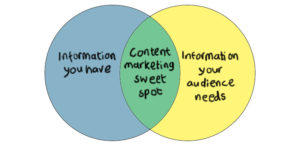
Getting to that level of usefulness and uniqueness is extremely hard, but if you can find your content “sweet spot” – the intersection of “information you have” and “information your audience needs” – it becomes easier to do.

ebook image diagram showing blue and yellow circles crossing in the middle to form a green segment

Hallmark #3: Great writing

The third and final hallmark of a great ebook is the writing itself. Reading it should be an enjoyable, enlightening, and inspiring experience – not a slog.

If you write as if you’re having a great conversation with your reader, about a subject you both care about, you can’t go far wrong.

How to approach the ebook project

At Radix, we have a process for writing a great ebook, which all of our writers follow. If you’re a marketer who has to write content, this could be a good process for you too.

  1. Read the brief. If you’ve been given a written brief, read it thoroughly and note anything you’re unsure of. Then have a call with your client to clarify those points. It’s always better to clarify upfront than to second-guess what the client meant and have to rewrite your draft when it turns out to have been wrong.
  2. Do your research. Your ebook needs to be convincing, which means you’ll need to include stats, figures, and quotes that support your argument. You should also interview subject matter experts to add credibility – these are the people who have the ‘sweet spot’ information that will make the ebook genuinely relevant and useful to your reader. Gather all the supporting information you think you’ll use in the ebook, so you won’t have to break off to look things up after you start writing.
  3. Write an outline. This is an essential part of getting the ebook right. It’s a chance for your client and stakeholders to review what you propose to write and make any corrections or suggestions before you go too far down the route of writing it. A section-by-section structure with bullet points is ideal: think of it as a synopsis document, as if you were pitching your ebook to an editor or literary agent.
  4. Write the first draft. Much of the legwork has now been done, so you should find it relatively easy to write the first draft. A word of caution, though: as you write, don’t be tempted to stray from the outline; it’s been approved, and it’s what you’ve agreed to deliver. Save any new ideas for another piece of content down the line.
  5. Review your first draft. If your deadline allows, don’t send the draft off to the client as soon as you finish it. If possible, ask someone else to take a look (they can even use our content review checklist checklist). Alternatively, put it aside for a few hours – ideally overnight – and come back to it with fresh eyes. You’ll almost certainly spot things that could be phrased better, and these relatively minor tweaks can go a long way to strengthening your first draft. (And the stronger the first draft, the less rework you’ll have to do later.)

Now let’s look at the writing itself. How should you actually write your first draft?

Writing the introduction

The introduction is a crucial part of the ebook. It’ll make people decide whether to keep reading – which you want them to do, because there’ll almost certainly be a call-to-action (CTA) coming that you want them to reach.

So what should a great intro do?

  1. Create an immediate rapport with the reader. The intro is where you show you understand your reader’s world, their professional goals, and their personal aspirations. You’ll mirror the language they use, and set their expectations for the rest of the ebook. (Will it be fun to read, for example, or will it be matter-of-fact but brimming with useful information?)
  2. Frame the problem – and your ebook as the solution. Articulate the main issue your ebook addresses, and clearly show how the ebook will help the reader overcome it. Right out of the gate, you need to make your reader aware that you have something important to tell them about something they care about, and that this ebook will help them to tackle the issue to their advantage.
  3. Define who will get value from the ebook. Showing you know who your audience is – both professionally and psychographically – allows the reader to decide whether the ebook is for them before you’ve taken up too much of their time.

For example: “This ebook is for contact centre managers in consumer-facing organisations who want to improve customer retention rates and aren’t afraid to try radical new ways of working.”

You could even use reverse psychology (respectfully rather than in a snarky way) by defining who won’t get value from it, such as: “This ebook is not for people who shy away from radical new ways of working.”

  1. Make it clear what they’re going to learn. Every B2B decision-maker is busy – so they need to know your ebook is a worthwhile investment of their time. So use your intro to set out clearly what they’ll learn, and how they can use it to their advantage.
  2. (Optional:) Show the reader why they should listen to you. Generally, an ebook is not a hard-sell piece of content, so it’s not usually appropriate to go overboard with the sales pitch. But you do need to convince the reader your ebook has something credible and relevant to say. A brief statement about the client’s credentials in dealing with this topic can help to establish that authority and justify the reader’s time.

A good ebook introduction might go a bit like this, for example:

Introduction: The Problem with X

Your situation is like X today, and because of that, you’re not achieving Y. This ebook will show you how to escape X and achieve Y.

It’s for X type of person, working in X type of organisation, with aspirations to achieve Y and/or avoid being X.

Over the following xx sections, you will learn A, B, C, D, and E. You’ll be able to use this information to do Y.

Plus, it will be super fun. Let’s go!

[Optional box-out feature: This ebook distils our experience from helping 10,000 companies in this area to achieve Y over the last Z years. We hope you’ll find it useful.]

Writing the sections                                  

You’ll already have structured the individual sections of your ebook in your outline, so now it’s just a case of fleshing them out. Here are a few pointers to help:

  1. Make your sections roughly the same structure and word count. This will give all the sections equal weight of authority and make the ebook feel satisfying and professional. It’ll also help the designers to lay out each page consistently.
  2. Stick to your word count. A typical ebook is around 2,000-2,500 words, which probably only gives you 300-350 words per section. Get the key points across crisply and succinctly.
  3. Pay attention to headlines and subheads. Make them enticing and appealing. You want your reader to enjoy reading the ebook and feel like they’re chatting with someone who’s interested in them and telling them valuable stuff.
  4. Think about how your copy will look on the page. What design elements will there be? Are there elements of your copy that would work better as a visual or graphic? If so, provide basic suggestions for a designer to create the image. (PRO TIP: To help with this, some ebook copywriters like to write the copy as it will eventually be laid out – in landscape format with text boxes and spaces for graphics.)
  5. Bring your copy to life. Reading lots of abstract, theoretical stuff can be boring. Show how the point you’re making works in the real world and directly impacts the reader. Did your subject matter expert use nice analogies or catchy phrases to explain the topic? If so, work these in.
  6. Back up your points with credible statistics and quotes. You’ll have gathered these in the research stage, so all you need to do now is drop them in (don’t forget to attribute them to their original source). Suggesting pull quotes and breakout stat boxes can also give your designer plenty to play with to make the finished book look interesting and engaging.
  7. Link to other content pieces. If you (or your client) have produced other content relevant to any of your sections, include a link to it. Even if the reader doesn’t make it to the CTA at the end, your ebook can still provide value.
  8. Include a key takeaway or recommendation at the end of each section. What’s the one thing you want the reader to remember about this section? Make it easy for them to remember it!

Writing the summary

This is where you sum up the key points of your ebook in the form of a handy list that will help your reader to achieve Y or avoid X (refer back to the intro at this point).

If you’ve included takeaways throughout the ebook, you can list them again here, so your reader has a summary of the key points to remember. And if your ebook is designed to be actionable, including a checklist can work well.

A nice touch is to include links to further resources – either the client’s own content or (if you want to be really helpful) industry-wide content that adds relevant and interesting new perspectives on the topic you’ve discussed.

And if you haven’t already set out the client’s credentials in the topic area, there’s another chance to do that here.

Writing the call to action

In B2B tech, sales cycles can be long – so your ebook likely plays a specific role in guiding the reader along their “buyer journey”. To do this, your CTA at the end should encourage the reader to take a sensible next step – whether that’s to read another piece of content, book a demo, or get in touch.

You can measure the ebook’s value by the number of people who follow this CTA, which means you need to make it as persuasive as possible. So don’t leave writing this until you’re exhausted and can’t wait to type the final full stop.

Instead, write the CTA early on – ideally in your outline – and make sure you assess it thoroughly when you come back to your draft with fresh eyes before you send it off.

…and that’s it!

There’s much more we could say about ebooks – but this getting started guide is already approaching ebook-style length.

If you’re looking for help creating a really great ebook, find out more about our services or get in touch – we’re always happy to help!

Note: this blog post was originally written by Radix’s founder, Fiona Campbell-Howes, in 2015. It has since been updated to keep up with evolving practices among our ebook clients, and changes to our writing process.

Radix Copycast Episode 24: Doug Kessler talks intelligent content and copywriting

B2B marketing has been going through a great many changes over the past three years, from the rise of content marketing to the adoption of marketing automation by many brands.

Today, 86% of B2B marketers use content marketing and 65% of information technology companies have adopted marketing automation.

But what about new technologies, and ways of producing and presenting content? Emily gives us the lowdown from this year’s Technology for Marketing & Advertising as regards new technology trends on show.

As we discussed in episode 23, intelligent content is a huge meteor that could be about to crash into content marketing – but many copywriters don’t even suspect it’s on its way.

So we’re delighted to have an interview with one of the B2B marketing sector’s top visionaries (not to mention one of its best copywriters and one of our favourite clients); the man that warned us about Crap: Doug Kessler, co-founder and Creative Director of Velocity Partners. In our exclusive interview, Doug shares his thoughts with us on intelligent content and what it means for B2B copywriters.

Listen now to find out:

  • Which marketing technology trends were on show at TFM&A 2015
  • Whether intelligent content will catch on in marketing organisations…
  • …and if so, whether it means copywriters will need to learn new skills
  • Six key B2B marketing takeaways from TFM&A
  • … and more

Download the episode here (right-click and “save as” to download). Or listen in the player at the top of the page.

You can subscribe to the podcast on iTunes here.

Alternatively: add our RSS to your preferred podcast player.

Music by Industrial and Marine.

Useful links

6 not-so-surprising marketing lessons from TFM&A 2015

Intelligent Content Demystified: A Practical, Easy-to-Understand Explanation

Radix Copycast Episode 23: What “intelligent content” means for B2B copywriters


Content marketing is on the move. The next stage in its evolution will be “intelligent” content, according to Joe Pulizzi of the Content Marketing Institute, and a host of other luminaries slated to speak at next month’s Intelligent Content Conference in San Francisco.

According to Noz Urbina, one of the leading lights of the intelligent content movement:

“We need to think of language at the level of “systems”, not words or pages. Intelligent content is free from format, rich in semantic and structural metadata, and automation-system-ready.”


It seems that intelligent content is content that adapts itself on the fly to the needs and wishes of the person consuming it. It’s guided partly by what the user is doing at the moment of consuming the content, partly by the device they’re using, and partly by what the content delivery platform already ‘knows’ about the user and what they’ve done previously.

What does it mean for writers?

For the people writing content that’s destined to be adaptive, we think it will lead to some big changes in mindset and approach.

As Noz Urbina says above, adaptive content is “free from format”. Writers can no longer assume their words will be consumed in a linear fashion, with the user starting at the beginning and following the writer’s narrative thread to the end. Instead, individual users will take different paths through the content, depending on where they are, what they’re doing and what they’re interested in.

The difference between writing traditional content and writing adaptive content may therefore be like the difference between writing a novel or screenplay, and writing a choose-your-own-adventure book or videogame. In all cases, there is a story, but in the latter formats, the user selects the narrative path, rather than the writer.

For more on the challenges we think intelligent/adaptive content will present for copywriters and B2B marketers, listen to the podcast as we discuss:

  • How copywriting practices and business models will need to change
  • How it will affect collaboration between writers, designers and marketers
  • Whether writing apps like MS Word are still fit for purpose
  • What you can do practise creating non-linear content
  • … and more!

Download the episode here (right-click and “save as” to download). Or listen in the player at the top of the page.

You can subscribe to the podcast on iTunes here.

Alternatively: add our RSS to your preferred podcast player.

Music by Industrial and Marine.

Mentioned this episode

2014: The year social content dominated B2B technology marketing?