How to tell a compelling brand story in a world full of heroes

As I took stock of everything I’ve learned throughout the year,  I had an interesting realisation. One of the most valuable copywriting lessons I learned this year didn’t happen in the Radix office.

It didn’t even happen in this world.

I’ve been a passionate player of MMORPGs (Massively Multiplayer Online Roleplaying Games) since my early teens. My hobby has taken me to dozens of fantasy worlds, but my experience this year really stood out – and helped me develop as a B2B copywriter.

Everyone’s a hero. So now what?

The nature of MMORPGs makes traditional video game storytelling very difficult. In a world where millions of players are running around together and constantly interacting, it’s hard to make each and every one of them feel like they are the one true saviour of the digital world – destined for glory and power above all others.

Yet, in spite of the obvious challenges, the game I played this year – Final Fantasy 14 if you’re interested – does it almost flawlessly. In the game’s world of Eorzea, every single player character is the “warrior of light”, a chosen individual destined to save the world from multiple catastrophic threats.

That got me thinking about the B2B copy I write. I’ve often found myself working on a project for a client that wants to stand out from their competition and sees themselves as a lone hero, but – at first glance – doesn’t really have any massively compelling USPs.

A crowded and competitive market is much like a world full of heroes. Every company wants to stand out and feel unique, but only a handful have an offering that’s obviously differentiated and able to deliver value above that of the alternatives.

It’s a difficult situation that many copywriters dread. But thanks to my online experiences, it’s a challenge that I’ve learned to embrace and overcome. Instead of clutching at straws and trying to scrape some kind of pseudo-unique proposition together, I’ve learned to embrace it – and devised a few tips to help you craft your own compelling stories for businesses in hero-filled markets.

Finding your individuality

The game makes every player feel like a uniquely significant hero by using:

  • Almost endless character customisation options
  • A strong supporting cast of non-player characters
  • A unique character development system where you can be whatever you want to be

Those tactics are great for game developers looking to achieve the same. But how exactly do they translate into tips and strategies for a brand that wants to be a hero, when its competitors are all offering the same?

The honest answer is “not directly”. But, by thinking about the principles behind those game design decisions, I’ve helpfully engineered them into three simple tips for brands that need to find the extraordinary hidden in the everyday.

Differentiate the brand through tone

So, your brand can’t do anything more than your closest competitor can. It’s a grim reality that few company stakeholders – especially those in marketing – will ever hold their hands up to. But if you can, you’ll be at an advantage.

Because products and capabilities aren’t the only way to differentiate a brand.

Voice and tone are important weapons in any brand’s arsenal. They provide a simple way of showing your reader your attitude, your ethos, and why working with you is a different experience – even if on paper the features and benefits look much the same.

Even if you can’t offer a massive amount of unique value, you can make dealing with you a unique experience – and as a copywriter, we can help you demonstrate that by talking to the customer in a unique way.

Be more open, honest and friendly than your competition. The person reading your content is going to remember that, and often simply being honest and approachable is enough to secure customer interest in an offering.

Tell your customers’ success stories

Telling real success stories is a great way to make your company look heroic – even if, realistically, many of your competitors could have solved the same problems and achieved similar outcomes.

That’s because your reader might not be looking for unique value. Often, they just need to know that you solved a real, relatable problem for a customer in their position, and that the outcomes achieved were positive and appreciated.

(By the way, if you haven’t already read Kieran’s blog post on everything you need to know about B2B case studies, you really should.)

It’s really helpful if your writer can talk directly to a satisfied customer. Often, by explaining why they chose to work with the company and what they gained from it, customers can help uncover USPs and differentiators that senior stakeholders hadn’t even considered.

Because ultimately, in your customer’s world, you’re not the hero anyway. They are.

Say the things other companies are scared to say

If you’re in a well-worn sector, where best practice is well-established and there’s little genuinely new or exciting to say, don’t fake it.

Instead, try cutting the crap.

Is there an elephant in the room that people are scared to address? Is there common jargon or shallow promises that get thrown around a lot in the marketplace? Or – if you’re feeling particularly brave – is there a glaring weakness that is common across all available solutions in your market?

Discussing the points that others are afraid to – and being open and honest about them – is a great way to make a brand stand out, and show your attitude in practice.

Whether it’s breaking the silence on an underdiscussed flaw, or just openly acknowledging that most solutions in the market are very similar and will deliver similar results, openness can pay dividends.

Don’t bullshit. Ever.

Whether they want to rise to the top of their market, make a difference to their customers or simply continue growing, every company we engage with as B2B copywriters wants to be a hero. If they have a compelling story to tell already, then that’s great – but often, they’ll look to us to provide that spark.

A clear, differentiated narrative is a luxury not everyone can afford. Especially in B2B tech, too many brands overstretch trying to look unique, and end up undermining their credibility by pretending something’s different when it’s not.

Instead, it’s up to us to find ways of making the ordinary extraordinary, and helping individuals stand out from a crowd of others with the same capabilities, on the basis of their attitude. Their ethos. Their people.

As copywriters, we’re in a unique position to make that happen. We can influence things like tone, voice and honesty in communication to help a single voice rise above the static. We don’t need to try and sex-up product offerings or call on unsubstantiated facts to fabricate a narrative that simply isn’t there.

(Even if, sometimes, we need to push back on a brief, and have those awkward conversations for the brand’s own good. Because somebody has to.)

If the offer looks the same on paper, we need to be honest about that. Because the conversation that happens next is when we can really make our chosen champion feel like the only hero in their world.

“How long will it take?” Five factors we consider when quoting for copywriting

As you may know from your own experience, quoting for any kind of project isn’t all about the money. A major component in delivering a job is being realistic about what’s achievable, so you can keep your promises. It’s how your client comes to know they can trust you to deliver.

Of course, it’s important to deliver jobs quickly, but quality is an important part of what we do – it’s what separates us from the content mills (*shudder*). So we have a clearly defined set of questions we need to ask before quoting for a project, which enable us to stick to deadlines, and ultimately, let our clients know exactly what they can expect, and when.

So, what do we look for before we put pen to paper? Here’s five things we consider when quoting for a writing project:

1. How complex is this, really?

We’ve been doing this for more than a decade (and we’re really geeky about our data). So when we get presented with a brief, we can usually work out how much work it’s going to entail at a glance. But there are of course exceptions.

For example, from time to time we get asked to copy edit an existing document (usually written by one of the client’s colleagues). It might need shortening, expanding upon, or something different to copy editing – like proof reading, or a rewrite. My colleague George has put together a great piece to explain the difference.

It’s only natural to take an optimistic view of an existing piece. But if we don’t quote properly for a project, we’re not helping the client. If the piece turns out needing a complete re-write, this could pose a problem when it comes to delivering the work to the agreed schedule. We pride ourselves on never being late, so it’s essential to get right.

The more information we have at the brief stage, the better we’re able to understand the true scope of the job. (And if we ask to see the content you’d like us to copy edit before we quote, this is why.)

2. Yes, we know B2B tech, but do we need a call, or extra research?

We understand enterprise technology; it’s what we write about every day. But that doesn’t mean we’re experts in every field. The nature of the industry means it’s constantly evolving, so we as much as anybody else to keep up with the latest trends and developments.

For some projects, this is pretty straightforward. But if it’s a key piece of content where you really want to add value for your reader, we’ll need to dig a little deeper, and uncover things your audience won’t already know.

This can mean doing extra research, or having a call with product experts – they live and breathe this stuff, so if anyone is going to give us invaluable insight, it’s them. (In fact, it’s so valuable we recorded a whole podcast episode about it.)

3. Who’s our best writer for the job?

One of the real benefits of having ten specialist B2B copywriters in a room is that we each have our own natural strengths. Like anything in life, we have subjects we find more interesting over others and special areas of interest – and our natural writing styles fit certain types of content.

This means we’ll always to try to match the job to the ideal writer and content lead. This can affect the turnaround time slightly, but it also ensures you’re getting a great piece of copy from a copywriter who has a genuine interest in the topic and, what’s more, truly understands what you’re trying to achieve.

The more specialised or important the job, the more essential it is to find just the right blend of interests and style.

4. Can we be certain of delivering quality work on time?

We know you’re busy, and you have deadlines to meet. If a job’s urgent, having 50+ hours of writing time at our fingertips every day means we can usually turn it around.

But like air traffic controllers at a busy airport, our account managers balance this hectic, fast-moving workload with the absolute need to get the job right. They’ll always have a clear, visual grasp of our writing diaries, enabling them to ensure the right writer has time to do the job well.

That’s why we need to receive a project brief, set out the breadth of the project, and understand who’ll write it, and when, before we give you a firm deadline. But once we have, you know we’ll absolutely deliver exactly what we say, when we say, for the price we agreed.

5. Have we allowed enough time for review, and amends?

To make sure you’re completely happy with our work, we factor in up to two rounds of amends as standard in our quotes – as well as our own internal review process.

This gives you the flexibility to question and edit what we’ve produced (within reason) if you need to, so we can refine the piece totally in line with what you want.

Quite often, that time won’t be necessary (especially if we’ve worked hard on the brief), but you’re safe in the knowledge that we’ve factored the time it usually takes into your project schedule – enabling you to confidently forecast your content schedule.

Ultimately, we’ll always be realistic and upfront with you

Getting copy projects turned around quickly is great, but getting them done properly – and reliably –  is even better.

In our experience, clients are much more satisfied with the end result (even if they’re in a hurry for it) when we’re clear about what they can expect, and keep them updated at every stage. That’s why we’ll never overpromise or say yes to a project without reviewing a brief first.

If you like the sound of the way we work and you’re interested to know more, feel free to give us a call on 01326 373592 or email us at [email protected].

(Or if you’d just like to see a copywriting price list, that’s no problem either.)

How to write an awards entry (and win*)

Ah, January. That strange post-Christmas period where B2B copywriters relearn how to juggle briefs like we’re in some kind of crazed copy circus, all while abstaining from things that we love. But hey, at least we’ve got awards season to look forward to.

And entering? Surely all it takes is to read the questions and have a wee gush about how great you are?

If only it was so easy.

Here at Radix towers, we’re flattered to have had our share of success writing clients’ awards entries. (Heck, we’ve even been nominated and won before in our own right, too.) And with deadlines looming, we thought it made sense to share a little of our secret sauce. Anyone can answer a question, but what does it take to actually win?

From our experience, it generally pays to be mindful of the following…

Knockin’ the judges dead (metaphorically, with words)

1. Stay on point.

Typically, you only have so many words to tell the judge why your candidate is so deserving of the award. Wasting time talking about how good Steve is at Magic: The Gathering wouldn’t win any us any favours – so we don’t (we’d need a lot more than 300 words for that, anyway).

Instead, we prioritise what makes our entry so unique, ground-breaking, and interesting – and present it proudly, right at the start. (With persuasive language, in an active voice.)

2. Provide evidence. For everything.

Our clients may love what we do, but if we can’t back up our grandiose claims with cold, hard stats, then we stick to the humble truth. If we are indeed the best (perhaps even the only) specialised B2B tech copywriting agency in the South West, then you can bet we’ll have the data to prove it. Nobody likes a blagger.

Wild, unsubstantiated statements undermine the credibility of everything else in your entry. So if you can’t prove it, don’t say it.

3. Tell a compelling story.

Who wants to read endless lines of self-congratulatory guff? OK, it may be the judge’s job to do exactly that, but let’s cut them some slack. Instead, we tell a compelling story that’ll seize their attention and keep them on our side.

Especially if you know the judging process includes a committee discussion, it pays to have a succinct, powerful “THIS is the one who did THAT”.

Of course, it’s still important to articulate why the candidate is so damn great, so it pays to break it down into a digestible beginning, middle, and end. For example: What objectives were set? How were these objectives met? And what super-amazing things happened as a result?

The judge needs to be able to describe exactly why you should win, in two seconds flat.

4. Mind the marking scheme.

The more we know about how the decisions are made, the better.

Sometimes, it’s obvious. If a question is worth double points, that’s the one where we really set our stall out. Often this means getting tactical; we may be itching to talk about a particularly juicy project, but in many cases, it pays to reserve the big guns for the highest-scoring questions.

If the scoring process is mostly numerical (each answer is scored out of ten, or five) then it’s a question of marginal gains: finding enough relevant things to say in each one, to gain a one-mark edge here or there.

But if it’s a group of people discussing each entry around a table, then it’s wiser to take the best shot as early in the entry as possible. It’s simple behavioural science: if they get a feeling early on that this entry is a good one, they’ll then see every subsequent point as a confirmation.

5. Check, check, and check again…

Slinging a first draft off for consideration may be tempting (gotta hit that deadline), but chances are we’d just secure a fast-track to the recycle bin. At Radix, we value quality – no rush jobs, no jargon, and no wince-inducing typos. It’s not like there are points for good grammar and spelling, but if it comes down to a gut decision, you need to look like a contender.

So we proof, we ask for a second opinion, we proof again… and then maybe (just maybe), we send.

[Editor’s note: it is an inescapable truth that the copywriting gods will now punish us for our hubris, and you’ll spot a typo in this blog post in the next three seconds. We can only apologise; such ancient and mischievous forces are beyond our control.]

The clock is ticking.

Most importantly, you do actually have to meet the entry deadline. (Yes, we know most awards end up extending the deadline “by popular demand” *cough* but you can’t rely on that.)

It’s not uncommon for an awards entry to run to 2,000 words or more. So if it’s going to be good, you do need to book out a fair chunk of time.

(Of course, nobody does… which might just be why a certain B2B copywriting agency finds late January tends to bring a sudden influx of urgent awards entries to write. Having ten writers in a room does mean we can turn things around pretty fast.)

If you have any questions about this post, or you’d like some help from Radix in hitting your own scary deadline, just get in touch at [email protected]

—

* Radix Communications Ltd cannot guarantee that you will win an award. Obviously. But by reading this far you have already won our esteem and our thanks. Well done you.

Podcast 57: how to write up a B2B marketing event

Whether it’s a launch party, industry expo, or dinner gala, B2B marketing events happen every day. To get the greatest mileage out of all their hard work, a marketer will often want a copywriter there to capture the day in beautiful prose.

Sounds easy enough. But as a writer, it’s really easy to get this job horribly, horribly wrong.

In this episode of Good Copy, Bad Copy David, Fiona and I share our dos and don’ts for tackling client events, as well as our own personal event successes and horror stories.

Listen now to discover:

  • Why you should always record an event twice
  • How events can make you a much better writer
  • Why it’s essential to capture the ‘feel’ of an event
  • What every writer needs to know before they set off

…and if you want to read the event copywriting blog post I plug so subtly in the conversation, you’ll find that here.

How to listen

You can download the episode here (right-click and “save-as” to download). Or stream the episode in the player at the top of the page.

(Or you can subscribe to the podcast on iTunes here. Alternatively, add our RSS to your preferred podcast player.)

Credits

Intro and outro music by Industrial and Marine.

What is an em dash, and when should you use it?

You mastered the full stop in primary school, and wielded the comma like a pro by secondary—but now, it’s time for you to master a new type of punctuation.

A versatile piece of punctuation that can give your writing far greater variety and impact, the em dash is the next best thing that will happen to your copy.

What is an em dash?

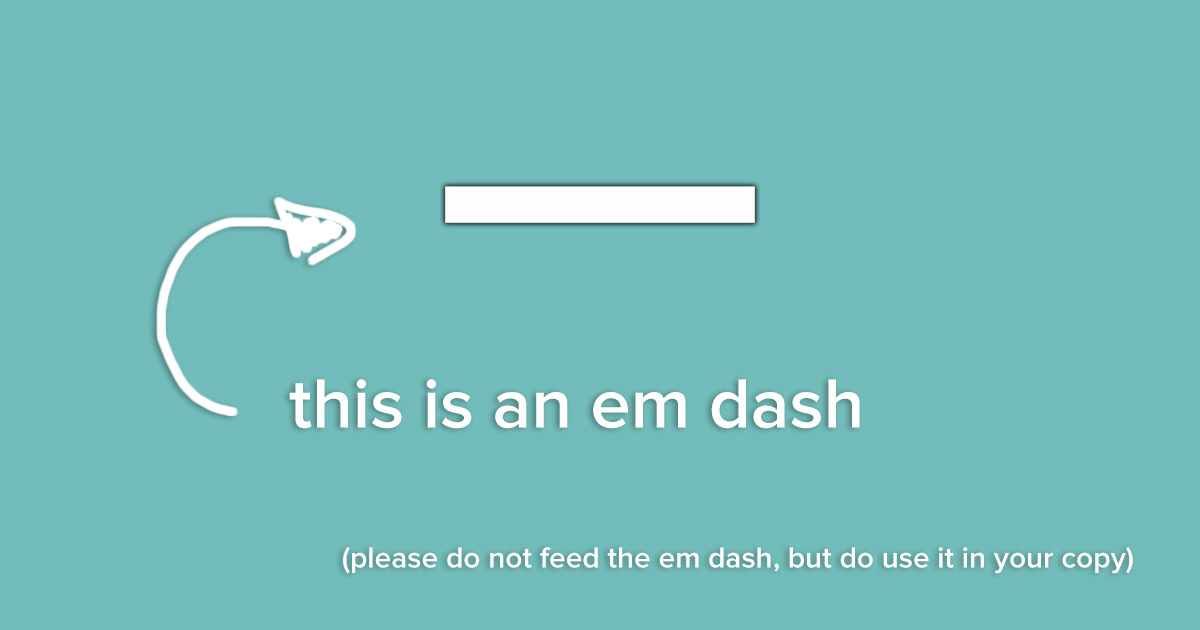
This:—

Longer answer, it’s a long dash that can take the place of commas, parenthesis or colons depending on the context.

To produce one in Microsoft Word, simply insert two hyphens between a pair of words without a space. So you’d type(–)like this, but without the brackets. (If that doesn’t work for you, check out this explainer from Punctuation Matters.)

What is an em dash not?

It’s important to clarify the difference between an em dash, an en dash and a hyphen.

  • An em dash is a longer line, roughly the length of an ‘m’.
  • An en dash is a shorter line – like this (it is roughly the length of an ‘n’). It represents a span of numbers or dates. In many cases it can be used similarly to an em dash if you are writing in UK English. You can produce it by typing a hyphen between a pair of words with a space either side( – )like so.
  • A hyphen is an even shorter line that links two words for clarity. You’d use it to distinguish a cloud-ready platform (a platform that’s ready for the cloud) as opposed to a cloud platform that is ready for… something else.

You probably already know how to use hyphens and en dashes (even if you didn’t know it was called an en dash before), so I’ll just be sticking to talking about the em dash for now.

When can you use it?

You can use the em dash in a variety of ways: As a more impactful comma replacement, an alternative to parentheses, or a way to round off a sentence in a snappy, concise way.

Like a comma

“Product X can help you do stuff better—transforming the way you meet, greet, and treat your customers.”

Sentences like this, that use the rule of three, it can become a real comma overload if you have another clause in there. By using an em dash here, you can keep both clauses in the sentence without bringing the comma-pocalypse. A well-timed em dash can also help break up your sentences visually, making it easier and more appealing to read.

Like a pair of brackets

“Product X helps you do stuff better—and at a lower cost—than competing solutions.”

While brackets are a great way to include additional information without breaking the flow of the sentence, they often lead to that information feeling separate from your argument, and less relevant as a result. When you want to split your message away from the main sentence, but without detracting from its value, the em dash can help.

End a sentence with a bang

“Product X accelerates deployment times, helping you meet the needs of your customers—fast.”

Sometimes a bit of extra info at the end can of a sentence really ram home a key point in your argument. Em dashes can help emphasise these key points and bring them to life for your reader.

Why would I want to use it?

While there are some subtle nuances between using a comma or bracket and an em dash, it’s mostly best suited to adding variety to your copy.

Whether it’s avoiding overusing commas, stripping out repetitive brackets, or just making your copy look nicer and more varied—the em dash is a powerful tool that all copywriters should try and master.

One final tip

One final piece of advice for any future em dash users out there: double check your style guide before using them.

Most style guides I’ve come across ask for em dashes to be used without any spaces between—much like this. Newspaper style guides and others that follow AP style however, are likely to favour spacing em dashes — like this.

So, make sure to double check which one your client prefers before you start putting em dashes to use in their copy. If in doubt, you can normally tell which is preferred based on whether you are writing in UK or US English. UK English prefers a spaced en dash normally, while our counterparts over the Atlantic use the closed em dash as standard.

Booking a successful B2B web copy project: a clients’ FAQ

Often, the first really meaningful interaction your customers have with you is through your website. They may have come across you on social media or heard of you through word of mouth, but your website is where they’ll dig in, find the information they need, and start to make a decision on whether they want to get in touch.

That’s why your website copy is so important.

And here at Radix, we’ve seen that reflected in recent years, with four years’ continuous growth in website copy as a proportion of our work.

Where once B2B marketers might have tried to carry out the writing in-house, they’re increasingly turning to professional copywriters like us when it’s time to renew the site. (Whether that’s because their old site wasn’t giving them the results they wanted, or they simply remember what a nightmare the job was last time out, we can’t say.)

For most, running a web copy project will be a fairly rare occurrence – so clients tend to ask us the same (completely understandable) questions:

“What do you need from me to write our web copy?”

There are quite a few bits of information which will make it easier for us to give you an accurate quote and – ultimately – to write your copy the way you want it. And we can get that knowledge from you in a number of different ways.

In the past, we’ve held immersive workshops in clients’ offices, or a series of calls with heads of departments to ensure we glean exactly what it is they need their website to do, what information each individual page needs to contain, and how the overall feel of the site needs to come across.

But generally, we’ll be looking for:

1. A proposed sitemap, if you have one

A sitemap makes it much easier for us to identify what your needs are and provide an accurate quote. (If you have a wireframe or preliminary design too, so much the better, as we can get a feel for how much copy you’ll need on each page).

2. A sense of your audience, and their buying process

It’s also great if we know exactly who your web visitors are, and where they tend to arrive from. For example, a curious visitor with little knowledge about the finer details of your industry is going to need different information than a seasoned industry expert. Also, how much do they already know about you? Will they be turning up fresh from Google (and how much is search ranking a priority), or are they following up to confirm you’re credible, after a different initial point of contact?

3. How your brand should sound

The tone and voice of the various areas of your website – and your overall brand – are very important.

Your voice needs to be consistent, as a representation of the personality of your brand. But we tailor the tone to your audience’s needs as they interact with the site. Even for the same visitor, the tone you use for a cheery greeting might be completely inappropriate for an error message.

(Though as our colleague Katy pointed out, even Microsoft can get that one wrong.)

So as we go along, it helps us to understand the context of each page – why somebody would read it, and how they’re likely to feel about that.

4. What each page needs to say

Perhaps the most obvious part – but, potentially, the most time-consuming. Because we need to know all the information you want on every page of your site – and which parts of that information are most important to your audience.

Of course, if you have an existing page of content to point us at, that’s somewhat easier. But even then, it’s helpful to have some guidance: what’s working for you, what’s not, and what’s new. You’re refreshing the site for a reason, after all.

5. Some idea of your SEO requirements

If you’d like the site to perform well on Google, it’ll be useful to have some kind of keyword strategy and/or research, so we can make sure each page aligns with what your audience are looking for, using the same language as they will. We’ll talk more about this in a bit.

“What if I don’t know about the voice and tone I want to adopt?”

Lots of brands already have extensive brand usage guidelines when they come to us – and some of them are even useful. But if you don’t, there’s no need to worry: as experienced copywriters, tone and voice are our marmite and toast.

Broadly, there are two approaches we can take. We can chat about your brand, your existing copy and what you do and don’t like, then approximate something for you. Or we can conduct a proper voice and tone workshop, and give you a short, usable document with some rules, suggestions, hints and examples.

(The former is OK if we’re the only ones writing for you; if you have writers in-house too, the guide is a good idea, because it can help you to stay consistent.)

“What’s the best stage to bring a copywriter into my web project?”

Most of our clients come to us with a plan for their site, normally devised between them and their web developer, and ask us to populate the pages. That makes it easy for us to give you an accurate quote and delivery schedule.

However, we’re open to other ways of working too. So, if you’d like our input on how many pages we think you should have and what should go on each one then we’re more than happy to put our experience to good use.

Likewise, some people like to create the copy first, and the design later. That’s fine by us.

“Do you write pages that are short/long/scrolling/really long/parallax/mobile/really, really long?”

The short answer is yes. Whatever kind of web page you want (so long as it contains words).

There’s been something of a cultural shift in web design over the last few years which has seen a rise in more mobile-friendly, scrolling websites. These tend to have smaller chunks of copy in panels scattered across the length of the page, whereas a traditional website will have tabs at the top of the page and longer sections of copy.

So alongside the traditional “250-words, title, copy and some bullet points” kind of web page, our price list also includes options to buy your web copy by the chunk. So we can build a quote for whatever kind of page you – and your web designer – can dream up.

“Do you do web design?”

Nope. We’re strictly words-only.

BUT we do often work in tandem with freelance designers and web developers, agencies, and in-house experts. We’re happy to collaborate in this way if you think it would add to the process, and may even be able to recommend someone if that would help.

“What’s your approach to SEO?”

Ah. We could (and possibly should) write a whole blog post about this. But in short…

We’re not search engine specialists, but we act on guidance SEO experts provide – like keyword recommendations and research. If one of your site’s objectives is to attract search engine traffic, it’s a good idea to work with an SEO consultant (as well as – not instead of – your copywriter, of course).

Most of the copy on your website is aimed at people. Some of the rest is primarily there to please search engine robots. And some parts (like your page title) is a mixture of the two.

Usually, we’ll work on the people-facing parts of your copy (on-page body text, meta description), incorporating keyword recommendations as appropriate, and leave the search engine-facing bits to the experts. Where the copy is dual-purpose (titles, headers, alt text), we tend to collaborate – generally, we’ll suggest something, then recommend you have your SEO team tweak it as appropriate.

We find it’s a good balance, because refinements to Google’s algorithm improved its ability to prioritise quality content, satisfying at the intent behind each search – there are fewer tricks and shortcuts. We use the keyword research to deduce your web visitor’s intent, then – without focusing too much on the technicalities – simply write the best page we can.

It seems to work well – and we’re regularly recommended for website projects by SEO agencies, so they must be happy too.

“Who else have you written web copy for?”

We’ve had the pleasure of writing web copy for dozens of B2B, technology and industrial brands – including some of the world’s largest organisations.

Sometimes, that work is confidential (we’re happy to namedrop, but only in private) – but to give you a flavour, a few sites we are allowed to tell you about include:

Aon Employee Benefits

VoxGen – conversational software and services

Tectrade – cloud services and consultancy

TomTom – fleet tracking technology

The Daniel Group – customer feedback for industry

Penzance Dry Dock – industrial and marine operations

“How much will my new web copy cost?”

Once, copywriters could quote a flat, per-page price for web copy. But that was when pages were all fairly standard. These days, a page could be anything from a 30-word text panel and a couple of buttons to a 1000-word Homerian epic in parallax form.

That’s why our Senior Account Managers will work hard to define the exact scope of the copy you want, and build you an accurate quote in advance.

But that’s not to say we can’t give you a good, ballpark idea before your sitemap is finalised. All the components we use to build our quotes – various sizes of panels and pages – are included in our price list, so it’s easy enough to get a thumbnail picture if you know the rough dimensions of the site.

If you’d like a copy of the price list, do get in touch.

“How much time will I need?”               

If history is any guide, significantly more than you’ve allowed so far. There’s something about web projects (the temptation to make last-minute additions to the site, maybe) which means they never seem to run to schedule.

But whatever’s delaying things, it won’t be the copy. We’ll give you a firm schedule alongside your quote, and we’ll stick to it.

Obviously, that schedule will depend on the scale of the site, and the amount of input we need from you and your stakeholders. But given a little advance notice, we’ve been known to take smaller sites from fact-find conversation to signed-off copy within a matter of days.

Got any more questions? Our Account Management team are here to talk you through the process. Please drop us a line…

How to write content for engineers – a primer for marketers

For B2B marketers, some audiences come easier than others. For instance, there’s enough crossover between “marketing” speak and “business” speak that writing for an enterprise audience is relatively straightforward.

On the other end of the spectrum, though, engineers can seem completely opposed to the usual corporate tone. Both software and industrial engineers can also be distrustful of slick marketing spin – making them a tough nut for content marketers to crack.

Here’s a few tips for writing for this challenging audience.

Be specific

Engineering revolves around finding problems and solving them as efficiently as possible. Engineers are often very focused on efficiency and practicality as a result, so you need to make sure your writing is as well.

Any waffle, rambling intros or anything else that stops your content from getting straight to the point is going lose an engineering audience.

Don’t be too corporate

Unlike other business audiences, many engineers are unlikely to trust your content just because it comes from your brand. No two engineers are the same of course, but as a general rule of thumb your content will go further with engineers if it’s based on evidence and clear expertise as opposed to brand recognition.

So, if you can link your content to a specific product expert (preferably another engineer), that can go a long way to establishing you as a credible voice that engineers should pay attention to.

Offer advice, not products

Like most professionals, engineers want to solve problems. Sometimes that involves using a product or service, but sometimes it doesn’t.

With this in mind, practical advice and technical specifics are more valuable than a selection of products and services. So, going straight for the jugular with product features and benefits will come across as unhelpful – and lose you a lot of goodwill.

Instead, start with practical advice. Tips and tricks, important equations or conversion tables, FAQs – anything that will offer value and help them do their job, without pushing a sale.

Don’t convince them – help them convince their boss

Engineers are smart cookies. If something’s a genuine problem, you probably don’t need to convince them, and you probably don’t have to tell them how your product solves it. They’ll have worked that out long before you get to the end of your blog, white paper or video.

But you will need to help them convince someone else. The engineer looking at your content knows what needs to be done, but they’ll need help building the business case to convince their manager/boss/whoever holds the purse strings. So, don’t spend time crafting subtle emotional appeals, and instead focus on offering proof that your solution is worth investing in.

Get your technical terms (and acronyms) right

Do you know the difference between signal-to-noise and carrier-to-noise ratio? Good. Now, do you know if your audience prefers C/N or CNR as an acronym for carrier-to-noise?

An incorrectly-used term or unpopular acronym – even a misplaced SI unit – will very quickly turn engineers off your content, and maybe even your brand altogether.

If you’re not sure about any terms, it’s worth finding out straight from the source. So, email an engineer, call up your client, and do anything else you need to do to actually learn first-hand what an engineer would expect to see.

Get these right – and engage engineers

By following these tips, you’ll have the basics covered and be well on your way to making your content much more targeted towards engineers.

Depending on the industry you’re talking to, there will be plenty of small nuances you’ll need to consider to demonstrate targeted, relevant expertise in a particular engineering sector. If you’re unsure, we recommend always getting in touch with a subject matter expert to clarify – and get their expert opinion on the topic.

(Hint: if you’re having trouble getting the most out of your interviews with subject matter experts, you might want to take a look at our guide to interviewing subject matter experts.)

Everything you need to know about writing a B2B case study

The written case study is the WD-40 of B2B marketing tools.

It’s been around forever, it’s not exactly glamorous, and it’s popular for one simple reason. It works. (Regularly lubricating those narrow few inches at the base of the sales and marketing funnel.)

The power of the case study is easy to understand. What’s more persuasive than learning how a company has helped someone just like you? And helped them so much, they’ll sign up to tell the world about it?

But some case studies are way more powerful than others. Because – let’s be clear about this – writing a genuinely brilliant case study is tough.

You need 100% commitment from your company and the customer. You need above average interviewing and writing skills.

And, of course, you need the magic formula…

Prologue: the case study formula

Unlike a can of WD-40, what goes into a case study is far from a trade secret. As Radix’s glorious leader explained in a recent B2B Copy Chat, the basic formula is simple:

You can mess with the order of these elements, but unless you’re writing for a particularly iconoclastic brand, you’ll save yourself both time and trauma by leaving well alone.

This flow is natural and chronological, and provides a solid structure for everything from your interview questions to your first draft.

Chapter one: getting the background

Track down the best person talk to about the case study. This will usually be the customer’s main point of contact with your company.

Arrange a quick call with them to discuss:

  • What the customer does
  • What the customer bought
  • What they think the case study should focus on
  • Who you should talk to at the customer company, and what their job entails
  • Where the case study will be published
  • If there’s an existing template you need to work to

You’ll also want to establish who’ll attend the call with the customer, and who will lead.

Your ideal scenario is as follows:

  • You will lead the call. You’ve a short time to get all the information you need to write this thing. Plus, it’s important to have the freedom to go off-script if you suddenly spot a great new angle on the story.
  • Only the customer (and you) will attend. In our heart of hearts, we all know the quality of a telephone call is inversely proportional to the number of people on the line.

By the time you’re done, you should have a basic understanding of the ‘solution’ part of your case study – i.e. what was sold, when, and how, be it a product, service, or combination of both.

This won’t just help you prepare for the customer call, it’ll let you focus on the stuff that only they can tell you.

Chapter two: writing your questions

Remember the other three bits of the formula? The challenge the customer was facing, the benefits (how the solution solved those challenges – and then some!) and the customer’s overwhelmingly positive feelings about the whole experience?

Put together a list of open questions, designed to give the customer ample chance to talk to each of these subjects.

Always prepare more questions that you think you’ll have time for, and always prioritise, aiming to cover the most essential points early on. (If you need extra inspiration, my colleague George has some excellent advice on weird-but-powerful questions, many of which can be used to great effect in a case study interview.)

Chapter three: talking to the customer

Yes, Jason. A thousand times, yes. In these thirty or so minutes, the case study’s potential for greatness will be decided.

The material you gather from the customer will dictate how much – or little – you can achieve at your keyboard later on.

Here’s how to run the call.

  1. Arrive first – you’re representing yourself and the brand, if you work for an agency, and leaving a customer hanging is always less than professional
  2. Greet the customer warmly when they join, and introduce yourself
  3. Recap the purpose of the call
  4. Check how long the customer has (and reprioritise your questions accordingly)
  5. Ask if you can record the call, and assuming they agree, set your recorder rolling
  6. Work through your questions – keeping an ear open for answers that suggest further questions, and an eye on the clock
  7. Mentally – or literally – tick off the formula elements as you cover them
  8. Press for concrete results (e.g. how much money has the solution already saved the customer? How much faster, in hours, days or weeks, can they now do the thing they do? How many extra people would they need to do this stuff manually? Etc.)
  9. Ask any bonus questions that have occurred to you during your conversation
  10. Wrap things up by thanking the customer for their time, and assuring them they’ll get to review a draft of the story before it’s published

(If you want more interviewing tips, you’ll find plenty here.)

Chapter four: writing the damn thing

You know how you work best. I always create an outline of the case study first – with sections based on the magic formula – and listen back to my recording of the call, filling in the gaps as I go.

Here are some classic best practices to guide you as you type…

Lead with your biggest result

Your headline has to capture attention, and sell the rest of the piece. Unless it really doesn’t fit with the story you’re trying to tell, be sure to put your most concrete, most impressive result front and centre. (e.g. ‘How Radix learned to write blinding B2B copy 160x faster.’)

Make the customer the hero, but keep the business case clear

A great case study pulls of the deftest of balancing acts.

It tells a hugely relatable story about human beings, but it also keep the one thing the reader really needs to know – the incredible business results – front and centre.

Write from the heart, but use subheads, box-outs, pull quotes – essentially, every trick in your pencil case – to make the those cold hard benefits leap out to someone scanning the page.

Make everyone look good

Your interviewees will often trust you with information that could be used to show their business in a bad light. When this happens, tread extra carefully.

Your job, more than anything else, is to make everyone look good. If you don’t, you risk damaging the customer’s trust in the vendor – and landing yourself with hours of major amends.

Don’t be scared to edit the customer’s ramblings

Few people train to be copywriters. If they did, there would be the same beautiful moment on every course, a couple of weeks into the first term.

The lecturer would leave the whiteboard and its arcane hieroglyphs – MOFU, CMO, ROI – turning slowly to face the hall. They’d pause just long enough to win the attention of its fifty, wide-eyed undergrads, and in a slow, patient voice, gentle as a hand placed on a shoulder, they’d say:

‘It’s OK. You can rewrite what your customer said to make it read well. They won’t sue you. If anything, they’ll be pleased.’

Do strive to keep the customer’s voice

The fact you’ve actually spoken to the customer automatically elevates your case study above a lot of the case studies already sent out into the world.

So when you add their glowing testimonial, be sure to preserve their more interesting turns of phrase and speech patterns. It’ll add life and authenticity to the finished piece.

(Frankly, I always aim to keep as much of the customer’s voice in there as humanly possible. If you can tell their story almost entirely in their own, neatly quoted words, so much the better.)

Remember the call to action

What should the reader do when they’ve finished reading? Since most case studies are designed to sit at the bottom of the funnel, the call to action will often be to get in touch with your company.

Make your call flow neatly out the story – e.g. ‘See how much faster you could write blog posts…’ – and add a placeholder until you’ve identified the best link, phone number, or email address.

Chapter five: acing the amends

Sharing the first draft of a B2B case study is a good feeling. But it’s rarely the end of the story.

Be ready to tackle amends from stakeholders at your company, then amends from the customer, then extra amends from either. Or both.

This (probably) isn’t your fault. It’s just what happens when you’re trying to please different parties, with different agendas. But if you’re charging for the work – say you work for a marketing agency, rather than the vendor itself – be sure to factor this time in when giving your quote.

Epilogue: I could drink a case of case studies

When everyone involved is fully engaged, the case study is easily one of the most rewarding content pieces to write.

You get to talk to a real human being, who daily uses the thing you’re trying to sell – giving you invaluable insight for future projects.

And you get to make a lot of people feel good about what they do.

Which, you know, is nice.

Use your new power wisely. And have fun along the way.

6 weird questions we ask subject matter experts (and why)

Some of the very best (and certainly the most in-depth) B2B content starts with interviewing a subject matter expert. We think it’s such an important skill that we even wrote a guide about it to help B2B writers, marketers and content creators get more from their interviews.

But there are more tips and tricks you can use to dig even deeper, and discover extra insights that help your content stand out.

Read on to learn six of our weirdest and most wonderful questions, and how they help take interviews to the next level.

Question 1: “What else is important here?”

Let’s begin at the end – with probably the ultimate final question to wrap up your interview. It may seem a bit vague, but it gives your expert a gentle nudge to offer that last essential point before your call ends.

Some of the most important information can come in response to this question, right when you get out of the formal interview structure and give your expert some room to just talk about what interests them.

Question 2: “…”

Nope, that isn’t a typo. One of the best things you can ask in an interview is nothing at all. Staying silent on a call can be tough, but it helps give your expert more time to add extra depth to their answers.

You might have to endure an awkward silence or two, but very often you’ll find experts break it themselves with ‘just one more thing.’ And more often than not that ‘one thing’ happens to be hugely significant.

Question 3: “Would you prefer to talk another time, or over email?”

Sometimes your subject matter expert might be phoning in from a crowded train or busy airport terminal. Other times it might just be they don’t like talking on the phone. Either way, you won’t be getting the best from them. It’s often better to ask to reschedule the call. If the expert is really not comfortable on the phone, you could offer to email your questions over instead (though this means you can’t immediately follow-up on any interesting points).

Question 4: “Why are we writing this now?”

Good content has a purpose, and often it’s an urgent one. It might be a new report prompting discussion, an industry event that everyone’s talking about, or a swanky new product launch. Or maybe the Marketing budget just needs using up?

You need to know why the piece is being written if you want to really get it right – and focusing in on the timing makes it hard to be vague.

Question 5: “How does *thing* do that?”

If you’re working in a particularly technical sector (like enterprise technology, say), you’ll know that you won’t always completely understand the stuff you write about. After all, your job isn’t to maintain, install or preserve the product – your job is to write about it (and its benefits) in a clear, concise way.

You don’t have to know every little thing about your topic, but it can help to learn more about what goes on with a product under the hood. It might not make it into your final draft, but the extra knowledge can add depth and nuance to a piece in other ways.

Question 6: “Can you repeat that?”

Even on conference calls where bad lines and phone systems are an easy excuse, you still might think you’ll sound stupid if you ask an expert to repeat something. Don’t.

Even if you think you’ll sound silly (I promise, you won’t), a simple request to repeat helps you better understand the subject – and produce much better content.

Great questions = great answers = great content

The right question – even if it’s out of left field – can prompt your expert for more info, or turnaround a suboptimal interview.

Keep these six questions in your pocket, to throw into the conversation when you need them. They can help you flesh out your interviews and help your subject matter expert to relax, talk naturally, and give you even richer information. And ultimately, that makes for great content.

Why is Alexa written to sound human?

“Umm, I’m sorry, I didn’t understand the question.”

When uttered by a perplexed interviewee or bemused passer-by, this phrase wouldn’t be out of place. When it’s spoken to me by a piece of software trapped in a box, it comes across as an oddity.

But it’s exactly what Alexa, Amazon’s virtual assistant, says to me when I ask the voice-activated Echo Dot yet another obscure question.

You and I know Alexa isn’t really a person. She’s a bot, one with a series of lines written for her by a team of savvy writers at Amazon – a team that deliberately chose to add this human inflection. But what place does humanity have in AI, bots and virtual assistants? And what skills do writers need to make sure this humanity comes across as genuine?

Writing the ‘virtual’ out of virtual assistants

Despite Alexa’s very-much virtual existence inside a box, she has been written to dot her lines with very human-sounding ‘umms’. Long, drawn-out sounds like “umm” are usually stallers: subconsciously used by you and I to buy more time to come up with the answer to a question, or the next essential beat in a conversation.

Alexa does not need this. I know, because I’ve seen the Echo Dot load in answers in a different way. It simply takes longer to return a query, with the ring of lights pulsating to show that Alexa is diligently racking her digital brain for an answer. So why does Alexa try and replicate human speech, and placate us with a natural sounding “umm” that further delays her response to a query?

It’s not just Alexa who’s out there ‘faking’ humanity. Apple’s Siri similarly says it “didn’t quite catch that” when the mic doesn’t pick up your query. But that’s the thing, it’s your phone’s hardware and software not quite working in tandem that results in your misheard request, not some magical human living inside your iPhone being slightly hard of hearing.

Putting the ‘A’ in AI

On the other end of the spectrum, some of the virtual assistants out there are being written in a way that embraces their virtual-ness.

Google Now and Google Assistant are prime examples, happily dumping a web search or info card onscreen for any query it finds too complex to answer immediately – shattering the fiction and reminding you you’re talking to a phone, not a person.

Meanwhile Cortana is also happy to embrace her place as an AI, represented by abstract icons and animations that make her appear virtual. She’ll even tell you she’s a robot if you ask her nicely enough. Considering her name also comes from the AI companion in the Halo game series, it’s also clear that Microsoft is happy for Cortana to be seen as a very non-human helper.

Writing humanity in

So why are some writers masquerading their virtual assistants as human beings when we know they absolutely aren’t?

A big part of it is to do with usage patterns. ComputerWorld spoke with the writers behind Cortana and found that “part of the craft of virtual assistant character development is to create a trusting, respectful relationship between human and assistant… If you don’t respect it, you won’t like it. And if you don’t like it, you won’t use it.”

But exactly how much does that respectful relationship hinge on the fiction that your AI helper is human-like?

The same ComputerWorld article goes on to examine humanity in AI with Intel’s Director of Intelligent Digital Assistance and Voice, Pilar Manchon.

Manchon tells us: “when we interact with a virtual agent, we’re compelled to behave in a specifically social way because we’re social animals. It’s just how we’re wired. In order for users to feel comfortable with a virtual assistant, the assistant must exhibit… social intelligence, emotional intelligence and more. Not doing so would make the agent unlikeable in the same way and for the same reason that a real person without these traits is unlikable.”

This doesn’t necessarily mean the assistant must be human, but this is how the writers of Alexa have chosen to respond to the need for a respectful, social relationship between person and virtual assistant.

It’s all about character

It all comes to down to virtual assistants being loved, and used more often by people. Robyn Ewing, TV and film writer turned AI wordsmith summed this up when she told the Financial Review that for most users, it’s often easier and quicker to get the info you need online without the help of a virtual assistant, “so if the character doesn’t delight you, then what is the point?”

With this in mind, it seems less about humanity, and more about a specific, authentic and relatable character. In fact, Cathy Pearl, director of user experience at Sense.ly, argues that people are more forgiving of mistakes made by an AI that presents itself as non-human – provided it has a sense of humour about any blunders.

If you’re currently building a chatbot, remember that it isn’t enough to simply inject some humanity into the dialogue. You have to give it some authentic, consistent character as well. So, if you haven’t hired any professional dialogue writers, it could be time to start putting up some job ads.

Insights

Want to stay up to date with the latest B2B copywriting trends? Sign up for our monthly email.