If you’re responsible for B2B marketing, you’ll probably have been asked at least once to write an ebook. And no wonder; they’re useful top-of-funnel and middle-of-funnel content pieces that can educate potential buyers about issues they’re not currently aware of, or to show them how to tackle an issue they are aware of.
But with so many ebooks competing for attention, how do you write a good one? Here’s a guide to help you produce a strong first draft.
What is an ebook?
Ebooks are often confused with B2B white papers – and that’s understandable. They’re both substantial, informative content pieces that sit in the middle of the funnel – where they’re occasionally gated for lead generation. John wrote a whole blog post about telling the difference, but in short an ebook is generally a little less detailed, with fewer words on the page (and they look prettier).
In B2B marketing terms, an ebook is usually around 2,000-2,500 words long, with artwork and graphical elements that break up the text. And the tone is usually lighter than a white paper: accessible, fun, and conversational, with snappy headlines and subheaders to introduce the key sections and points.
Three hallmarks of a great ebook
59% of companies created an ebook (or white paper) in 2022, so writing one that stands out from the crowd can be difficult. But it’s not impossible.
There are three things that characterise a great ebook – and only one of them is down to the writing itself.
Hallmark #1: Audience insight
The first hallmark of a great ebook – and any great B2B content piece – is that it shows an understanding of your audience, what matters to them, and what they need from your content.
To make an impact, the ebook should pack an emotional as well as a rational punch, and it’s hard to make an emotional connection with your reader if you don’t know who you’re writing for.
This is especially important if it’s a top-of-funnel ebook. Here, you’re trying to make your reader aware of a problem or opportunity they don’t currently know they have. To do that, you need to be able to relate your subject to something the audience does know and care about. That takes research, careful questioning of subject matter experts, and (ideally) a persona or avatar to work from.
Hallmark #2: Genuine usefulness
A great ebook also brings the reader useful, practical, actionable, and unique information they can’t get elsewhere, which genuinely helps them do something they want or need to do.
Ideally, this information should be so useful (and hard to find elsewhere) that the reader will feel compelled not just to act on it, but to share it too.
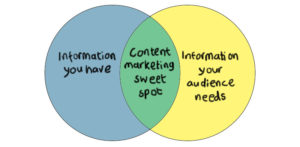
Getting to that level of usefulness and uniqueness is extremely hard, but if you can find your content “sweet spot” – the intersection of “information you have” and “information your audience needs” – it becomes easier to do.
Hallmark #3: Great writing
The third and final hallmark of a great ebook is the writing itself. Reading it should be an enjoyable, enlightening, and inspiring experience – not a slog.
If you write as if you’re having a great conversation with your reader, about a subject you both care about, you can’t go far wrong.
How to approach the ebook project
At Radix, we have a process for writing a great ebook, which all of our writers follow. If you’re a marketer who has to write content, this could be a good process for you too.
- Read the brief. If you’ve been given a written brief, read it thoroughly and note anything you’re unsure of. Then have a call with your client to clarify those points. It’s always better to clarify upfront than to second-guess what the client meant and have to rewrite your draft when it turns out to have been wrong.
- Do your research. Your ebook needs to be convincing, which means you’ll need to include stats, figures, and quotes that support your argument. You should also interview subject matter experts to add credibility – these are the people who have the ‘sweet spot’ information that will make the ebook genuinely relevant and useful to your reader. Gather all the supporting information you think you’ll use in the ebook, so you won’t have to break off to look things up after you start writing.
- Write an outline. This is an essential part of getting the ebook right. It’s a chance for your client and stakeholders to review what you propose to write and make any corrections or suggestions before you go too far down the route of writing it. A section-by-section structure with bullet points is ideal: think of it as a synopsis document, as if you were pitching your ebook to an editor or literary agent.
- Write the first draft. Much of the legwork has now been done, so you should find it relatively easy to write the first draft. A word of caution, though: as you write, don’t be tempted to stray from the outline; it’s been approved, and it’s what you’ve agreed to deliver. Save any new ideas for another piece of content down the line.
- Review your first draft. If your deadline allows, don’t send the draft off to the client as soon as you finish it. If possible, ask someone else to take a look (they can even use our content review checklist checklist). Alternatively, put it aside for a few hours – ideally overnight – and come back to it with fresh eyes. You’ll almost certainly spot things that could be phrased better, and these relatively minor tweaks can go a long way to strengthening your first draft. (And the stronger the first draft, the less rework you’ll have to do later.)
Now let’s look at the writing itself. How should you actually write your first draft?
Writing the introduction
The introduction is a crucial part of the ebook. It’ll make people decide whether to keep reading – which you want them to do, because there’ll almost certainly be a call-to-action (CTA) coming that you want them to reach.
So what should a great intro do?
- Create an immediate rapport with the reader. The intro is where you show you understand your reader’s world, their professional goals, and their personal aspirations. You’ll mirror the language they use, and set their expectations for the rest of the ebook. (Will it be fun to read, for example, or will it be matter-of-fact but brimming with useful information?)
- Frame the problem – and your ebook as the solution. Articulate the main issue your ebook addresses, and clearly show how the ebook will help the reader overcome it. Right out of the gate, you need to make your reader aware that you have something important to tell them about something they care about, and that this ebook will help them to tackle the issue to their advantage.
- Define who will get value from the ebook. Showing you know who your audience is – both professionally and psychographically – allows the reader to decide whether the ebook is for them before you’ve taken up too much of their time.
For example: “This ebook is for contact centre managers in consumer-facing organisations who want to improve customer retention rates and aren’t afraid to try radical new ways of working.”
You could even use reverse psychology (respectfully rather than in a snarky way) by defining who won’t get value from it, such as: “This ebook is not for people who shy away from radical new ways of working.”
- Make it clear what they’re going to learn. Every B2B decision-maker is busy – so they need to know your ebook is a worthwhile investment of their time. So use your intro to set out clearly what they’ll learn, and how they can use it to their advantage.
- (Optional:) Show the reader why they should listen to you. Generally, an ebook is not a hard-sell piece of content, so it’s not usually appropriate to go overboard with the sales pitch. But you do need to convince the reader your ebook has something credible and relevant to say. A brief statement about the client’s credentials in dealing with this topic can help to establish that authority and justify the reader’s time.
A good ebook introduction might go a bit like this, for example:
Introduction: The Problem with X
Your situation is like X today, and because of that, you’re not achieving Y. This ebook will show you how to escape X and achieve Y.
It’s for X type of person, working in X type of organisation, with aspirations to achieve Y and/or avoid being X.
Over the following xx sections, you will learn A, B, C, D, and E. You’ll be able to use this information to do Y.
Plus, it will be super fun. Let’s go!
[Optional box-out feature: This ebook distils our experience from helping 10,000 companies in this area to achieve Y over the last Z years. We hope you’ll find it useful.]
Writing the sections
You’ll already have structured the individual sections of your ebook in your outline, so now it’s just a case of fleshing them out. Here are a few pointers to help:
- Make your sections roughly the same structure and word count. This will give all the sections equal weight of authority and make the ebook feel satisfying and professional. It’ll also help the designers to lay out each page consistently.
- Stick to your word count. A typical ebook is around 2,000-2,500 words, which probably only gives you 300-350 words per section. Get the key points across crisply and succinctly.
- Pay attention to headlines and subheads. Make them enticing and appealing. You want your reader to enjoy reading the ebook and feel like they’re chatting with someone who’s interested in them and telling them valuable stuff.
- Think about how your copy will look on the page. What design elements will there be? Are there elements of your copy that would work better as a visual or graphic? If so, provide basic suggestions for a designer to create the image. (PRO TIP: To help with this, some ebook copywriters like to write the copy as it will eventually be laid out – in landscape format with text boxes and spaces for graphics.)
- Bring your copy to life. Reading lots of abstract, theoretical stuff can be boring. Show how the point you’re making works in the real world and directly impacts the reader. Did your subject matter expert use nice analogies or catchy phrases to explain the topic? If so, work these in.
- Back up your points with credible statistics and quotes. You’ll have gathered these in the research stage, so all you need to do now is drop them in (don’t forget to attribute them to their original source). Suggesting pull quotes and breakout stat boxes can also give your designer plenty to play with to make the finished book look interesting and engaging.
- Link to other content pieces. If you (or your client) have produced other content relevant to any of your sections, include a link to it. Even if the reader doesn’t make it to the CTA at the end, your ebook can still provide value.
- Include a key takeaway or recommendation at the end of each section. What’s the one thing you want the reader to remember about this section? Make it easy for them to remember it!
Writing the summary
This is where you sum up the key points of your ebook in the form of a handy list that will help your reader to achieve Y or avoid X (refer back to the intro at this point).
If you’ve included takeaways throughout the ebook, you can list them again here, so your reader has a summary of the key points to remember. And if your ebook is designed to be actionable, including a checklist can work well.
A nice touch is to include links to further resources – either the client’s own content or (if you want to be really helpful) industry-wide content that adds relevant and interesting new perspectives on the topic you’ve discussed.
And if you haven’t already set out the client’s credentials in the topic area, there’s another chance to do that here.
Writing the call to action
In B2B tech, sales cycles can be long – so your ebook likely plays a specific role in guiding the reader along their “buyer journey”. To do this, your CTA at the end should encourage the reader to take a sensible next step – whether that’s to read another piece of content, book a demo, or get in touch.
You can measure the ebook’s value by the number of people who follow this CTA, which means you need to make it as persuasive as possible. So don’t leave writing this until you’re exhausted and can’t wait to type the final full stop.
Instead, write the CTA early on – ideally in your outline – and make sure you assess it thoroughly when you come back to your draft with fresh eyes before you send it off.
…and that’s it!
There’s much more we could say about ebooks – but this getting started guide is already approaching ebook-style length.
If you’re looking for help creating a really great ebook, find out more about our services or get in touch – we’re always happy to help!
Note: this blog post was originally written by Radix’s founder, Fiona Campbell-Howes, in 2015. It has since been updated to keep up with evolving practices among our ebook clients, and changes to our writing process.











 It’s not just Hollywood that’s been finding uses for comic books in recent years. B2B brands have also been using comics, strips and books, to reach new and existing audiences.