
The B2B Content Audio Blog #13: how to run a B2B messaging workshop

Successful B2B marketing requires everyone pulling in the same direction: sales, marketing, product specialists… everyone.

Which is why you can’t properly market your brand unless there’s alignment around your key messaging.

We’re increasingly asked to run messaging workshops to help our clients nail down a core set of wording they can use across all their external communications, sales collateral, and training. And this audio blog explains how these messaging workshops work, and why they’re so valuable to the business as a whole.

Hit “play” now to learn:

  • Who you should invite to your workshop
  • What to do before, during and afterwards
  • The key components of a successful messaging framework

“Looks like we got ourselves a reader…”

If you’d prefer to read Fiona’s original blog post for yourself, here’s What happens in a B2B messaging workshop?

This is the end of this podcast season, so if you’d like to keep hearing from us, you’ll want Good Copy, Bad Copy: the B2B Copywriting Podcast. (The next episode drops next week, revealing the best B2B content of 2018.)

How to listen

You can download the episode here, or stream it in the player at the top of the page.

Alternatively, you could subscribe to us on iTunes, or use this RSS feed here. You can also find us on Spotify.

Get in touch

Want to hear a second season of this audio blog? Let us know. Email [email protected], tweet at us, or leave an iTunes review.

Credits

Audio editing: Bang and Smash

Theme tune: “Chinny Reckon” by the Nye Bevans

The B2B Content Audio Blog #12: 7 tips to help you write up a live event

Attending industry events can be fun and informative, but they’re not so much fun for the marketer whose time, budget and stress goes into making everything run smoothly. So it makes sense to get as much ROI as you can, by turning your hard work into written content too.

That means you’ll need a write-up. And unfortunately, years of scribing at client events have taught us that turning your speakers’ key takeaways into engaging content isn’t always as straightforward as it sounds.

In this audio blog episode, you’ll hear some of our top tips for producing post-event content, from how to the make the most of your time at the event to how to nail that first draft.

Tune in now to hear:

  • Common pitfalls, and how to avoid them
  • Why you should work out your angle before you begin
  • How food might be the key to successful content

“Looks like we got ourselves a reader…”

If you’d rather read than listen, here’s George’s original blog post: Attending a client event? Here’s how to write a kick-ass summary.

Or if you’d like to try another Radix podcast, there’s always Good Copy, Bad Copy: the B2B Copywriting Podcast.

How to listen

You can download the episode here, or stream it in the player at the top of the page.

Alternatively, you could subscribe to us on iTunes, or use this RSS feed here. You can also find us on Spotify.

Get in touch

Love this podcast? Hate it? Lonely? Email [email protected], tweet at us, or leave an iTunes review. We’d love to know whether you’d like another series.

Credits

Audio editing: Bang and Smash

Theme tune: “Chinny Reckon” by the Nye Bevans

The B2B Content Audio Blog #11: how to run a successful editorial board

Editorial boards are a great way for marketers to continually produce original, engaging ideas and deliver on a successful content marketing strategy. But, getting people together is just the first step.

For your editorial board to truly work its magic you need to follow some best practices, and this 8-minute audio blog will tell you what they are.

Tune in now to learn:

  • What and editorial board is – and why you should run one
  • 5 essential steps for editorial board success
  • How to structure your meetings for the best results

“Looks like we got ourselves a reader…”

If you’d rather read than listen, here’s Emily’s original blog post: Editorial boards in B2B content marketing: a beginners’ guide.

Or if you’d like to try another Radix podcast, there’s always Good Copy, Bad Copy: the B2B Copywriting Podcast.

How to listen

You can download the episode here, or stream the episode in the player at the top of the page.

Alternatively, you could subscribe to us on iTunes, or use this RSS feed here. Excitingly, you can also now find us on Spotify.

Get in touch

Got something to say?  Email [email protected], tweet at us, or leave an iTunes review. We have three episodes left, so we’d love to know what you thought of the series.

Credits

Audio editing: Bang and Smash

Theme tune: “Chinny Reckon” by the Nye Bevans

The B2B Content Audio Blog #10: five essential QA tests for B2B copywriting

Even the best writer can have an off day. So how do you ensure your content is consistently top-notch?

Unfortunately, there are no shortcuts—but there are some tricks of the trade. Here at Radix, we have a set of five quality control standards, which we use for our internal reviews.

Whether you’re reviewing someone’s copy, or about to publish some of your own, these five questions will let you know if your writing is good to go.

Listen now to learn:

  • The questions behind our Maslow-inspired pyramid of copywriting skills
  • How to spot simple, and not-so-simple, mistakes
  • How to pass the ‘so what’ test and the importance of being exceptional

“Looks like we got ourselves a reader…”

David’s original blog post includes a graphic of the skills hierarchy itself: Does your B2B tech copy pass these five tests?

Or if you’d like to try another Radix podcast, there’s always Good Copy, Bad Copy: the B2B Copywriting Podcast.

How to listen

You can download the episode here, or stream the episode in the player at the top of the page.

Alternatively, you could subscribe to us on iTunes, or use this RSS feed here. Excitingly, you can also now find us on Spotify.

Get in touch

Got something to say?  Email [email protected], tweet at us, or leave an iTunes review. We have three episodes left, so we’d love to know what you thought of the series.

Credits

Audio editing: Bang and Smash

Theme tune: “Chinny Reckon” by the Nye Bevans

Podcast 67: B2B content trends and analytics – which formats get the best results?

At any point in time, B2B content marketers have an almost infinite number of strategies, formats and tactics they can use to engage their audience.

But how do you know which will have the greatest impact? Do you need to adopt different approaches at different points in the funnel? And how do you even measure the real engagement of your content assets?

In our latest episode of Good Copy, Bad Copy, David and Fiona dig into the CMI and MarketingProfs B2B Content Marketing report. They look at the different content trends marketers are using and discuss why some types of content are performing better than others.

They also recap twitter conversations with MarketingProfs’ Ann Handley, and Lisa Murton Beets and Robert Rose from the Content Marketing Institute, about the report, and what’s really stopping marketers from producing their best work.

David also speaks with analytics consultant Jake Kimpton from specialist SEO agency 3WhiteHats. They discuss why bounce rate isn’t a great metric, how you can use Google Analytics to add goals and calculate real page value, and some advanced engagement tracking tips offered by Google Analytics expert Simo Ahava.

Also discussed in this month’s episode:

  • Will better data help B2B content marketers secure buy-in for better content?
  • Why do so few marketers use conversations with real customers to inform content?
  • Should you ever really consider bounce rate an accurate measure of performance?

We want to hear from you

We very much welcome any comments, questions and ideas on the podcast. You can send them via @radixcom on Twitter or [email protected] (you can even email us a voice memo, if you’re into that sort of thing).

Lots of ways to listen

There’s a big “play” button at the top of the page. But if you don’t fancy streaming, you have plenty of other options…

Have you heard our *other* podcast?

The pilot series of our B2B Content Audio Blog is nearing its climax. The idea is it’s a quick, weekly listen that’s easy to digest on a commute, or a run, or while you’re darning your socks.

Lately, we’ve talked about QA tests for B2B copywriting, a multipurpose blog structure you can steal, and a new way of looking at email subject lines. We’d love to know what you think.

Credits:

Podcast editing and music by Bang and Smash

Podcast 60: the lowdown on B2B messaging workshops

If your business has more than one person communicating externally, you’ll know it’s hard to keep messaging consistent across your sales and marketing, and make sure everyone always has the right personas in mind.

One way to solve this issue is a messaging workshop – and it can also sharpen your elevator pitch, and give you a matrix of powerful, multi-use copy blocks to boot.

In the newest episode of Good Copy, Bad Copy, George and Fiona dig deep into what these workshops are all about.

Listen now to find out:

  • Why consistent messaging is so important
  • Who should attend messaging workshops
  • What you really get out of a messaging workshop

(If you’d like a more detailed rundown of how a messaging workshop works, you’ll find Fiona’s in-depth blog post here.)

Also, copywriter Ben Philpott explains why he nominated Zoom’s “A Video Conference Call in Real Life” as our inaugural B2B Content Hall of Fame inductee.

Want to contact the show?

We want to hear from you. You’ll find us on Twitter… or feel free to send your thoughts, jokes, questions, suggestions, complaints or hat recommendations to [email protected] (better still, email us a voice memo).

Next month, we’ll be going shopping for essential copywriting kit, and inducting another member into our B2B Content Hall of Fame. 

How to listen…

You can download the episode here (right-click and “save-as” to download). Or stream the episode in the player at the top of the page.

(Or you can subscribe to the podcast on iTunes here. Alternatively, add our RSS to your preferred podcast player.)

Credits:

Audio editing and music by Bang and Smash.

Podcast 57: how to write up a B2B marketing event

Whether it’s a launch party, industry expo, or dinner gala, B2B marketing events happen every day. To get the greatest mileage out of all their hard work, a marketer will often want a copywriter there to capture the day in beautiful prose.

Sounds easy enough. But as a writer, it’s really easy to get this job horribly, horribly wrong.

In this episode of Good Copy, Bad Copy David, Fiona and I share our dos and don’ts for tackling client events, as well as our own personal event successes and horror stories.

Listen now to discover:

  • Why you should always record an event twice
  • How events can make you a much better writer
  • Why it’s essential to capture the ‘feel’ of an event
  • What every writer needs to know before they set off

…and if you want to read the event copywriting blog post I plug so subtly in the conversation, you’ll find that here.

How to listen

You can download the episode here (right-click and “save-as” to download). Or stream the episode in the player at the top of the page.

(Or you can subscribe to the podcast on iTunes here. Alternatively, add our RSS to your preferred podcast player.)

Credits

Intro and outro music by Industrial and Marine.

Podcast 99: Why we need emotion in B2B

This month’s episode of Good Copy, Bad Copy is all about bringing the emotion back into B2B content.

We’re joined by Paul Cash, CEO and Founder of Rooster Punk – and author of Humanizing B2B – for our feature interview. David and Paul talk about the human side of B2B copywriting, how the focus on the individual who is ultimately reading your content has been lost, and how and why we need to get it back.

B2B Marketing’s Propolis Hive Expert Barbara Stewart makes her co-hosting debut, chatting with David about Paul’s thoughts, and exploring them further from a sales perspective. They cover everything from a bizarre focus group on crisp varieties, to the huge and often overlooked benefit of testimonials.

And, of course, we have another superb copywriting tip for you. This time it’s from none other than last week’s co-host, George Reith, and he’s going to help you get that all-important variety into your writing.

You’ll find a full transcript of our podcast at the end of this post.

Why we should be striving to put the human back into B2B copywriting

Emotion has always been part of B2B marketing. However, as B2B and industrial marketing have moved further into the digital world – and away from in-person contact – emotion has faded into the background.

But selling products based entirely on features and benefits leaves a void where the emotional side once lived. And as B2B brands have become more and more focused on promoting a similar set of sales points, clients and customers are finding new ways to differentiate between them – and emotion is the biggest.

There is evidence to support the fact that clients and customers are increasingly giving weight to the brands that are showing up outside of their products. Brands that exist in a positive, meaningful, and authentic can connect with their clients and customers on an emotional level and create the best relationships.

So, how can you put this into action?

It’s all about inspiring a specific feeling, so establish what you want to convey, and identify the triggers you can use to evoke it. Paul Cash uses psychologist Robert Plutchik’s Wheel of Emotion, which breaks emotions down into emotional states and substates, as a planning tool when thinking about how to build that feeling-based connection.

Remember: you don’t want to talk about a feeling, but to create that feeling.

If you can be likeable as well as competent, you can gain an edge over your competition. By creating an emotional connection with your clients and customers, through taking creative risks with your marketing and setting yourself apart from other brands, you can inspire better engagement and loyalty.

In this episode, you’ll find…

00:40 – We welcome our co-host Barbara Stewart to Good Copy, Bad Copy

02:55 – Likeable, as well as competent: our interview with Paul Cash.

16:45 – Barbara and David discuss the interview, Barbara’s experiences with emotion in B2B, and how the buying journey has changed.

30:35 – Copywriting tip of the month: How to keep your writing varied.

Anything you loved in this episode? 

We’d love to hear your thoughts. Tweet us at @radixcom or pop us a message on [email protected]. Or, if you fancy your chances of appearing on the podcast, send a voice memo our way.

How to listen: 

Transcript: Good Copy Bad Copy 99: Why we need emotion in B2B

Speakers:

Paul (clip): We’re really cool. You can be cool too. Come and buy our product.

David: Hello listener and thank you for joining us for Episode 99 of Good Copy Bad Copy the B2B copywriting podcast. It’s so good to have you with us.

Barbara: This month we’re talking about using emotions in your B2B content. And Paul Cash will be telling us why it’s not enough for your B2B brand to be competent. It needs to be likeable too.

David: My name is David McGuire. I’m creative director at Radix Communications which is a B2B tech copywriting agency. And I really am delighted to be joined by a brand-new guest co-host for this episode. It’s B2B marketing’s Propolis Hive Expert for CX, which is easy for me to say. It’s Barbara Stewart. Barbara, welcome.

Barbara: Thanks, David. Thanks so much for having me. I’m very excited too. It’s a topic that’s very much at the heart of my passion. So, thank you.

David: Oh, no, thank you for coming in and agreeing to do it. So, you’re a Propolis Hive Expert, what’s one of them?

Barbara: I am indeed I lead the CX Hive. So, my role is very much to help. There’s approximately 100 currently, different B2B marketers that are in my hive, and they have a multitude of needs and advice and support. And I get to basically, every month, host events to help them understand frameworks, different methodologies, that they can be using such as CX metrics, or how to get buy-in from CEOs. And it’s very much focused on giving them practical advice or listening to each other and learning from each other. So, it’s a lot of fun.

David: How does it feel having to introduce yourself as an expert?

Barbara: I do not like it. I refer to myself as a practitioner. So, I do from strategy to deployment. So, the word expert it’s… yeah, it’s always unsettling. I like to avoid it.

David: They called me an expert. I didn’t say that.

Barbara: Yeah, I didn’t ask for it.

David: I believe you. Thousands wouldn’t.

So, could you please perform your first official duty as co-host? And tell the listener how they can get in touch with us?

Barbara: I certainly can. So, listener if you have any comments, questions, or suggestions, you can contact the show by email: [email protected] or on Twitter: @Radixcom. Apologies because in Northern Irish, the word Twitter is hard to hear in my accent.

Our guest this month has a lot to say about emotions in B2B marketing, doesn’t he?

David: Yeah, he absolutely does. Paul Cash from Rooster Punk. He’s the author of Humanizing B2B with a Z. And when I saw him speak at Ignite on the importance of likability for B2B brands, I just thought he’d be really ideal for this episode. So, I was delighted when he agreed to chat. And I started by asking him: Well, hasn’t emotion always been part of B2B? What’s changed now?

Paul: So, I don’t think it’s new for sure. But it’s always been on the fringes of B2B marketing – was, as you say, hiding in the background. I think it’s more of a question of how and where it appears, that has changed. So much of historical B2B or industrial marketing was heavily reliant on emotional selling. The good old-fashioned sales rep with his expensive cameras and his company car would win deals based on his ability to charm, win over, and schmooze the traditional B2B buyer. And B2B was a relationship game. And emotion was the primary technique to get a foot in the door and expand from there.

So, I think obviously, the internet SaaS business models, the shift away from sales, obviously trying to cut out costs from the process, the digital customer journey now being everything. Actually, the emotion has gone out of the process, and brands haven’t necessarily filled that void. Instead, they’re doing what they always do, which is sell product, lead on features and benefits, and expect everything to be rosy.

And that, to me, is where the opportunity is. And that’s where we’re seeing this kind of change, as far as I’m concerned.

David: So, what kind of emotional responses does marketing need to pick up with now, that sales would have provided, what kind of emotions do we need to key into?

Paul: Yeah, so I think generally speaking evidence exists to support the fact that brands that show up in a positive, meaningful, and authentic way are the most liked brands. Having a positive outlook, I think, is key. But I think desire, appeal, kudos, stature, confidence, control are all emotional states that B2B buyers and decision-makers are either consciously or subconsciously influenced by.

And on the flip of that, you’ve got fear, which is another powerful emotion that is prevalent in the buyer journey, specifically for B2B. So, you’ve got fear of missing out, the whole FOMO thing; you’ve got fear of being irrelevant as a brand, or even as a marketeer; you’ve got fear of making the wrong decision, you know, the whole loss aversion bias that Rory Sutherland talks about. So, my take is, it’s more about the feeling that I’m trying to induce in a prospect, rather than just an emotion, and I think feelings have a greater context, but they are both the same side of the queen.

So, for example, if the feeling I want to create is, how do I make a prospect feel 10 feet tall? What emotional triggers do I need to use to induce that feeling? And there’s a brilliant tool by a famous psychologist called Robert Plutchik. And he has this wheel of emotion. And on this wheel of emotion, you’ve got all the main eight states and all these sub emotions. And they’re actually just really good planning tools to think about how you build that emotional and feeling-based connection.

David: By what you’re saying, it’s definitely about invoking the feeling, rather than talking about the feeling, right? From the point of view of when we’re creating the content – we often talk about ‘show don’t tell’.

Paul: Yeah, it’s the subtlety of marketing. Obviously, we’re not in a market stall. We’re not just shouting out: Yeah, we’re really cool. You can be cool too. Come and buy our products. You’ve got to earn the right to talk about products, you’ve got to influence and persuade people. All the usual rules of B2C marketing that, we have this conversation about, are they applicable to B2B? etc.

There’s a lot of really good stuff that B2C have done in their journey that we’re absolutely leveraging, which are really powerful ways to do that: the power of word; video is a fairly new medium in the world of B2B. And so, for the first time ever, we’re able to convey emotion through the power of video or words and music and we’ve only just touched the surface as far as I’m concerned.

David: And so, with the book, the whole concept of humanizing B2B, humanizing with a Z listener, if you want to find the book.

Paul: Yeah, trying to capture the American market.

David: Quite right too. So, what does that actually look like in practice? What does a more human approach to B2B marketing or B2B content look like?

Paul: Yes, I think it’s important to say that when I talk about humanizing B2B, at its heart, I see it as a modern-day philosophy, that actually promotes the human side of marketing as much as the functional side. So, we’re not trying to take away all the good stuff that B2B is known for, we’re just trying to add something to it. And most B2B brands are built on this single dimension of what I call competency.

For example, you make a good product, you scale it, you use automation tools, you’re operationally savvy, you build demand engine, and so forth. And all this comes with the territory of being professional, talking in jargon, using the colour blue, being ordinary, looking like everybody else in your category looks. And hopefully, if you’ve got all that right, you can be the trusted advisor. And all that stuff is so cookie-cutter, playbook-driven, every brand in every category – most of the companies look and feel and talk the same way. And so, it’s definitely lost its edge.

And I think that when I talk about the dimension of likability, as well as the dimension of competency, and I don’t mean likeability as it relates to people, there’s lots of conversation and narrative about that. I’m talking about likability in the absence of people. So, as you mentioned, through your brand, your content, your emails, your website, and so forth, the language, the way you speak, the way you come across, all those things are incredibly important. And that is this digital likeability. And that, to me, is where the game is won or lost.

And with so many buyers whether they’re 60%, 70%, 80%, or 90%, through the buying cycle, before they speak to a sales rep or some form of expert. The opportunity, therefore, to influence people is absolutely huge. And most brands don’t do anything, they still do the tired old, same old stuff. They’re not thinking about how to influence people in that digital journey from an emotional point of view. And I think that’s why B2B is an incredibly exciting place to be right now.

David: So, if the listener is nodding away, thinking great I could definitely want to take a step into this territory with my brand with my content? What kind of tips could you give them, to make their content more emotional, or more human? What can they practically do? And how can they sell that to their stakeholders too?

Paul: I’d look, first of all, at what other B2B brands are doing, not necessarily in your category but generally, which are the brands out there that have taken a decision to try and put a bit more emotion into their brand.

I would also say that I think most B2B agencies are just aching to do more interesting, more creative, more imaginative stuff, you’ve got to take some calculated risks. We are marketeers at the end of the day, we have to balance the demand engine bit, with actually pushing our business and our brands forward. So there needs to be some calculated risk that goes with it all.

And we did a campaign for Sage Pay last year. And it was incredibly difficult to understand the way that the marketing team had been set up and the way they’d conventionally done things. And we had to really shift their mindset to take a very subtle, emotional approach with this campaign called your business, your baby, but seven months after the campaign ad ran, we literally doubled all the marketing KPIs that they’d done the previous year.

So, there’s proof that this stuff works from just a marketing KPI point of view. But again, we did a campaign for KPMG, where the ask of us as an agency was, how do we dial the emotion in our campaign, and we did this pretty big content piece, it was a £1 million investment that KPMG spent, but they saw a £58 million return of close business opportunity off the back of this changing features campaign.

So, if you need a reason to go tell your commercial stakeholders, why you want to experiment and push it – because the growth metrics, increased all the value, increase lifetime value, increase margins, and so forth, are there to be had for the people brave enough to go and make a decision to push on this door. And the book is full of examples of these facts and data points and everything else

David: You mentioned to look at people maybe in other parts of B2B that are doing it well and taking inspiration from them. Apart from the couple that you’ve mentioned, is there anyone else in the space that you see and go, yeah, they’re doing it well, you can take some inspiration there?

Paul: I will say that I’ve always looked at SAP. So, from an enterprise point of view, I think SAP have always done a really good job of being able to humanise what they do. They made a decision to use consumer tactics like employing Clive Owen as being almost like that character, an ambassador for their brand and being able to use him to narrate their story and build that familiarity and likability.

I know that Hewlett Packard have used Christian Slater, again with his wolf campaign. So again, very B2C tactics driven in B2B. But on a lower scale, we’ve worked with brands like Crowdcube, who I think have taken to this whole humanizing notion brilliantly well, and again have seen significant business results off the back of it.

But there’s a brilliant commercial on YouTube for a company called Waze which is using these inflatable signpost dolls that signpost things across America – and it’s just hilarious. It’s a brilliant piece of storytelling, it gets the message across in a really interesting, engaging way.

So, I think there’s loads of good stuff happening in different pockets. And I guess you’re just trying to make it more mainstream. I think that’s the journey we’re on, as B2B marketeers is just for this not to be on the fringes anymore, but to be more mainstream, and the more we see, the more we experiment, the more data points say this stuff works, the more it’ll happen.

David: So why do you think this is so relevant right now, it certainly seems like it’s having a moment. Why do you think it is?

Paul: So, you’re absolutely right, David. It is having a moment. I think B2B marketing in its modern form is on an incredible learning curve. We are 50 years behind B2C in terms of leveraging emotion and positioning brands beyond the functional nature of what they do. But the good news is, we’re catching up fast. Emotion is catching people’s attention it feels like there’s a bit of a perfect storm of opportunity, which is brewing.

And I say that because I think, customers are less loyal than ever. The pandemic has meant people are more open-minded to exploring different vendors, etc. I think marketers are fed up with doing same old, same old, that speeds or feeds marketing, so they’re crying out for some kind of change. They’re also fed up with chasing technology or product differentiators as strategy when it’s easier sometimes to differentiate emotionally.

I think grabbing keeping people’s attention is harder than it has ever been. And we talk about storytelling being something new. But storytellers have got to compete with storytellers these days. It’s incredibly difficult. It’s not just about telling a story; you’ve got to tell a bloody good story.

I think business buyers and decision-makers have generally become a bit more compassionate. I think we’ve seen the millennial buyer. And definitely, as we see senior buyers eek past the age of 40, we tend to be more value-driven less about ourselves more conscious about the planet, and family and life and all those kinds of things like that.

And, finally alongside the fact that COVID is jolted people’s thinking, and this fear of being irrelevant in a post-pandemic world is actually scaring people into wanting to look at their brand and do things differently. We’ve also got all this amazing research from Binet and Field and the B2B LinkedIn institute that actually put in some numbers and metrics down. So, I think if you put all that stuff into the mixer, it feels like there’s real momentum, and that moment is happening.

David: If the listener wants to find out more, they want to get in touch with you and ask you stuff, they want to buy the book. Where can they do things like that?

Paul: So, the book is available on Amazon and all good bookstores. I can’t get enough of saying that – it’s my thing.

David: It really is, like you’re actually in shops.

Paul: Exactly. And if £16 is too much, you can get the Kindle version for a bargain busting 99p. You can track me down on LinkedIn, you can go to the agency website, which is roosterpunk.com. There is a specific HumanizingB2B.com website. And if you’re waiting for the audiobook, because I’m a big audio fan, that’s probably another nine months away I’m afraid. Or connect with me on LinkedIn, there’s loads of places to find me.

David: Thank you, Paul, you’ve given us a lot to think about there. And the book plug was expertly done, I must say, we’ll include a link to it in the show notes for you.

Barbara, I know you’re a big advocate of using emotions in B2B. So, what stood out there for you?

Barbara: I think, for me, listening to Paul, it really resonated. Very often when we’re communicating with our B2B potential customers or customers, we tend to see a job title and see that first and foremost, and actually, we’re all just human beings, we all have needs, we don’t differentiate ourselves, we don’t take off one cap and put on another at different moments. So, we are irrational, we are emotional people. Even people in procurement, that’s what they are. They’re emotional. We might not always think that, but they are.

And I think the reality is, we very much have to work out what type of mission that they’re on, how we can support them, and what is the way they want to be supported? Or do they want encouragement to do they want support and understanding that will help us understand how we are best partnering with them.

With B2B and digital, it’s got so complex, we’ve got so many buzzwords now. And I think for a lot of people, they’re still clinging to the past. And digital’s scary, they have this fear that digital stops the relationships that were so valuable. They think that sales reps are going to be eradicated because of automation and digital channels. Sales Reps will always be needed, they are incredibly valuable.

You basically need to focus on crafting the messaging that you can automate in the moments that should be service messaging, and let the sales reps, that the salespeople who are incredibly good at developing relationships, be in those moments that really matter. Driving deeper relationships and understanding how to add value to the customer. For me, that’s the opportunity for B2B marketing. And that was the overriding message the whole way. Listening to Paul, it was like, yes, finally, I’m hearing the magic words.

David: Absolutely. So, do you think the buying journey in B2B has been changing quite a bit? I know people have been saying, for a long time, people are doing more and more and more of their research before they engage with a salesperson.

And I guess COVID has probably kicked that percentage even higher because you can’t go out to events and meet people. So, although, of course, a lot of the time people will buy a product, because they like the salesperson and the salesperson recommended it and that’s the end of it. But do you think there’s an extent to which content is taking over some of the lifting as far as that rapport building, or not so much.

Barbara: I think content has such an important role. I think what content allows us to do is start having a conversation earlier. And start really making sure that what we have to offer and what solutions we can provide our customers with, they’re able to do some of the research beforehand. There is nothing worse than when you’re at the start of a potential journey when you’re doing the awareness and consideration and suddenly someone is telling you the solution when you haven’t worked out what the problem is.

For me content is the opportunity for whenever I’m being a B2B buyer, I’m having to work out exactly what I need, not what someone’s telling me I need and what someone’s gadgets and gizmos and features are telling me but what is the best resolution. And for me, I always go to referrals, I always go and ask people who I know have had a similar problem, or I get into Google fast, and I want to read articles, I want to read the features and functionality. And I want to read people’s blogs and understand how they’re helping customers just like me to solve problems.

So, for me, it’s giving me my automation process, I’m unwilling to speak to a salesperson at that moment. I don’t want to have a demo. I want to just do the research. When I’m ready, and I’m shortlisted, then I want to have a demo, but don’t try and sell to me before I’m ready and content is perfect for doing the pre-sale.

David: And that shortlisting process? Is it fair to say that’s maybe, in B2B, a bit less rational than people give it credit for, a lot of that’s down to how you feel about the company? Right? How you feel about the brand?

Barbara: Absolutely. I think a lot of times we forget how much brand purpose actually plays in in all of this, and especially in B2B. Brand purpose is very, very important in CX and in marketing. And the reality is, sometimes you have a gut feeling about a brand, or a product, or a service and it’s not rational. But that gut feeling is dictating and it’s not price led, it’s not, I have made some decisions where I was like, I really don’t know why I made that decision – but it felt right at the time. And these are not small decisions. And these are B2B purchases on a grand scale.

So, for me, we have to understand that people, when they are coming to consider your solution for what they need, they don’t always understand it. So don’t go and do lots of focus groups. And don’t spend lots of time asking people why they do things and then replicating content for that. What you need to do is understand what’s the job to be done? What are the products and features that they really need to not what you want to sell? And help them understand how your solution solves their problem via testimonials. To me, I don’t understand why everybody runs away from testimonials. I’m like, get them out there. let everybody see how you solve that.

David: Yeah, absolutely. Because a lot of it is testimonials, you’ve got the social proof. It’s a lot about helping people to feel comfortable and to feel safe a lot of the time in B2B. You’re a big fan of behavioural economics. I know. And you gave a really good webinar with Steve Kemish on Propolis. And that plays into that, doesn’t it? The different ways that people make decisions, and whether you make a slow decision or whether you make a snap decision. And actually, a lot of the time in B2B, we might assume it’s one. But really, it’s, it’s the other, right?

Barbara: Absolutely. It’s so easy to get stuck in making assumptions about how people purchase your products. And I think that is so true in B2B, it’s even true in B2C let’s be honest. We dictate we create these journeys and say this is how someone exactly behaves, and it’s not. There are so many intricacies for how we behave. What people forget very frequently, which I love, is as soon as you purchase something there’s social permissibility – you are now at risk of making the wrong decision.

So, you are actually naturally trying to do a natural referral programme with anybody else that you can because the more people that you can sell this exact same product to – it means you were right. So, we actually are at our highest advocacy and referral as soon as you handed money over not once you’ve got the product. You’re actually in a risk pattern, and you want to take that risk away from you, so you want to diversify that risk, which nobody uses referral straightaway.

David: Yeah, and because I suppose the features and benefits, they have their role to play, but again it’s almost post-rationalisation, right? There’s always this thing that the heart is the Oval Office, and the head is the Press Office. And it’s like, you’ve made your mind up and then you have to justify the decision that you’ve already made – to yourself, or to your buying unit, and to the rest of your organisation in B2B.

And I think it probably has a lot more in common with – oh, I bought this more expensive car because they’re more reliable, that’s a better-known brand or something like that – rather than just, I wanted one. But I think a lot of the time it’s the same thing in B2B, it’s in Thinking Fast and Slow, right? It’s type one and type two decision making, is that right?

Barbara: Absolutely. A lot of people, we don’t know why we think certain things. Now, there aren’t many decisions that are absolutely set in stone, especially when it comes to purchases that you will not change. These are big decisions that impact who you are at your absolute core. The rest, you’re actually making up why you’ve done a lot of it.

I’ve spent a lot of time doing focus groups, which I find highly entertaining. And I remember a very long time ago, doing one for Aldi, understanding new crisp variants, and I literally sat in a room, listening to people post-rationalise why they buy crisps. And I was just like, this is crazy, you walk down an aisle, right? Like, come on, there wasn’t that much to this. And I think from that moment on, I was like, we as human beings don’t always know why we make decisions, a lot of our decisions can be flipped incredibly fast.

And we can do a huge amount of research; we can absolutely be believing that we have the right solution. And then suddenly, either someone can influence us, or somebody can just land with an incredibly simple, valuable value proposition in the last moments, and convert us at rapid pace. And I think everybody’s experienced that – where suddenly you’re almost at the purchasing, and you put something down and lift something up really fast. And then what? And that’s it. That’s it on this tiny little scale, where it’s just the: Oh, there I go.

And I think a lot of times, it’s everybody, with behavioural economics. I’m really interested in the fact that, behavioural economics and CX are fascinating because everybody’s trying to manage and own the whole journey. Let’s plot out the whole journey. Let’s own all these key moments of truth. And I don’t worry about all the key moments, there’s actually probably two or three that are actually the key moments work out what they are, and be in those moments, spend your money where your competitors spreading themselves too thin. And you can hijack the brain and get it to be you as the last decision, because it’s usually the first and the last that are the pieces, all the stuff in between – you can change your mind incredibly rationally.

David: So, in a B2B buying process, what would that look like?

Barbara: Oh, now you’re asking me that the big questions, I think it’s making sure a lot of times when we create content for websites and looking at the sales reps, and the onboarding stage as well, we ensure we spend so much time in that top of funnel. But as we’re coming down, we get lesser and lesser content and less pointed, less sticky. We’ll just start throwing blogs in, we may do a white paper, but actually it’s that bottom funnel. That’s the real key.

Spend your time thinking about: What content do they need in the tiniest of bite sizes? And what are the messages that they need at that final moment? What can you tell them that’s better about the services or the products or what’s going to solve their problems more in those moments? Because that’s the key magic, that absolute top awareness. And for me, bottom funnel, getting those exactly right, focused on what their actual needs are, what their expectations are, show them in those moments how easy the onboarding is because that’s usually the biggest fear. Whoever’s buying, it is nervous that whoever is going to use it isn’t going to use it.

So, show from testimonials from users not from buyers, at that moment show how easy it is. Tell them that the onboarding was automated, and it only took X amount of time, and it saved X amount of money. And then show someone who actually went through the onboarding. I think very often we keep talking about ourselves, instead of showing our customers people just like them, and why they made those decisions.

Before we finish this month’s episode, it’s time for our copywriting tip of the month. This time, it’s from Radix, consultant writer, and last month’s guest co-host, George Reith.

George: My name’s George, I’m a senior copywriter and consultant at Radix. And my favourite copywriting tip is to keep a running record of phrases that you use a lot in your copy. Whether you choose to do that on a piece of paper, digitally, or on lots of post-it notes stuck to your monitor and desk, I find having that list of phrases you use a lot means you can avoid using them too much. I find that helps me keep my copy a bit more varied.

David: Thanks, George. If there’s anybody that I would take advice from on how not to be boring, it’s you. Barbara, does that one resonates with you?

Barbara: Honestly, I love that. I’m going to start doing it and actually understand what my buzzwords are. Because I’m sure my clients are going mad with the number of times I say, certain words that I’m not aware of. So, thank you very much, George, I’m going to let you know how I get on.

David: I want to know what’s on your list.

Barbara: I’m scared, I’m scared.

David: I’m afraid that is about all we have time for this month. Now, listener, it might not have escaped your attention. That next time is our 100th episode. And I have to tell you, it is going to be all change.

We have a slightly new format coming, a shorter running time and a new name for the podcast. So, look out for that. We will still have great guests. We’re starting with Doug Kessler next time. And we’ll keep the same focus on helping you get the most out of your B2B content.

So, if you’re a subscriber and you see a new B2B content podcast appear in September, don’t worry. It’s just us, just a new name and a new theme tune. I really can’t wait for you to hear it. Before then, though. Barbara, could you thank our contributors for this episode and also remind the listener where they can get in touch.

Barbara: Of course, thanks again to Paul Cash for helping us put the human back into B2B. And thanks, George for that wonderful copywriting tip. But most importantly, thank you, the listener for joining us, it’s been a lot of fun. And don’t forget, if you’d like to contact the show, you can do that on email: [email protected] or on Twitter: @Radixcom. And if you’re listening on Apple Podcasts, a review would be marvellous.

David: And thank you Barbara for co-hosting. I do hope you’ve enjoyed it. Has it been alright?

Barbara: It’s been wonderful. So much fun.

David: That’s kind of you. Listener, we’ll see you next time with a fresh new format, new name, and Doug Kessler. But until then, remember, science has discovered 27 distinct human emotions, but nobody has ever experienced the desire to enable website notifications.

David and Barbara: Bye.

Acknowledgements and thanks

  • Firstly, a huge Radix thank you to Barbara Stewart. It was wonderful to have you as our co-host for the first time – hopefully, it won’t be the last.
  • Thanks also to Paul Cash, for reminding us about the human side of B2B copy in that fantastic interview. And, of course, showing us all how it’s done with that smooth book plug.
  • And George, thank you for that brilliant copywriting tip of the month.

And for the eagle ‘eared’ listener…

Yes, this was Episode 99 of Good Copy, Bad Copy, which can only mean one thing. Next month we are celebrating our 100th episode! And we’re celebrating in style – with a slightly new format, a shorter running time, and a new name.

So, watch out for that next month, and when you subscribe and see that brand new B2B content podcast appear in September, know that it’s still us – and get ready to hear our exciting new sound.

Podcast editing and music by Bang and Smash

B2BQ&A 105: How do you evaluate B2B content quality?

This month’s question comes from Caroline Robinson who, among many other roles, is the senior editor of the British Cartographic Society’s popular magazine, Maplines.

She wants to know: “What QA/QC processes do other people have for editing content?”

It’s a fantastic question. At Radix, we use a version of this 16-point copywriting quality checklist when editing each other’s work, but we were also super curious to find out what processes others use to ensure the quality of their B2B content.

So we spoke to Laurence Taphouse, Director of Digital Marketing and Content Strategy at Deltek‘s EMEA & APAC Demand Centre, to find out how she ensures consistent quality across so many writers, subjects, and territories.

We also called on the members and experts of B2B Marketing’s Propolis Hive for Brand and Content Strategy and got a detailed response from Scott Stockwell, Propolis Hive Ambassador for Strategy and Evolution. You can hear Scott’s process in full, later in the episode.

This week, our co-host is the luminous Katy Eddy, a Senior Copywriter here at Radix and editor extraordinaire. She recently gave an editing masterclass at a local university, and shares some of her approach.

And we have two excellent copywriting tips this month. Giles Edwards tells us how to keep our content succinct, and we hear the first of a series of tips on creating inclusive copy from language consultant Ettie Bailey-King.

You’ll find a full transcript of our podcast at the end of this post.

Laurence’s top tips for consistent quality

First, Laurence tells us how she achieves consistently high quality across Deltek’s varied content.

A consistent editor

“You need to have a consistent editor; I think it’s crucial,” Laurence explains. “For us, it’s our product marketing team. So when we do editing, it will be me; you always add a constant.”

Include someone with industry acumen

“You need a person who’s got all the industry acumen,” she adds. “Someone who understands their role in the industry, who can make sure the messaging is resonating the way it should be.”

Check – and check again

“Once all that is done, a second pair of eyes can check this is all good,” she concludes. “And then we go back to me for proofreading, making sure there’s no grammatical mistakes or anything like that. Once that is done, we all agree that the content is good to go. And we always follow the same process.”

Scott’s advice from a tech giant

Next, Scott gives us a sneak peak into the content quality process at a bona fide tech giant. And, like Laurence, he reveals that quality control starts much, much earlier than the final edit.

“Assets go through agency production, and then face a rigorous ‘go live’ test before they’re launched,” he tells us. “The ‘go live’ alone has 12 elements that are checked before an asset is signed off, including the brand guidelines, legal requirements, and SEO optimisation, among others.

“Much of this happens within a standard set of tools and apps that all the content team share along with supporting workflows. The squad of marketers working on the campaign… will all have an input into the content being made for the campaign and how it will be deployed. So that quick quality check is a final glimpse at a far more detailed journey that each asset has taken to get there.”

Radix’s Quality Assurance Checklist

At Radix, our content quality checklist consists of 16 questions. We check for accuracy, clarity, authority, empathy, and wizardry to make sure our content is as complete – and as appropriate for its intended audience – as possible.

If you’d like to adapt it for your own purposes, or even steal it wholesale, feel free:
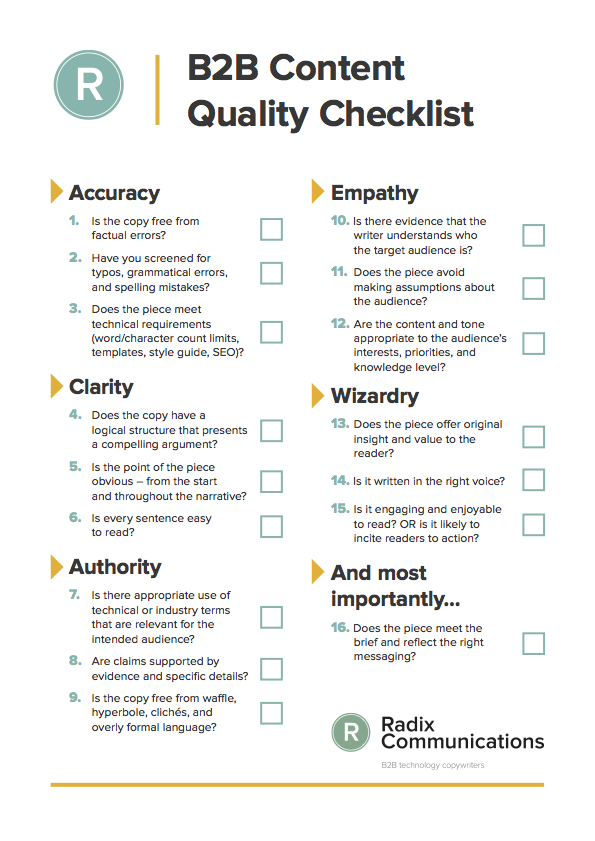
Steal this 16-point quality checklist when editing your B2B content. Click this image to download a printable PDF.

(Click the image to open a printable PDF)

In this episode, you’ll find…

1:10 – We welcome this week’s co-host, Katy Eddy

1:55 – Our first copywriting tip from Giles Edwards on how to keep content succinct

2:10 – We put Caroline Robinson’s question to Laurence Taphouse

15:20 – David shares Scott Stockwell’s thoughts about how to keep quality in your content

17:35 – David and Katy discuss her three-stage content editing process

25:47 – We hear copywriting tips from Ettie Bailey-King about how to keep content inclusive


We want to hear from you…

Have you got a question for B2BQ&A? Or a copywriting tip you’d like to share?

You could be featured on our next podcast. Send us a voice memo at [email protected]. And if there are any other thoughts you’d like to share, you can find us on Twitter @radixcom.

How to listen: 

Credits

  • Firstly, thank you to Katy Eddy for your excellent insight and co-hosting skills.
  • Thanks to Caroline Robinson for your question. It was really interesting to explore.
  • And thank you to Laurence Taphouse for the insights into Deltek’s quality process.
  • Thanks to Scott Stockwell for your brilliant contribution, too.
  • And last but absolutely not least, thanks to Giles Edwards and Ettie Bailey-King for your brilliant copywriting tips.

Podcast editing and music by Bang and Smash.

Transcript: B2BQ&A 105: How do you evaluate B2B content quality?

Caroline Robinson: I would like to know what QA/QC processes other people have for editing content.

Katy Eddy: That’s a great question. Let’s ask Laurence Taphouse from Deltek.

David McGuire: Hello listener, you are extremely welcome to B2BQ&A, the podcast where we go in search of an answer to your question about B2B content writing. This is episode 105.

Katy: In a moment, we’ll ask Laurence Taphouse, Deltek’s Director of Digital Marketing and Content Strategy for EMEA and APAC, how she manages content quality, and get copywriting tips from Giles Edwards and Ettie Bailey-King. Plus, we’ll have news of a helpful new resource you can use to check your own B2B content quality. That’s a lot of stuff.

David: That is, it’s a lot, isn’t it? It’s a packed episode, I know. Before all of that, though, some introductions. My name is David McGuire. I’m Creative Director at Radix Communications, the B2B copywriting agency. And this month, our guest co-host is a familiar voice. It’s Radix Senior Copywriter, Katy Eddy. Katy, welcome back.

Katy: Thank you very much. It is good to be back.

David: It’s good to have you here. Before we go ahead and answer this month’s question, would you mind telling the listener how they can get in touch with us?

Katy: Yeah, of course. Listener, if you have any comments or suggestions you can find Radix on LinkedIn or Twitter @radixcom. Or if you want us to answer your question on a future episode, record a quick voice note and send it by email to [email protected].

David: That’s marvellous. Thank you very much.

Giles Edwards: Hello, this is Giles from …Gasp! My tip is: trim the fat. If you can take a word out and nothing is lost, you should.

Katy: Thanks, Giles, for that tip. Now it’s time to hear this month’s question. Who do we have?

Caroline: Hello, Radix Podcast. I’m Caroline Robinson, Marketing and Business Development Manager for Compusult Europe. I am also Senior Editor of Maplines, the membership magazine for the British Cartographic Society. I write and edit in different styles for my work. I would like to know what QA/QC processes other people have editing content. Love the podcast by the way.

David: Thanks, Caroline. That’s a great question. Content quality control is something we’re asked about a lot. And in a minute, Katy will explain how we approach editing here at Radix. First, I put your question to Laurence Taphouse, who’s Director of Digital Marketing and Content Strategy for EMEA and APAC at the global software company, Deltek. Laurence leads on content and digital strategy and works with stakeholders and writers around the globe. So I asked her what processes do you have to ensure that your content meets a high standard.

Laurence Taphouse: The process really starts with our marketing plan, when we decide to put in place a marketing plan to drive demand for some of our products. My role is to really do a content gap analysis. From this content gap analysis, I then decide with different stakeholders what type of content are needed. The type of content that are needed can be different formats to fit some of the digital tactics that we are using to drive demand. And based on that we do a content plan. So the content plan is very much around: “what do I want this content to achieve? Who do I want to read it? What do I want readers to think, feel, or do afterwards?” So if there’s any, you know, call to action? And then once I got all those answers lined up, is “what should this piece look like, really? When is the best time to publish it? What’s the best source of material? What’s the call to action? And then maybe where will the content be published?

Once I’ve got that it’s all started with a creative brief and a content brief and either we use, you know, writers in house or if we use third party writers, the content brief is the key for whomever is going to write the content, understand, you know, the audience to which the content will be targeted to. So normally in the brief you’ll have a synopsis, some key messages, the deadline on when we want the content to be created, the target audience, some of the source materials. Sometimes when we create these brief we also do a call with the writer to make sure that we go through all the detail and source material. So we give the opportunity to the writers to ask questions, and make sure that everyone is on the same page. So once we’ve done that, we are being really clear on the deadlines, any iteration will be done as well for that type of content. Because content is quite subjective. Some people might like it, some people might not like it, depending on the tone, and within the brief, you know, that’s where the standards come into play, to make sure that, you know, you don’t end up having 10 or 15 iterations, just based on the personal opinion, though, which is more… it needs to be around when, you know, you review the content around, “okay, this is for that, the format is that, the best practice is that, and the standard of the company is tone of voice should be that way, the way we address ourselves to the audience should be that way.” So once you’ve got all of that, then you can create this not rigid, but a little bit rigid deadline, where you say, “okay, and say three iteration would be the maximum that will be good for you”.

Then you need to have a consistent editor, I think is crucial. For us it’s our product marketing team. So when you do the editing it will be me. And then I will use some of my peers as well  so I have, you know, other pairs of eyes as well on the content because it’s always great. But you always have a constant, you know, consistent editor, person with … generally a person who’s got all the industry acumen. So they understand their industry, they understand their work so that they make sure that the messaging is resonating, the way it should be resonating.

Once that is done, the second pair of eyes is there to double-check this is all good. And then we go back to me for proofreading, making sure that there’s no, you know, grammatical mistakes or anything like that.

Once that is done, that’s when we, you know, we decide that we’re all in agreement that this is all good. And we follow, you know, always the same process, the briefing, once the briefing is done, the deadline once the deadline is done… We don’t let writers just write right away, we usually ask for an outline. So the writer being an internal writer, or third party writer, we make sure that whatever is in his mind of how he’s going to structure the content. So it could be a blog, or could be a white paper, what is it he’s going to write in each of the different parts – we agreed on this outline. So we know that when he start writing, it should be pretty much what we asked him or her to do, you know, he’s not far off, he’s not going on a tangent, where we’re like, “oh, actually, we didn’t want you to really focus on that part”.

And then once we do all this editing that I was telling you about, and this proofreading and this peer review, where we have multiple pair of eyes, that’s when we go into market. And what we also like to do is to take time and reflect once things are in motion in markets. So how this is engaging? Is it engaging the right way? Could we tweak some of the promotional copy that we are creating?

So it’s not just once it’s launched is gone. There is a constant optimisation of the content. We have standards as well, when it comes to publishing online. It is important that we think about search engine optimisation. So it should not be, you know, the main focus when you write, you don’t want to just use keywords, you know, in the wrong way. It is important when you promote, for example, a blog, you know, to think about your title, to be engaging in your subtitle, you need to detail the backend, your backlinks, you know, if you are talking and referring to other research or content on the web to link that through your blog. So there’s a big best practice that we follow for different type of format content.

David: That sounds really comprehensive. That’s great. Thank you. Obviously, kind of, you work across lots of different geographies, lots of different kinds of locations and kinds of writers and that kind of thing. How easy is it to apply a consistent set of standards across different formats, subjects, locations?

Laurence: Yeah, that’s a really good question. So we normally got standards from our digital team, our corporate team, so you will have standard that you follow. So that process that I just explained to you is a process that everyone will do across the globe. However, there’s something there is very important when you talk to different markets when different languages. This is something that in our email and admin centre is crucial is one. When you write content in English, and you know that this content is going to be translated, you need to make sure that you don’t play with words. Often we like to play with word and we feel like they’re more engaging, if we make a touch of humour or make the title a bit punchier in English. That’s great, but it’s not always translates really well when you wanted to, you know, target another market. Also, you know, the content that we are creating is very thought leadership, is not so much product heavy. So it is quite easily transferable, I would say for other markets, but you always need to have a think of who is the target audience, if the target audience is the same, but the market is less mature, you need to make sure they you know, you got that point across. So, it depends on the type of content, I think content that is very high level, for a specific persona, should be able to work and follow the right standard and the right process that I just explained across the globe, really. If there is something that is more specific, you know, I’m thinking sometimes when we do a piece of content around survey research, or based on dates and key points, it needs to be, you know, obviously updated and to resonate with the other markets. But obviously, the standard of the best practice to make sure that the content looks good, should be able to easily be applied across the globe. Because the importance of knowing what’s good look like, is crucial. Because if not, you will never really make the decision to go into market. Because some people might have another opinion of what good looks like. And you’ve got a different line of businesses, which are hot, because you’ve got the content and marketers who think marketing content, and what marketing good content look like. And you’ve got maybe someone who is more an expert in the product, or maybe an expert in, you know, an engineer in the product, where he feels that they need to talk about something more technical, is actually what good content will be.

David: So when you’re trying to apply those standards, and agree what good looks like, between the marketing team and stakeholders in product or sales or, or wherever, how does that work? How do you reach agreement on what the standards are and what good is?

Laurence: So we do something called RACI. So when we do every piece of content that we do, and that we create, if we need to involve multiple stakeholders, they need to understand their role within the creation of that content. So RACI will be you know, the, are you responsible, are you accountable? Are you going to be just a consultant? Or is it just informative that we’re going to provide you this content? Based on the RACI, we’ll set the standard and the process on the brief. So that’s always on the brief. So the first step, and when we agree on that brief, then people understand what good looks like and what we are aiming for and what the objective is. If you miss that brief, and the brief is not clear, that’s when it gets really hard for everyone to be on the same page on what good look like for specific content or specific campaign.

David: Laurence, that’s brilliant, that’s absolutely everything that we needed from my point of view. Is there anything when you were kind of thinking about the questions and what you prepared, is there anything that I haven’t asked you about, that you feel is important in this?

Laurence: I think often people think that content is, you know, you need to be very creative, you need to be someone who likes to read. And it’s true, when you are content, you need to really like the wording and all of that. But I think when you write marketing content, you need to have also this view of not only writing what you like to write about, but always thinking about the customer, and what they’re going to want to write. So following the process, it looks like really heavy, but once you do it for longer and longer and longer. Yes, it seems completely obvious is like, you know, it’s like if you were going into market without having a marketing plan in place or without having a budget in place. If you don’t have this process in place, then, you know, everything would fall apart. So I would just suggest to everyone who wants to do content, to also have a good eye on you know, digital tactics and format. Content is the oil of the machine of demand. So you need to think about where this content going to go before you start writing. I think it’s crucial.

David: Thanks, Laurence for giving us such a detailed answer to Caroline’s question. We really appreciate your time. Katy, before we hear your approach to editing, I’d like to share a bit of further information on this. I asked the members and experts of B2B Marketing’s Propolis Hive for Brand and Content Strategy, how they approach content QC. And I got quite a detailed response from Scott Stockwell. And I thought it showed some real similarities with Laurence’s answer. Scott says the following:

This feels like one of those, it’s taken me five years to do this in five minutes. If you’re just considering content, that’s something that’s coming off a content production line, then quality assurance could be seen as the quality controller equivalent. A quick look from a trained eye at the finished products, able to spot what passes muster, and what needs to be rejected. As editor-in-chief for EMEA, that’s part of my role: to examine finished assets. But like the tip of the iceberg that doesn’t show all the work that went into designing and fabricating that product, and sourcing the ingredients before any components even set out on their path to becoming a product. Where I work, we have a three by three model, three briefs, three sessions, three outcomes. We have an input brief that researches the market, the customers, the personas within the customers, the local conditions, et cetera. That moves into a content strategy that looks at the high-level customer journey and the touches along the way. The concept brief comes next, and looks at the creative landscape and options for testing at the campaign level. A SWOT analysis examines the creative testing results and implications. And a greenlight meeting looks at what it will take for all the assets in the journey to deliver on the vision for the campaign. A content plan takes the defined campaign deliverables, and looks at all the components needed to create them, which are detailed in an asset brief for each asset. The assets go through agency production, and then face a rigorous ‘go live’ test before they’re launched. The ‘go live’ alone has 12 elements that are checked before an asset is signed off, including the brand guidelines, legal requirements, and SEO optimization among others. Much of this happens within a standard set of tools and apps that all of the content team share along with supporting workflows. The squad of marketers working on the campaign, across discipline and involved throughout and will all have a good view of and input into the content being made for the campaign and how it will be deployed. So that quick quality check is a final glimpse of a far more detailed journey that each asset has taken to get there.

So Katy, now you have insight into content quality control at two tech giants. And to me, it’s striking just how much work goes into getting things right before that final review. Did anything else stand out for you?

Katy: I think firstly, it makes me glad that we’re just the copywriters. The amount of work that goes in, you know, to prep a brief before it reaches us, and everything that happens to it after we’re done with it. That sounds exhausting. It’s really interesting to have that, that little bit of insight into where our little bit of writing and editing that we do slots into a much bigger thing. And it’s yeah, it is a big responsibility to take on, like a little bit of editing journey.

David: Yeah, ‘cause I mean, our review process, I mean, we have a checklist. But that really is, it’s more at the end of that final check – right? – of all the kind of elements that are already in the brief to make sure that everything lines up.

Katy: Yeah, everything we do is as much in line with the brief as we can possibly get it. And the other thing that I thought was really interesting that Laurence picked up on was talking about how you adjust things for different locations and different markets. I’ve been doing a lot of that recently. And it’s a difficult challenge because unless you’re going and you’re talking to every individual person in that market, you don’t necessarily get a full picture of how they like to talk about things and things that you shouldn’t mention for their markets and things like that.

So recently, I did a big project for five regions. And we set up a massive spreadsheet that had all our main talking points in it for UK. And we handed it to the teams in each of the regions and we’re like, what do you need to change? What don’t you want from us because it can be really tiny accuracy, things like stuff that’s hosted in Microsoft Azure here might be in a different cloud provider in Sweden, something like that. But then there’s loads of really tiny things. Kinda like we don’t like… humour. Like, don’t give us puns, don’t come near us with a pun, which you know, you’re pretty safe with me. I’m not a great fan of puns. But yeah, just those little things that I’m so used to editing for stuff for the UK and for the US. And that’s really where my expertise is. So bringing in other people’s knowledge for that is really useful.

David: Yeah. Now, you were talking about that editing process at a local university, recently. You were talking to the students about – you have a particular kind of structure and an approach that you follow when you’re editing someone else’s content. Can you give us a quick summary?

Katy: Yeah, it was a 45-minute talk. So I’ll try and condense it as much as possible

David: We haven’t got quite that long.

Katy: Yeah, the way I approach it, and I’m not sure if this is best practice at Radix but it’s the way I’ve found that most effective. For me, I take three passes at something. And it’s very much based on our quality checklist that you mentioned earlier. So the first pass I do is as a reader, and I don’t think about anything from a writing or editing standpoint. It’s just the really basic, does this make sense? Am I interested the whole way through? Do I want to do whatever I’m being told to do at the end of the piece? And at this point, I don’t do anything to the copy, I won’t start picking things apart. Because there’s no point editing something in paragraph two, if you get to paragraph five, and there’s a massive structural issue, that’s going to negate all of that anyway. So that’s one I’ll just drop the occasional comment on if there’s something I need to come back to.

And my second pass, I tend to look at it as a kind of content editing pass, which is where I start looking at the structure. Is the argument logical? Does it follow through? Does it go off on a weird tangent halfway through? Are there logical leaps where, you know, we haven’t quite explained our thinking. That’s where you start, maybe having to pull bits apart and restructure and move paragraphs around, that kind of thing.

And then, once you’ve done all of that, you come back around for the last pass, which is where you look for the typos, the grammar, the really like nuts and bolts things of copywriting craft, that when you’re writing a massive piece can kind of get away from you a little bit sometimes. And, you know, if you’ve done major edits at the structural point, you might have introduced typos, which aren’t the original writer’s fault at all. So that’ll be my last major pass. And I always give it a quick proof before I send it back to whoever is working on it, that kind of thing. And it’s not always me doing these changes. Sometimes if they’re very small, specific changes to make, I’ll do them myself. But if I’m reviewing somebody else’s work, and there are multiple avenues to go down for how you change something, I’ll bounce it back to them with comments and suggestions that hopefully give them some guide and some rationale, because the really important thing for me is that you always have to have a solid rationale for why you’ve changed something. You never want to give it back to somebody and they look at it, and they have no idea what you’ve done to it and why. Yeah, so for me being very clear and very descriptive of why you’ve made changes, or what changes you want them to make is really important, too.

David: Yeah, I mean, one of the big traps I guess you can fall into as an editor is “I wouldn’t have written it that way”. Rather than does it meet these criteria, yes or no. I think it’s interesting that when we look at our checklist, we, you know… If you like work our way up Maslow’s hierarchy of needs for copywriting, but you know, we start with the detail and work out to the picture, but you start with the big picture, and work backwards. So the total impression back from that to the structure, and then back from that to like, the detailed kind of words and commas and yeah, that kind of thing.

Katy: There’s no point editing the tiny bits if it doesn’t do what it’s meant to do. So if it’s, I mean, I’ve never seen this happen. But if you just look at it, and it’s completely wrong, and it has to go back and be rewritten from scratch, there’s no point spending, you know, 30 minutes fiddling around with semicolons. But yeah, it’s interesting you said that about not making changes just because you would have written it differently. It’s another point I had in my presentation I called editing without ego. Which is –

David: – it’s hard for writers.

Katy: It is hard and especially when you’re a content lead or a senior and you know something really well. You can get really protective over a topic or a client. But that doesn’t mean you’re always right or you always have the best answer or the only answer, so you’ve got to know when to loosen the reins a little bit on those things.

David: Sure. Listener, Katy mentioned the checklist that we use here at Radix to quality check the content we write for clients. I think we refer to it a few times, actually. And I’m delighted to let you know that we’ve actually just published a new updated version of that checklist that you can steal, and adapt and borrow for your own purposes and use it for your own content reviews. If you’d like a copy, just head over to radix-communications.com, and download it. And we’ll also put a link in the show notes.

Ettie Bailey-King: I’m Ettie Bailey-King. I’m an inclusive language consultant. And here are my tips on creating inclusive copy. Number one, ask people. Always ask people how they want to be referred to. For example, don’t think that you can guess somebody’s pronouns based on their appearance. There’s no way of knowing someone’s gender identity just from looking at them. So always check. Secondly, be aware that somebody might be out in the sense of out as having a particular sexual orientation or gender identity in one space, but not in another space. So always check, otherwise, you risk outing someone who might be let’s say out on a social media platform where you happen to follow them, but not out with their work colleagues.

Katy: Thanks, Ettie Bailey-King for that. We actually have a whole bunch of inclusive writing advice from Ettie, and we’ll be including that across our next few episodes. We’d also like to thank Giles Edwards for the tip we heard earlier, Caroline Robinson for this episode’s question. And both Laurence and Scott for answering it so thoughtfully.

David: Caroline, I hope you found the answer that you are looking for. And remember, we’ve published our revised content quality checklist so be sure to grab that, too. And thanks to you, Katy, you’ve been a wonderful co-host as ever.

Katy: Well, thank you for having me back, David. I think this was the one where I felt the most useful. So hopefully, I’ve given people some useful things to think about.

David: Absolutely. Listener remember, it could be your question we answer in a future episode. If you have a question for B2BQ&A to answer, email, a voice memo to [email protected]. Or find us on social media. Thank you, Katy. And thank you, listener. I’ll see you next time for another B2BQ&A. Until then, make good content. And remember, Hemingway may have said write drunk, edit sober, but he didn’t have HR to deal with.

David and Katy: Goodbye!

B2BQ&A 100: How can I stop clients and stakeholders meddling with my wording?

It’s the 100th episode of the Radix Communications podcast… and it’s all change. New format, new sound, and a new name. So if you were expecting Good Copy, Bad Copy, don’t panic; you’re in the right place.

You’ll still hear great guests discussing B2B content and copywriting. But as the new name suggests, each episode of B2BQ&A will focus on a specific question, submitted by you. You set the agenda, and we go in search of an expert who can answer.

To kick off, we have an excellent question from marketer and content specialist Zdenka Linkova.

Zdenka asks: “How do you convince your clients to check for the factual accuracy of a content piece, like an ebook or a case study, rather than checking and changing every single word in your document – and leave the tone of voice and wording up to the copywriter?”

As our Barriers to B2B Content survey revealed, this is a perennial problem for writers and marketers alike. So we enlisted Doug Kessler, no less, to give us the definitive answer.

For this special episode, we’re also joined by a very familiar voice. Fiona Campbell-Howes returns as co-host, as we take the opportunity to reflect on the last eight and a half years of the Radix podcast, revisiting some of the wisdom from our previous contributors over the last 99 episodes.

You’ll hear from (deep breath): Emily King, Fiona Campbell-Howes, James Henry, Doug Kessler, Lorraine Williams, Pauliina Jamsa, Lasse Lund, Kate Stoodley, Maureen Blandford, Dr Andrew Bredenkamp, Harendra Kapur, Nick Mason, Shaema Katib, Matthew Harper, Alice Farnham, Angela Cattin, Mwamba Kasanda, Professor Chris Trudeau, Raine Hunt, Joel Harrison, Dr Christine Bailey, Rhiannon Blackwell, Luan Wise, Natalie Narh, Kavita Singh, Sonja Nisson, and John Espirian.

Huge thanks to you all, and to everyone else who contributed to the last 99 episodes. And huge kudos to Emily, who had the idea for the podcast (waaaay before it was cool) and kept it running for so long. You rock.

Finally, it wouldn’t be a Radix podcast without a copywriting tip of the month. Radix Copywriter Ben Clarke lets us into the secret of how to make sure your tone of voice is on brand for the client you’re writing for.

You’ll find a full transcript of our podcast at the end of this post.

So, how do you get clients to stop meddling with your wording?

A conversation with a client or stakeholder, asking them to trust that you know what you’re doing as a content creator, is never an easy prospect. But like most difficult conversations, it can be well worth it if you get the outcome you want.

Thankfully, Doug Kessler has loads of tips to make sure you raise the subject at the right time, and in the most constructive way. Here are three to get you started:

  1. ‘If it’s making the copy better, it’s not meddling.’

Whisper it quietly, but the first thing to consider is whether the client or stakeholder reviewing your work might actually be right. It’s important to remember that they have probably been in this game for a long time, like you. And they might be tweaking your copy for the better.

  1. ‘Defend your work without defensiveness.’

If you want clients and stakeholders to listen to you as an expert writer, first you have to establish credibility. And that credibility cannot be demanded – it has to be earned. Start by by standing your ground in situations where you have the expertise, but also accepting neutral things that aren’t going to change the copy that much.

  1. ‘You’ve got to brief them clearly.’

If you can be really clear in advance about which aspects of your content need feedback, you’re more likely to get constructive results. So if your work is going to a client or stakeholder for review, adding a note to say: “We’re reviewing writing style separately, but I really need you to check the technical accuracy of this piece” might make them more inclined to focus less on the wording, and more on the facts.

In this episode, you’ll find…

1:20 – We welcome our co-host Fiona Campbell-Howes and introduce B2BQ&A.

4:45 – We mark our 100th episode by revisiting clips from the last eight years.

10:50 – We put Zdenka Linkova’s question to Doug Kessler.

23:35 – We hear some more wisdom from the last 99 episodes of the Radix podcast.

29:50 – Our copywriting tip of the month from Ben Clarke.

31:20 – We listen to a final set of past contributions to the podcast.

Have you got a question for B2BQ&A?

We’re ready to asnwer you! Send us a voice memo at [email protected] And if there are any other thoughts you’d like to share, you can find us on Twitter @radixcom.

How to listen: 

Credits

  • Firstly, thank you to Fiona Campbell-Howes. It was wonderful to have you back as our co-host.
  • Thank you to Zdenka Linkova, for your brilliant question.
  • And Doug Kessler, thank you for answering it so expertly.
  • Thanks to Ben Clarke, for that excellent copywriting tip of the month.
  • And last but absolutely not least, thank you to everyone who has contributed to the last 99 episodes of the Radix podcast. We couldn’t have made it to 100 without you.

Podcast editing and music by Bang and Smash

Transcript: B2BQ&A 100: How can I stop clients meddling with my wording?

How do you convince your clients to check for the factual accuracy of a content piece, like an ebook or a case study, rather than checking and changing every single word in your document and leave the tone of voice and wording up to the copywriter?

Fiona: It’s a brilliant question and I love it. Let’s ask Doug Kessler.

David: Hello, listener and welcome to B2BQ&A, the podcast where we go in search and an answer to your question about B2B content writing. This is also Episode 100 of the Radix Communications Podcast, so if you were expecting Good Copy, Bad Copy, don’t panic, you are in the right place. You’ll still hear great guests and co-hosts sharing advice on B2B copywriting – just in a shorter, more focused format. With a new sound and a new name.

Fiona: This episode, we ask Doug Kessler a question from Zdenka Linkova. How do you get clients and stakeholders to focus on checking for accuracy and let the writer handle the wording and the voice?

David: But first, where are my manners? We need some introductions. My name is David McGuire. I’m Creative Director at Radix Communications the B2B writing agency. And for this special episode, I’m joined by a suitably special guest co-host. It’s B2B technology writer, co-founder of this very podcast and my former boss, Fiona Campbell-Howes. Fiona, welcome back.

Fiona: Hello, thank you very much and thank you for having me back.

David: Oh no; anytime. How have you been?

Fiona: Good? Thank you. Yeah, surprisingly good, considering, you know, what we’ve just all been through. But yeah, the writing’s going well and I think I’ve been quite lucky in having quite a lot of clients and quite a lot of work. So I think our sector, especially, was one that survived the pandemic pretty well. Did you find the same at Radix?

David: Yeah, absolutely. I mean, we’ve never been so busy as we were over the last year or so. Which is, admittedly, a nicer set of problems to have than a lot of people have had lately. Do you feel that the market has changed at all, for B2B writing over the over the last year, 18 months?

Fiona: Well, I think what it seemed to be is, in all of the content that we wrote over the last three or four years or so it was all about digital transformation is going to happen in the future, and the future is going to be like this. And then suddenly it happened. And then every tech company suddenly had to rethink what the future is going to be. So all the content that had been produced kind of went out of date overnight. And we were called in to produce brand new content with brand new predictions about the future. So yeah, that’s pretty much how it’s gone for me.

David: Yeah, that sounds very, very familiar. And the new company, the new world post-Radix, for you is Greythorne. Is that right?

Fiona: Greythorne, yes. That’s my alias. It’s basically just me. I’ve got an unnecessarily swanky office – next door to yours.

David: It’s good to know you’re not far away.

Fiona: In the next-door building. I did move one building away. We could just about wave to each other. But we’re facing in different directions. So that’s where I am. And I’m doing pretty much what I was doing before at Radix. So it’s still B2B tech content.

David: Just without having to wrangle a team of 20 people?

Fiona: Yeah. So it’s more wrangling clients and less wrangling of people. Which does give more time to do the writing, which I actually really enjoy.

David: Well, great. Can’t criticise that at all. So anyway, Fiona, I’m sure you know, if you cast your mind back, you’ll remember how this goes. But could you please tell the listener how they can get in touch with us?

Fiona: Well, yeah, I sort of remember how this goes. But I’m wondering if maybe there’s new jingles – so I’m looking forward to finding out. So listener, if you have any comments or suggestions, you can find Radix on LinkedIn or on Twitter @radixcom. Or if you want us to answer your question, email us the voice memo, [email protected].

David: Well, I guess that answers that. In just a moment, we’ll hear from Zdenka Linkova and from Doug. But this is our 100th episode and it’s one where one podcast is turning into another. So we’re going to mark that by playing in a few clips and thanking some of the people who have contributed over the past eight and a half years.

Emily King: “Welcome to Episode One of the Radix Copycast. Here we’ll be discussing some of the current trends and issues in B2B technology copywriting.”

Fiona: “You have to show the benefit of what you’re offering to your audience. It’s no use talking about your own product or talking about your own company or saying, ‘Oh, we’ve got a webinar’, ‘we’ve got a white paper’, those don’t seem to work. It’s can you show the value of opening the email to the recipient.”

James Henry: “I’m not sure having a three-act structure automatically engages the audience. But I think the human brain is hardwired to expect stories to have a certain shape. So if your story has got three acts, in whatever kind of proportion to each other, that’s just enough for the brain to sort of click into ‘Ah, I’m hearing I’m experiencing a story here’, then what you have to do is bring the engaging kind of elements to it.”

Doug Kessler: “Structurally rich and semantically categorized content, which makes it automatically discoverable, reusable, reconfigurable, and adaptable, that seems to be the characteristics of intelligent content.”

Emily King: “Hello, and welcome to the 26th episode of radix. His podcast, which we’ve renamed Good Copy, Bad Copy,” (Fiona: “Nice.”)

Lorraine Williams: “If you can write something and then leave it, even if it’s for like an hour before you go back to it, or do something different away from anything, you have a slightly different headspace. So you won’t still be in that zone. So just, if you can leave it a whole day, that’d be amazing. Because you will definitely spot things.”

Pauliina Jamsa: “Stand-up comedy is all about dealing with difficult things, and making fun out of it. So, all the videos and content that I’m doing, I always have a little glint in the eye, so to speak. So it’s done with a sense of humour which makes even serious topics much more fun.”

Lasse Lund: “The data shows our customers are really interested in getting into, like, the nitty-gritty detail of what’s going on with some of our products and stuff like that. And so they do like the other stuff, too, at certain points. But that’s just one example of that we, you know, it’s one thing to rely on gut instinct. And the longer you’re in a company that the better that will be, right? But also making sure to measure and track and pull lessons away.”

Kate Stoodley: “It kind of has to again, come down to having social be a seat at the content planning table, and be a really collaborative approach. I think that’s really the only way that things can can really make sense. Because just because you can put something on social doesn’t mean you should.”

Maureen Blandford: “Generally what resonates with targets are their own words. If I’m selling ,particularly in a complex sale, I need marketing to behave the way in the market that great salespeople behave. So bubble up pain, ask good questions.”

Fiona: We just heard from Emily King, me, my husband James Henry, Doug (who we’re going to hear from in a minute), Lorraine Williams, Pauliina Jamsa, Lasse Lund, Kate Stoodley, and Maureen Blandford.

David: It’s always been an excuse to talk to really good people, this podcast. It’s changed a lot over the last eight and a half years. I think that’s safe to say.

Fiona: And thanks very much to all of you for being part of the podcast.

David: So lots of memories there. Fiona, when you started the podcast with Emily back in 2013, did you think it would get to 100 episodes?

Fiona: I didn’t think it would get to 10 episodes! I have to say I was a very reluctant participant at the start. So I don’t even know if I could be thought of as the co-founder of the podcast, because it was Emily. And you know, she had a lot of podcasting experience. She’s very keen that we did this and I was absolutely terrified. So if anybody’s listening, I apologise for the fact that I was so reluctant back in the day. But yeah, I thought we’d run out of topics after five or six. So the fact that it’s still going, what, eight years later, and 100 episodes. Yeah, it just shows how much there is to talk about in B2B copywriting.

David: Yeah, I mean, it’s now had three names. So for the first 25 episodes it was Radix Copycast, then it had 74 episodes as Good Copy, Bad Copy, before being B2BQ&A. And also, both of the original presenters have now left. I’m kind of wondering if it’s one of these Ship of Theseus things. At what point does it cease to be the same podcast? Although they called it the Ship of Theseus on Wandavision, but to me, I just always think of that as being Trigger’s Broom.

Fiona: Yeah, I had to look up the Ship of Theseus. You said, is it like the Ship of Theseus/Sugarbabes/Trigger’s Broom. So I was alright with the Sugarbabes and Trigger’s Broom, butt Ship of Theseus I had to look up. Well, I think you’ve had Emily back on as a guest presenter or co-host and I’m back here now. So you know, there are certain elements that recur.

So we’ll hear from some more guests later in the episode. But first the part we’re actually here for where we take our listener’s question and find an expert to answer it. Here’s Zdenka.

Zdenka: Hi, this is Zdenka Linkova. I’m a freelance content specialist from the Czech Republic. And I would like to ask for your advice on clients feedback. How do you convince your clients to check for the factual accuracy of a content piece, like an ebook or a case study, rather than checking and changing every single word in your document and leave the tone of voice and wording up to the copywriter? Thank you very much. Take care, and bye-bye.

David: Oh, this is a great question to start our new format. Although, Zdenka, if you don’t mind, we’ll take clients to include internal stakeholders, too, so that we can cover both agency people, freelancers, and in house marketers. Our research into obstacles to great B2B content shows stakeholder interference is among the biggest frustrations for B2B content marketers worldwide. 86% of respondents said it was an issue. What’s more, six out of ten think their sign off process makes their content worse. So we went right to the top for this one. Doug Kessler, creative director and co-founder of Velocity Partners. He’s known for content that’s a little outside the usual B2B comfort zone. So I asked him, How do you stop pesky clients meddling with your copy?

Doug: I do think it’s only meddling if it’s wrong, if it’s making the copy better, it’s not meddling. And so we think of it as meddling, whether it is or it’s irrelevant. And, you know, I think the core thing is you earn your credibility, you can’t just demand it, you have to earn it. And you have to deserve it. I do get prima donna writers who, the work isn’t good enough to be Prima Donna, if you know you slam-dunked it by all means defend everything to the last minute. But if you haven’t, listen and take on board stuff. Now we all know, some of that isn’t great.

But first thing is your positioning as an expert, as an expert writer, and as really good at this. And your positioning as it goes up, you get less and less of that. And, of course, there are stakeholders who come in and don’t know you and so there’s that. But your job is to earn that credibility and part of earning that is defending your work without defensiveness. Accept the neutral things that aren’t going to change it that much the things that make it better embrace, so be ready to do all that.

Whereas I do find some writers are like, every note seems to be a stain. And we’ve got to get out of that mindset. They’re not the enemy here. And so, you want feedback, we need feedback for our work, right? So you just want to focus that feedback on the person’s area of expertise, you don’t necessarily want style notes from a techie. I once got a ton of style notes. And at the end of the call, I realised this is the lawyer, they were asked to review it, because of legal reasons. And he’s given me all the style points as soon as he hung up, I pretty much crumpled it up.

But you want to try to focus it on their area of expertise, then you’ve got to brief them clearly, don’t just send them the copy. You’ve got to brief them on what is it for? What’s it not for? Who’s it for? Who’s it not for? What do you want from them, and what don’t you want? So if you are really clear and say, Look, I don’t really need you for style, I need you for accuracy – you might find that they’re, less inclined to improve your style.

So some of that actually briefing them is a big part of it. And I think maybe the last part is or a third part is don’t ask if you don’t really want the input. Now, obviously, if it’s you’re client you may not have that option, but you don’t have to ask everybody. And so there’s always that option, you know, I guess finally if it’s a chronic problem, and it’s a stakeholder you can’t get away from you got to have that difficult conversation. There’s a book called difficult conversations. I absolutely love it. It helps you have these and get them to the table to say we seem to have a working problem, let’s talk about it. So there’s that too.

David: Is this a problem that you still yourself get sometimes? Or do you get to a point where your Doug Kessler, Nobody messes with you?

Doug: Absolutely. No, there’s absolutely no, I get no points, I get kids out of college with a ‘how to write copy’ book on their desk in front of them, telling me how to fucking write copy. And so I get it all the time. And in truth, no, I was going to lie there. I said, in truth, and I was about to lie and say, it doesn’t bother me – it can really fucking bother me. But let’s face it, it’s a service business, we have to give the client what they want. But our job is to make them want the right thing. It’s not an obstacle to our job. This is our job. We’ve got to take that seriously.

If we’re failing to make them want the right thing. That’s our fucking fault. Right? We cannot cry about it and moan about it. So it’s a service business, and I’m in a service business, I don’t care if they’re right out of college, they’re the fucking client, they’re paying the bills, I will listen. But my job is to try to make them want the right thing. And if you fail over and over and over, well, you know, you got to fire that client or fire that boss by quitting. So if you really don’t, you’re just out of sync with what good is, you’re never going to please them or yourself. So find something else. Find somewhere else.

David: Thank you. So, to summarise, just in terms of tips for the listener, you were kind of saying it starts with briefing them clearly, earning it, earning the credibility, picking your battles a little bit on the feedback that you push back on, and what you won’t push back on. Anything else that I’ve missed there, or are those really the key things aligning around what good looks like?

Doug: Yeah, those things, I think, aligning up front to agree on what good looks like is a really big one. And if it’s the thing about they’re killing my mojo, like they’d systematically went through at every conversational moment, they stomped it out – you may not be aligned on what good copy is. And you need to kind of talk about it in the abstract before you talk about it for this specific piece of copy. And if you really fundamentally disagree then, well then, if you still want to please that stakeholder or client, you do it their way you don’t get to have all bitter about it. They’ve agreed they don’t want to do conversational, let’s say.

But let’s face it, some of this is: be open to being wrong. One person’s conversational is another’s cute, like, I hate cute. And I know that a lot of writers who go for conversational trip into cute very easily. I know I do it myself. There are times I think it was fine. And I read it later and think wow, that that’s horribly cute. That’s ‘Look at me’ writing and I think a lot of writers are very proud of the ‘look at me’ writing. It’s not what we’re here for. It’s not to make people say, wow, it’s so well written, it’s to change their mind and incite action and do something not to, to say Wasn’t that a cool turn of phrase. So these cool turns of phrase that we’re so proud of, might truly be jangling for the reader.

And so we should be open to being wrong. And that, our conversational and cool turn of phrase, actually didn’t serve the brief.

David: Thanks again, Zdenka, for your question. And thanks, Doug, for such a thoughtful response. Fiona, you’ve been at this writing game for a while, you must have some thoughts on this, I’m sure.

Fiona: Yeah, this is actually one of my favourite topics. Because I’m sort of jumped to the end of what Doug was saying, you know, having those difficult conversations with clients or stakeholders about them, in quote marks, ‘meddling’ with your copy is something that I’ve come to really enjoy doing. And I actually sometimes hope that stakeholders will meddle with my copy, so that I can have those conversations.

So, yeah, I really like this topic. And I really like Doug’s answers to it. Because there’s just so much wisdom in everything that Doug says, he’s like a sort of Egyptian cotton sheet.

David: I’m sorry what?

Fiona: You know how Egyptian cotton sheets have got a really high thread count? I think that with Doug, you get a really high wisdom count, a high insight count. I’ve got his interview in front of me, and I’ve just bolded all the things that I think: Yeah, he just said that really well. That’s absolutely brilliant. And it’s so true. About how you can’t demand credibility, you earn it. So very often, when stakeholders have input into your copy it is actually, right, they are actually helping to make it better.

And you can’t just, as a writer, just assume that you are the best and that everything you write is the best possible way it can be written. Because there are many people who are very good writers, and they may not be a writer for a living, but they do have some very valid suggestions to make. So, I really like that. But once you kind of earn your credibility, and part of that you actually do by having those difficult conversations with stakeholders. I find it’s much easier to earn your credibility by working in collaboration and having conversation rather than communicating with the stakeholder through the comments on a Word document.

David: So how do you actually approach those conversations, then if that’s something you particularly relish doing?

Fiona: So there has to be real reason for it. So, to give you one example. Recently, I’ve been working with a big tech company, one that you’ve heard of, I mean, not you, you’ve heard of all tech companies, but one that everybody’s heard of. And there were let’s say that about eight to ten, stakeholders for each piece that I was writing, and there was a real was a real division between one group of stakeholders who were briefing me to write something like a white paper, and another group of stakeholders who were reviewing that copy, but who wanted to see something that would read like an article in wired. And so I was caught between these two groups, and whatever I wrote for the first group would not wash with the second group, so I had to rewrite it.

And after three of four times of having to rewrite the entire thing from scratch, because it didn’t read like an article in wired, I thought, okay, we’re going to have to have that conversation. So let’s request – this was going through an agency as well, so I didn’t have direct contact with the stakeholders – let’s request a meeting with these stakeholders. And let’s just work out what it is they actually want to see? And how can we all get on the same page with what the output looks like? So how do I get brief to produce something that everybody wants to see? And that went really well.

So, those conversations were had. They weren’t confrontational conversations at all. They were really collaborative conversations. Like, we’re all working towards the same goal, we want to produce a brilliant piece of content. And since having that, I haven’t had to rewrite anything, which is brilliant for me. But also, I think they’ve got much better content out of it, as well. So the whole thing about being aligned on what good content looks like and making sure everybody knows what the end product should look like, is really, really important. And sometimes it does take a conversation like that.

David: So if you had to take one point away from what Doug said, to answer Zdenka’s question, how would you put it?

Fiona: So I think for Zdenka and for all the other hundreds and thousands of writers out there that are getting these horrible bits of feedback from clients and clients meddling in things that they shouldn’t be. I think the thing that Doug said, for me, is that we’re not enemies, it’s not us and them, it’s not the client and us and it’s a kind of war of attrition. I think the thing to know is that we are, or we should be on the same side.

It should be a collaboration. So, I’d say the way to stop stakeholders meddling is to have those conversations and to make sure that you are collaborating and not being confrontational with each other.

So in a moment, we’ll hear from Ben Clarke with his copywriting tip of the month. But first, as this is Episode 100, let’s hear some more wisdom from the last 99.

Andrew Bredenkamp: “There are, as with anything else, parts of the writing process that are very repetitive, and don’t require a very sophisticated process. And I think in those situations we’re looking at automating some of those. And so it’s really a collaborative… as in many fields, AI will not be replacing people, it will be taking away the grunt work, taking away the boring repetitive tasks and leaving the humans to do the higher end thinking and creative pieces of it.”

Harendra Kapur: “Very often, when people do research, they’re researching to collect facts. The thing I find way more interesting and way more useful, is to research for opinions. Really, the most useful thing for me is a phone call with a customer or a blog from someone with actual skin in the game, just complaining about their job, or just the category. That is so much more useful to me than ‘12% of people use this system and that system.’ ”

Nick Mason: “The reason why we are sort of anti-PDF, if you like, where we’re on that side of the of the argument, is we see it as a format that was created obviously, a long time ago; I think back as far as 1991. And really, so much has moved on since then. And PDF really, to our minds, hasn’t kept pace with that.”

Shaema Katib: “Of course, we do have a clear good standard of what good content is based on historical performance, right. So these are our safe bets; content pieces that we know, will always work. Things like case studies, we’ve we’ve always seen that many of our best performing content have that credibility factor in them, like, they have things like statistics, testimonies, customer success stories in different formats, whether it be videos, case studies, or webinars. These things have always performed the best on a global scale.”

Mat Harper: “I get the impression that marketers are always trying to justify their worth, and justify them being in the company. So to spend time on something that isn’t easily measurable, or doesn’t quickly show return on investment, is difficult.”

Alice Farnham: “It’s really about sort of bringing, I think anyway, it’s about bringing out the best of them and bringing out that sort of individuality within the orchestra. But at the same time having a sort of coherence, and the sort of vision of what you want as well.”

Angela Cattin: “So that’s the classic where a company’s using it’s own data and there’s naturally lot’s of sensitivities around that. So naturally in those instances, you want to go out there with very bold message. And there’s just a little bit of sensitivity, and you have to rein it in a little bit.”

Mwamba Kasanda: “And that is a critical differentiator. Rather than people seeing an advertisement, an email, but when they have their actual contact within the business talking to them about the campaign, it’s much more powerful and and that person can also put it into their into context, into their world, and make it relevant for where they are right now.”

Chris Trudeau: “There’s even more data now suggesting that as, you know, people know what they like. When you ask them do they want plain language, they don’t know what that means. So they tend to think as I was listening to one of your podcasts from a few months ago, that plain language is dumbing things down, but yet that’s not what it is. When you read something that’s clear, how many times have you actually said, ‘Oh, this is too clear’? You know, nobody says that.”

David: We just heard from Dr Andrew Bredenkamp, Harry Kapur, Nick Mason, Shaema Shazleen Katib, Mat Harper, Alice Farnham, Angela Cattin, Mwamba Kasanda, and Professor Chris Trudeau. We are super grateful. Now let’s get that copywriting tip.

Ben: My name is Ben and I’m a copywriter at Radix. For my copywriting tip of the month, I’m going to steal a piece of advice I learned from Fiona when I first joined the company. Every time you switch the brand you’re writing for, just take 15 minutes to read some of their work. Even if you’re already familiar with them. It could be a few blog posts, emails, or even an ebook. It will help you really capture their tone and voice, and get you in the right headspace for approaching the task at hand. It’s especially useful if you’re writing for multiple brands a day.

Fiona: Thank you very much, Ben. I’m glad to hear you found the advice helpful. I have to say, it wasn’t my advice. I nicked it from George RR Martin, who said that, because there are so many characters in his Game of Thrones books, whenever he comes to write for a character that he hasn’t written for a while, he goes back to read previous sections where that character featured so that he can get back into their voice. And I’ve always found it really useful. And I still do it now. So it’s a very good tip. Thank you.

David: I wonder which B2B tech firm is the equivalent of Hodor?

Fiona: I don’t think we should say in a public forum.

David: Well, that is very nearly all we have time for. But before we go, let’s hear one last chunk of distilled wisdom from our guests over the last 99 episodes.

Raine Hunt: “I think what people forget is, they are still consumers, in their jobs and outside. And as such, the messages must be more sophisticated than they have been to date to ensure that we are responding to the needs of those individuals. So that’s where the value proposition and what you stand for, and what makes you unique is so important for marketers in the NHS.”

Joel Harrison: “The biggest thing that’s made a difference in this industry is the understanding of the importance of emotion. And it is about understanding what drives an individual. And being able to really focus in on that, whether it’s on a granular level, or a kind of persona based level is, I think, what’s made the industry so much more of a wonderful, fulfilling place to work for everybody who’s remotely creative.”

Dr Christine Bailey: “Right now, we need certainty. It’s a very uncertain world. So we need some data points. And we’ve also been conditioned to believe that the more points of evidence we have, the more likely people are to believe us. So that’s another reason why it’s good to use data and insights in our story.”

Rhiannon Blackwell: “So that, for me, is the most critical thing about content in ABM. I think it’s really important that whatever you do produce, clients can recognise themselves in it. So not only the relevance to what they’re trying to achieve, but also the language that’s being used.”

Luan Wise: “When it comes to writing content, I think there’s best practices, whether it’s social media content, or blogs or anything else, and that’s: know who you’re writing it for, and write it for them. And to have a purpose, particularly when we’re doing it for business. Make sure you include a call to action, make it into a conversation and make it social on social media. That’s a good post.”

Natalie Narh: “It’s always, lik,e thinking about how you might perceive it and then putting yourself in the shoes of someone else to see how other parties might perceive it as well. And I think if more businesses did that, at every stage of production, they would then get to realise how the story changes over time. It sounds like a very simple thing to do, but I don’t think people question their processes enough.”

Kavita Singh: “So I would say, if you do want to do more diversity content, set a target. You know, for us we do a monthly feature or blog. And you know,  sometimes it’s around mental health, you know, I’ve done one on psychological safety in the workplace, these all contribute to different aspects of diversity.”

Sonja Nisson: “It’s an approach to market which you could coin with this mantra: ‘Help, don’t sell; talk, don’t yell; show, don’t tell.’ So it’s a different approach to marketing, and it came out of sales experience, really.”

John Espirian: “It’s even more the case these days, especially now we’re in pandemic land, the last thing we want to get is a sales message. And yet, she says, and I totally agree with this, that if you give away your information, your ideas, as generously as you can, that’s actually what gets people’s attention. So you know, valuable content is is actually being as helpful as you can to the other person. That’s what builds trust. And actually, ultimately, that’s what does business for you.”

Fiona: So we just heard from Raine Hunt, Joel Harrison, Dr Christine Bailey, Rhiannon Blackwell, Luan Wise, Natalie Narh, Kavita Singh, Sonja Nisson, and John Espirian. Thanks very much to all of you for contributing. And thanks too, to Ben Clarke to Doug Kessler and to Zdenka Linkova. I hope you feel we’ve answered your question.

David: And thanks to you, Fiona for coming back in and co-hosting. It’s been lovely. I hope you’ve enjoyed it.

Fiona: I have it’s taken me right. Yeah, it’s been a pleasure.

David: We don’t have the ‘pod yurt’ these days, you’re not surrounded in a cardboard box trying to—

Fiona: No, I am! I am! I’ve built one. I’ll send you a photo.

David: I look forward to it. Listener, remember, in a future episode, it could be your question we answer.

If you have a question for B2BQ&A to answer, email a voice memo to [email protected], or find us on social media.

David: I’ll see you next month for another B2Q&A. When we’ll be answering: How important is grammar, really? If you have any answers or thoughts on that please do send them our way. Until then make good content and remember, we have every right to create our own destiny, but none to interfere with someone else’s. Unless it’s to insert an Oxford comma. Goodbye!