Who should write your B2B copy? Hiring freelancers vs using an agency vs doing it yourself

At this very moment, a triple-threat brawl is breaking out in meeting rooms across the globe.

With huge campaigns looming on the horizon, the world’s marketing teams need to answer an important question: “Who on Earth is going to write this thing?”

Who indeed?

In most cases, there are three contenders:

  • Someone in your organisation
  • A freelance copywriter
  • A copywriting agency

Each option comes with a very different set of pros and cons. Stick around, and you can see how they weigh in – and which one should win for different project types.

The DIY approach

Doing it yourself (or at the very least, getting someone within your organisation to do it) is a very attractive prospect. After all, you and your people already know your business inside out, you (hopefully) know what you want to say, and not spending money is, well, ideal.

There is a huge downside here though. Controversial opinion alert: not everyone is a writer. I know, shocking.

Yes, most of us can write. But writing something that’s compelling, exciting, and readable – and will convince readers to take action – is a totally different skillset.

There’s a small chance one of your product experts is a genuine polymath, who can write marketing copy with the best of us. But that introduces another problem: good writing takes time. For every hour that technical expert spends writing a blog, ebook, or press release, it’s one less hour they have to do the parts of their job that only they can.

Simply put, the do-it-yourself approach to writing is a useful fall-back if you’ve in-house writing skills, team members with available hours, and – frankly –  no spare time or budget to hire an external writer.

DIY copywriting: pros

  • Saves time as there’s no need to brief an external writer
  • Saves budget as your people are already on the payroll

DIY copywriting: cons

  • The copy might not be especially compelling unless you have writing skills in-house
  • Takes up valuable time your people could be using elsewhere

Finding a freelancer

If your in-house teams aren’t comfortable taking on the writing, freelancers can be a very useful resource.

Offering deep expertise in specific areas, and often charging less than their agency counterparts, freelancers can offer a strong balance between quality and price.

But as the old saying goes, you can have something quick, cheap or good – pick two.

While a good freelance writer will, of course, do their best to get things done efficiently, they are only one person. Diary clashes, long wait times and delays aren’t uncommon – especially if it’s a large project. And the better a freelancer is, the busier they’ll be – making it even harder to find time with them.

And because your eggs are in one basket, you also increase your risk. If it turns out the writer isn’t a good fit for the job, or something unavoidable comes up that takes them off the project, you have to start the briefing process all over again with someone else.

If you’re taking on a job that has roomy deadlines, or if you want to bring in external skills and knowledge while still keeping costs low, freelancers can be a really good fit. But if deadlines are tight, if there’s a lot of writing to do (say, a website or ABM campaign), or if it’s a high-profile project where you can’t risk anything going wrong, you may want to go with a copywriting agency.

Freelance B2B copywriter: pros

  • May offer deep knowledge in particular areas of expertise
  • Can often be cheaper than going to an agency

Freelance B2B copywriter: cons

  • Need to book projects in early, especially for highly sought-after freelancers
  • Can have long turnaround times for larger projects, or if your freelancer has a lot of work on the go
  • Risk of having to brief someone else if something comes up and your freelancer isn’t able to complete the job

Article continues below.

How to give copywriters better feedback

Amends are a natural part of the copywriting process. Sometimes it’s because a writer missed something in a brief or didn’t fully grasp the topic. In other cases, new information comes to light halfway through a project, plans shift and change, or a new stakeholder wakes up and wants their say.

Regardless, if you run projects that involve copywriters, you’ll likely have to give them feedback so they can amend their first draft. But not all feedback is created equal.

If you can deliver your comments in a precise, constructive, positive way, you’ll get far better results from your writers – both on that project and in the long term.

Follow these five feedback tips, and you’ll find your writers are better motivated, and better equipped to make the right changes to their drafts.

1. Be specific

Try and be as prescriptive with your feedback as possible. Telling a writer the piece is “generic” or “lacks impact” leaves them guessing what needs to be done.

But if you instead highlight specific phrases you feel need more authority, or give concrete examples of areas that need more detail, your writer will have a much better idea of what you’re looking for.

This isn’t to say you need to hold your writer’s hand. But if you don’t give them a good idea of where changes are needed, they’ll be left guessing – and likely missing the mark once again.

(This is also true of things you do like. If you can highlight specific sections for comment, rather than saying things like “this reads well”, then your writer will be able to carry that feedback into the next piece.)

2. Use positive framing

Just in case you roll your eyes looking at this subhead: yes, we’re all adults working in this industry. So no, you don’t need to sugar-coat our feedback unnecessarily.

But we’re human beings too – and nobody likes re-writing work they’ve already done. A little psychology can help you get a more engaged writer – and a better result.

If you come in with strong negative criticism right from the first round of amends, you’re likely going to put your writer on the back foot and make them feel defensive. And defensive people seldom do their best work.

But what if, instead of saying “you missed out points x, y and z”, you said “can we include points x, y and z?”

Your writer isn’t an idiot – they’ll be able to read between the lines and realise they forgot to put the points in. But they will absolutely appreciate you helping them save face.

A little positive framing can make the world of difference to your copywriter. It will keep them better motivated during the amends process, help them act on the spirit of your comments, and ultimately lead to better changes to your piece – and better content overall. And that’s the real goal, isn’t it?

3. Consolidate your criticism

Maybe you have a lot of stakeholders who need to offer their feedback on a document. Or maybe you come back to a piece a few days later and have additional thoughts. Either way, you should avoid the temptation to send feedback to a writer in bits and pieces.

The average copywriter needs several reference documents at a time (brief, product spec, company website etc), and if you add several different emails to the mix, you’re making their job far harder than it needs to be.

And if the various comments conflict (believe me, they often do), you’re far better placed than the writer to consider which should take precedence. If you don’t want to go to another round of amends, it’s best not to make them guess.

4. Consider what’s possible (and what isn’t)

We’d all love the perfect stat to come falling from the heavens to give every blog a punchy intro. But if no one’s published the study, that stat simply doesn’t exist. And if it doesn’t exist, no amount of desk research will help your copywriter find it (no matter how nicely you ask).

Similarly, your writer might be limited in other ways. If they can’t talk to any subject matter experts, end customers, or other specialists, it’s unlikely they’ll be able to add the extra depth or unique insights you’re asking for. Even an experienced B2B tech writer is only a writer.

So, before you request a change, consider what your writer will realistically be able to do with the time, information and resources available.

5. Build in time for changes

It’s well understood that rushing any creative process leads to poor results. For the first draft at least. Yet, when it comes to amends, there’s always an expectation that they should be done quickly to avoid derailing the project. But just as rushing the initial draft leads to suboptimal copy, editing a document too hastily can also lead to ineffective changes.

The key is to keep amends in mind when first planning out your content delivery schedule. A good rule of thumb is that any writing project will require two rounds of changes – one round for any big tweaks or new additions, and another to sand off the remaining rough edges. So plan for that, and anything else is a bonus.

(That’s also why we allow for two rounds of amends in all our quotes.)

Good content needs a good feedback process

Robert Graves once said, “there is no such thing as good writing, only good rewriting.”

Were he around today, he would no doubt approve of a great amends process. And once you see the impact changing your feedback can have on the quality of your content, you’ll probably be converted too.

So, take these lessons to heart, and show your copywriter a little kindness during the amends process. They’ll likely be very grateful for it – and deliver you even better copy as a result.

B2BQ&A 105: How do you evaluate B2B content quality?

This month’s question comes from Caroline Robinson who, among many other roles, is the senior editor of the British Cartographic Society’s popular magazine, Maplines.

She wants to know: “What QA/QC processes do other people have for editing content?”

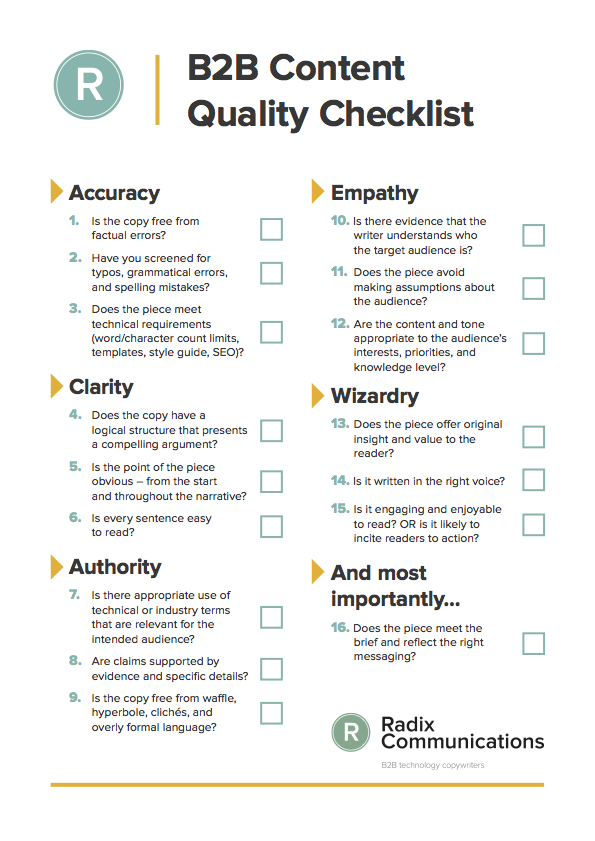
It’s a fantastic question. At Radix, we use a version of this 16-point copywriting quality checklist when editing each other’s work, but we were also super curious to find out what processes others use to ensure the quality of their B2B content.

So we spoke to Laurence Taphouse, Director of Digital Marketing and Content Strategy at Deltek‘s EMEA & APAC Demand Centre, to find out how she ensures consistent quality across so many writers, subjects, and territories.

We also called on the members and experts of B2B Marketing’s Propolis Hive for Brand and Content Strategy and got a detailed response from Scott Stockwell, Propolis Hive Ambassador for Strategy and Evolution. You can hear Scott’s process in full, later in the episode.

This week, our co-host is the luminous Katy Eddy, a Senior Copywriter here at Radix and editor extraordinaire. She recently gave an editing masterclass at a local university, and shares some of her approach.

And we have two excellent copywriting tips this month. Giles Edwards tells us how to keep our content succinct, and we hear the first of a series of tips on creating inclusive copy from language consultant Ettie Bailey-King.

You’ll find a full transcript of our podcast at the end of this post.

Laurence’s top tips for consistent quality

First, Laurence tells us how she achieves consistently high quality across Deltek’s varied content.

A consistent editor

“You need to have a consistent editor; I think it’s crucial,” Laurence explains. “For us, it’s our product marketing team. So when we do editing, it will be me; you always add a constant.”

Include someone with industry acumen

“You need a person who’s got all the industry acumen,” she adds. “Someone who understands their role in the industry, who can make sure the messaging is resonating the way it should be.”

Check – and check again

“Once all that is done, a second pair of eyes can check this is all good,” she concludes. “And then we go back to me for proofreading, making sure there’s no grammatical mistakes or anything like that. Once that is done, we all agree that the content is good to go. And we always follow the same process.”

Scott’s advice from a tech giant

Next, Scott gives us a sneak peak into the content quality process at a bona fide tech giant. And, like Laurence, he reveals that quality control starts much, much earlier than the final edit.

“Assets go through agency production, and then face a rigorous ‘go live’ test before they’re launched,” he tells us. “The ‘go live’ alone has 12 elements that are checked before an asset is signed off, including the brand guidelines, legal requirements, and SEO optimisation, among others.

“Much of this happens within a standard set of tools and apps that all the content team share along with supporting workflows. The squad of marketers working on the campaign… will all have an input into the content being made for the campaign and how it will be deployed. So that quick quality check is a final glimpse at a far more detailed journey that each asset has taken to get there.”

Radix’s Quality Assurance Checklist

At Radix, our content quality checklist consists of 16 questions. We check for accuracy, clarity, authority, empathy, and wizardry to make sure our content is as complete – and as appropriate for its intended audience – as possible.

If you’d like to adapt it for your own purposes, or even steal it wholesale, feel free:

Steal this 16-point quality checklist when editing your B2B content. Click this image to download a printable PDF.

(Click the image to open a printable PDF)

In this episode, you’ll find…

1:10 – We welcome this week’s co-host, Katy Eddy

1:55 – Our first copywriting tip from Giles Edwards on how to keep content succinct

2:10 – We put Caroline Robinson’s question to Laurence Taphouse

15:20 – David shares Scott Stockwell’s thoughts about how to keep quality in your content

17:35 – David and Katy discuss her three-stage content editing process

25:47 – We hear copywriting tips from Ettie Bailey-King about how to keep content inclusive


We want to hear from you…

Have you got a question for B2BQ&A? Or a copywriting tip you’d like to share?

You could be featured on our next podcast. Send us a voice memo at [email protected]. And if there are any other thoughts you’d like to share, you can find us on Twitter @radixcom.

How to listen: 

Credits

  • Firstly, thank you to Katy Eddy for your excellent insight and co-hosting skills.
  • Thanks to Caroline Robinson for your question. It was really interesting to explore.
  • And thank you to Laurence Taphouse for the insights into Deltek’s quality process.
  • Thanks to Scott Stockwell for your brilliant contribution, too.
  • And last but absolutely not least, thanks to Giles Edwards and Ettie Bailey-King for your brilliant copywriting tips.

Podcast editing and music by Bang and Smash.

Transcript: B2BQ&A 105: How do you evaluate B2B content quality?

Caroline Robinson: I would like to know what QA/QC processes other people have for editing content.

Katy Eddy: That’s a great question. Let’s ask Laurence Taphouse from Deltek.

David McGuire: Hello listener, you are extremely welcome to B2BQ&A, the podcast where we go in search of an answer to your question about B2B content writing. This is episode 105.

Katy: In a moment, we’ll ask Laurence Taphouse, Deltek’s Director of Digital Marketing and Content Strategy for EMEA and APAC, how she manages content quality, and get copywriting tips from Giles Edwards and Ettie Bailey-King. Plus, we’ll have news of a helpful new resource you can use to check your own B2B content quality. That’s a lot of stuff.

David: That is, it’s a lot, isn’t it? It’s a packed episode, I know. Before all of that, though, some introductions. My name is David McGuire. I’m Creative Director at Radix Communications, the B2B copywriting agency. And this month, our guest co-host is a familiar voice. It’s Radix Senior Copywriter, Katy Eddy. Katy, welcome back.

Katy: Thank you very much. It is good to be back.

David: It’s good to have you here. Before we go ahead and answer this month’s question, would you mind telling the listener how they can get in touch with us?

Katy: Yeah, of course. Listener, if you have any comments or suggestions you can find Radix on LinkedIn or Twitter @radixcom. Or if you want us to answer your question on a future episode, record a quick voice note and send it by email to [email protected].

David: That’s marvellous. Thank you very much.

Giles Edwards: Hello, this is Giles from …Gasp! My tip is: trim the fat. If you can take a word out and nothing is lost, you should.

Katy: Thanks, Giles, for that tip. Now it’s time to hear this month’s question. Who do we have?

Caroline: Hello, Radix Podcast. I’m Caroline Robinson, Marketing and Business Development Manager for Compusult Europe. I am also Senior Editor of Maplines, the membership magazine for the British Cartographic Society. I write and edit in different styles for my work. I would like to know what QA/QC processes other people have editing content. Love the podcast by the way.

David: Thanks, Caroline. That’s a great question. Content quality control is something we’re asked about a lot. And in a minute, Katy will explain how we approach editing here at Radix. First, I put your question to Laurence Taphouse, who’s Director of Digital Marketing and Content Strategy for EMEA and APAC at the global software company, Deltek. Laurence leads on content and digital strategy and works with stakeholders and writers around the globe. So I asked her what processes do you have to ensure that your content meets a high standard.

Laurence Taphouse: The process really starts with our marketing plan, when we decide to put in place a marketing plan to drive demand for some of our products. My role is to really do a content gap analysis. From this content gap analysis, I then decide with different stakeholders what type of content are needed. The type of content that are needed can be different formats to fit some of the digital tactics that we are using to drive demand. And based on that we do a content plan. So the content plan is very much around: “what do I want this content to achieve? Who do I want to read it? What do I want readers to think, feel, or do afterwards?” So if there’s any, you know, call to action? And then once I got all those answers lined up, is “what should this piece look like, really? When is the best time to publish it? What’s the best source of material? What’s the call to action? And then maybe where will the content be published?

Once I’ve got that it’s all started with a creative brief and a content brief and either we use, you know, writers in house or if we use third party writers, the content brief is the key for whomever is going to write the content, understand, you know, the audience to which the content will be targeted to. So normally in the brief you’ll have a synopsis, some key messages, the deadline on when we want the content to be created, the target audience, some of the source materials. Sometimes when we create these brief we also do a call with the writer to make sure that we go through all the detail and source material. So we give the opportunity to the writers to ask questions, and make sure that everyone is on the same page. So once we’ve done that, we are being really clear on the deadlines, any iteration will be done as well for that type of content. Because content is quite subjective. Some people might like it, some people might not like it, depending on the tone, and within the brief, you know, that’s where the standards come into play, to make sure that, you know, you don’t end up having 10 or 15 iterations, just based on the personal opinion, though, which is more… it needs to be around when, you know, you review the content around, “okay, this is for that, the format is that, the best practice is that, and the standard of the company is tone of voice should be that way, the way we address ourselves to the audience should be that way.” So once you’ve got all of that, then you can create this not rigid, but a little bit rigid deadline, where you say, “okay, and say three iteration would be the maximum that will be good for you”.

Then you need to have a consistent editor, I think is crucial. For us it’s our product marketing team. So when you do the editing it will be me. And then I will use some of my peers as well  so I have, you know, other pairs of eyes as well on the content because it’s always great. But you always have a constant, you know, consistent editor, person with … generally a person who’s got all the industry acumen. So they understand their industry, they understand their work so that they make sure that the messaging is resonating, the way it should be resonating.

Once that is done, the second pair of eyes is there to double-check this is all good. And then we go back to me for proofreading, making sure that there’s no, you know, grammatical mistakes or anything like that.

Once that is done, that’s when we, you know, we decide that we’re all in agreement that this is all good. And we follow, you know, always the same process, the briefing, once the briefing is done, the deadline once the deadline is done… We don’t let writers just write right away, we usually ask for an outline. So the writer being an internal writer, or third party writer, we make sure that whatever is in his mind of how he’s going to structure the content. So it could be a blog, or could be a white paper, what is it he’s going to write in each of the different parts – we agreed on this outline. So we know that when he start writing, it should be pretty much what we asked him or her to do, you know, he’s not far off, he’s not going on a tangent, where we’re like, “oh, actually, we didn’t want you to really focus on that part”.

And then once we do all this editing that I was telling you about, and this proofreading and this peer review, where we have multiple pair of eyes, that’s when we go into market. And what we also like to do is to take time and reflect once things are in motion in markets. So how this is engaging? Is it engaging the right way? Could we tweak some of the promotional copy that we are creating?

So it’s not just once it’s launched is gone. There is a constant optimisation of the content. We have standards as well, when it comes to publishing online. It is important that we think about search engine optimisation. So it should not be, you know, the main focus when you write, you don’t want to just use keywords, you know, in the wrong way. It is important when you promote, for example, a blog, you know, to think about your title, to be engaging in your subtitle, you need to detail the backend, your backlinks, you know, if you are talking and referring to other research or content on the web to link that through your blog. So there’s a big best practice that we follow for different type of format content.

David: That sounds really comprehensive. That’s great. Thank you. Obviously, kind of, you work across lots of different geographies, lots of different kinds of locations and kinds of writers and that kind of thing. How easy is it to apply a consistent set of standards across different formats, subjects, locations?

Laurence: Yeah, that’s a really good question. So we normally got standards from our digital team, our corporate team, so you will have standard that you follow. So that process that I just explained to you is a process that everyone will do across the globe. However, there’s something there is very important when you talk to different markets when different languages. This is something that in our email and admin centre is crucial is one. When you write content in English, and you know that this content is going to be translated, you need to make sure that you don’t play with words. Often we like to play with word and we feel like they’re more engaging, if we make a touch of humour or make the title a bit punchier in English. That’s great, but it’s not always translates really well when you wanted to, you know, target another market. Also, you know, the content that we are creating is very thought leadership, is not so much product heavy. So it is quite easily transferable, I would say for other markets, but you always need to have a think of who is the target audience, if the target audience is the same, but the market is less mature, you need to make sure they you know, you got that point across. So, it depends on the type of content, I think content that is very high level, for a specific persona, should be able to work and follow the right standard and the right process that I just explained across the globe, really. If there is something that is more specific, you know, I’m thinking sometimes when we do a piece of content around survey research, or based on dates and key points, it needs to be, you know, obviously updated and to resonate with the other markets. But obviously, the standard of the best practice to make sure that the content looks good, should be able to easily be applied across the globe. Because the importance of knowing what’s good look like, is crucial. Because if not, you will never really make the decision to go into market. Because some people might have another opinion of what good looks like. And you’ve got a different line of businesses, which are hot, because you’ve got the content and marketers who think marketing content, and what marketing good content look like. And you’ve got maybe someone who is more an expert in the product, or maybe an expert in, you know, an engineer in the product, where he feels that they need to talk about something more technical, is actually what good content will be.

David: So when you’re trying to apply those standards, and agree what good looks like, between the marketing team and stakeholders in product or sales or, or wherever, how does that work? How do you reach agreement on what the standards are and what good is?

Laurence: So we do something called RACI. So when we do every piece of content that we do, and that we create, if we need to involve multiple stakeholders, they need to understand their role within the creation of that content. So RACI will be you know, the, are you responsible, are you accountable? Are you going to be just a consultant? Or is it just informative that we’re going to provide you this content? Based on the RACI, we’ll set the standard and the process on the brief. So that’s always on the brief. So the first step, and when we agree on that brief, then people understand what good looks like and what we are aiming for and what the objective is. If you miss that brief, and the brief is not clear, that’s when it gets really hard for everyone to be on the same page on what good look like for specific content or specific campaign.

David: Laurence, that’s brilliant, that’s absolutely everything that we needed from my point of view. Is there anything when you were kind of thinking about the questions and what you prepared, is there anything that I haven’t asked you about, that you feel is important in this?

Laurence: I think often people think that content is, you know, you need to be very creative, you need to be someone who likes to read. And it’s true, when you are content, you need to really like the wording and all of that. But I think when you write marketing content, you need to have also this view of not only writing what you like to write about, but always thinking about the customer, and what they’re going to want to write. So following the process, it looks like really heavy, but once you do it for longer and longer and longer. Yes, it seems completely obvious is like, you know, it’s like if you were going into market without having a marketing plan in place or without having a budget in place. If you don’t have this process in place, then, you know, everything would fall apart. So I would just suggest to everyone who wants to do content, to also have a good eye on you know, digital tactics and format. Content is the oil of the machine of demand. So you need to think about where this content going to go before you start writing. I think it’s crucial.

David: Thanks, Laurence for giving us such a detailed answer to Caroline’s question. We really appreciate your time. Katy, before we hear your approach to editing, I’d like to share a bit of further information on this. I asked the members and experts of B2B Marketing’s Propolis Hive for Brand and Content Strategy, how they approach content QC. And I got quite a detailed response from Scott Stockwell. And I thought it showed some real similarities with Laurence’s answer. Scott says the following:

This feels like one of those, it’s taken me five years to do this in five minutes. If you’re just considering content, that’s something that’s coming off a content production line, then quality assurance could be seen as the quality controller equivalent. A quick look from a trained eye at the finished products, able to spot what passes muster, and what needs to be rejected. As editor-in-chief for EMEA, that’s part of my role: to examine finished assets. But like the tip of the iceberg that doesn’t show all the work that went into designing and fabricating that product, and sourcing the ingredients before any components even set out on their path to becoming a product. Where I work, we have a three by three model, three briefs, three sessions, three outcomes. We have an input brief that researches the market, the customers, the personas within the customers, the local conditions, et cetera. That moves into a content strategy that looks at the high-level customer journey and the touches along the way. The concept brief comes next, and looks at the creative landscape and options for testing at the campaign level. A SWOT analysis examines the creative testing results and implications. And a greenlight meeting looks at what it will take for all the assets in the journey to deliver on the vision for the campaign. A content plan takes the defined campaign deliverables, and looks at all the components needed to create them, which are detailed in an asset brief for each asset. The assets go through agency production, and then face a rigorous ‘go live’ test before they’re launched. The ‘go live’ alone has 12 elements that are checked before an asset is signed off, including the brand guidelines, legal requirements, and SEO optimization among others. Much of this happens within a standard set of tools and apps that all of the content team share along with supporting workflows. The squad of marketers working on the campaign, across discipline and involved throughout and will all have a good view of and input into the content being made for the campaign and how it will be deployed. So that quick quality check is a final glimpse of a far more detailed journey that each asset has taken to get there.

So Katy, now you have insight into content quality control at two tech giants. And to me, it’s striking just how much work goes into getting things right before that final review. Did anything else stand out for you?

Katy: I think firstly, it makes me glad that we’re just the copywriters. The amount of work that goes in, you know, to prep a brief before it reaches us, and everything that happens to it after we’re done with it. That sounds exhausting. It’s really interesting to have that, that little bit of insight into where our little bit of writing and editing that we do slots into a much bigger thing. And it’s yeah, it is a big responsibility to take on, like a little bit of editing journey.

David: Yeah, ‘cause I mean, our review process, I mean, we have a checklist. But that really is, it’s more at the end of that final check – right? – of all the kind of elements that are already in the brief to make sure that everything lines up.

Katy: Yeah, everything we do is as much in line with the brief as we can possibly get it. And the other thing that I thought was really interesting that Laurence picked up on was talking about how you adjust things for different locations and different markets. I’ve been doing a lot of that recently. And it’s a difficult challenge because unless you’re going and you’re talking to every individual person in that market, you don’t necessarily get a full picture of how they like to talk about things and things that you shouldn’t mention for their markets and things like that.

So recently, I did a big project for five regions. And we set up a massive spreadsheet that had all our main talking points in it for UK. And we handed it to the teams in each of the regions and we’re like, what do you need to change? What don’t you want from us because it can be really tiny accuracy, things like stuff that’s hosted in Microsoft Azure here might be in a different cloud provider in Sweden, something like that. But then there’s loads of really tiny things. Kinda like we don’t like… humour. Like, don’t give us puns, don’t come near us with a pun, which you know, you’re pretty safe with me. I’m not a great fan of puns. But yeah, just those little things that I’m so used to editing for stuff for the UK and for the US. And that’s really where my expertise is. So bringing in other people’s knowledge for that is really useful.

David: Yeah. Now, you were talking about that editing process at a local university, recently. You were talking to the students about – you have a particular kind of structure and an approach that you follow when you’re editing someone else’s content. Can you give us a quick summary?

Katy: Yeah, it was a 45-minute talk. So I’ll try and condense it as much as possible

David: We haven’t got quite that long.

Katy: Yeah, the way I approach it, and I’m not sure if this is best practice at Radix but it’s the way I’ve found that most effective. For me, I take three passes at something. And it’s very much based on our quality checklist that you mentioned earlier. So the first pass I do is as a reader, and I don’t think about anything from a writing or editing standpoint. It’s just the really basic, does this make sense? Am I interested the whole way through? Do I want to do whatever I’m being told to do at the end of the piece? And at this point, I don’t do anything to the copy, I won’t start picking things apart. Because there’s no point editing something in paragraph two, if you get to paragraph five, and there’s a massive structural issue, that’s going to negate all of that anyway. So that’s one I’ll just drop the occasional comment on if there’s something I need to come back to.

And my second pass, I tend to look at it as a kind of content editing pass, which is where I start looking at the structure. Is the argument logical? Does it follow through? Does it go off on a weird tangent halfway through? Are there logical leaps where, you know, we haven’t quite explained our thinking. That’s where you start, maybe having to pull bits apart and restructure and move paragraphs around, that kind of thing.

And then, once you’ve done all of that, you come back around for the last pass, which is where you look for the typos, the grammar, the really like nuts and bolts things of copywriting craft, that when you’re writing a massive piece can kind of get away from you a little bit sometimes. And, you know, if you’ve done major edits at the structural point, you might have introduced typos, which aren’t the original writer’s fault at all. So that’ll be my last major pass. And I always give it a quick proof before I send it back to whoever is working on it, that kind of thing. And it’s not always me doing these changes. Sometimes if they’re very small, specific changes to make, I’ll do them myself. But if I’m reviewing somebody else’s work, and there are multiple avenues to go down for how you change something, I’ll bounce it back to them with comments and suggestions that hopefully give them some guide and some rationale, because the really important thing for me is that you always have to have a solid rationale for why you’ve changed something. You never want to give it back to somebody and they look at it, and they have no idea what you’ve done to it and why. Yeah, so for me being very clear and very descriptive of why you’ve made changes, or what changes you want them to make is really important, too.

David: Yeah, I mean, one of the big traps I guess you can fall into as an editor is “I wouldn’t have written it that way”. Rather than does it meet these criteria, yes or no. I think it’s interesting that when we look at our checklist, we, you know… If you like work our way up Maslow’s hierarchy of needs for copywriting, but you know, we start with the detail and work out to the picture, but you start with the big picture, and work backwards. So the total impression back from that to the structure, and then back from that to like, the detailed kind of words and commas and yeah, that kind of thing.

Katy: There’s no point editing the tiny bits if it doesn’t do what it’s meant to do. So if it’s, I mean, I’ve never seen this happen. But if you just look at it, and it’s completely wrong, and it has to go back and be rewritten from scratch, there’s no point spending, you know, 30 minutes fiddling around with semicolons. But yeah, it’s interesting you said that about not making changes just because you would have written it differently. It’s another point I had in my presentation I called editing without ego. Which is –

David: – it’s hard for writers.

Katy: It is hard and especially when you’re a content lead or a senior and you know something really well. You can get really protective over a topic or a client. But that doesn’t mean you’re always right or you always have the best answer or the only answer, so you’ve got to know when to loosen the reins a little bit on those things.

David: Sure. Listener, Katy mentioned the checklist that we use here at Radix to quality check the content we write for clients. I think we refer to it a few times, actually. And I’m delighted to let you know that we’ve actually just published a new updated version of that checklist that you can steal, and adapt and borrow for your own purposes and use it for your own content reviews. If you’d like a copy, just head over to radix-communications.com, and download it. And we’ll also put a link in the show notes.

Ettie Bailey-King: I’m Ettie Bailey-King. I’m an inclusive language consultant. And here are my tips on creating inclusive copy. Number one, ask people. Always ask people how they want to be referred to. For example, don’t think that you can guess somebody’s pronouns based on their appearance. There’s no way of knowing someone’s gender identity just from looking at them. So always check. Secondly, be aware that somebody might be out in the sense of out as having a particular sexual orientation or gender identity in one space, but not in another space. So always check, otherwise, you risk outing someone who might be let’s say out on a social media platform where you happen to follow them, but not out with their work colleagues.

Katy: Thanks, Ettie Bailey-King for that. We actually have a whole bunch of inclusive writing advice from Ettie, and we’ll be including that across our next few episodes. We’d also like to thank Giles Edwards for the tip we heard earlier, Caroline Robinson for this episode’s question. And both Laurence and Scott for answering it so thoughtfully.

David: Caroline, I hope you found the answer that you are looking for. And remember, we’ve published our revised content quality checklist so be sure to grab that, too. And thanks to you, Katy, you’ve been a wonderful co-host as ever.

Katy: Well, thank you for having me back, David. I think this was the one where I felt the most useful. So hopefully, I’ve given people some useful things to think about.

David: Absolutely. Listener remember, it could be your question we answer in a future episode. If you have a question for B2BQ&A to answer, email, a voice memo to [email protected]. Or find us on social media. Thank you, Katy. And thank you, listener. I’ll see you next time for another B2BQ&A. Until then, make good content. And remember, Hemingway may have said write drunk, edit sober, but he didn’t have HR to deal with.

David and Katy: Goodbye!

Podcast 58: how to get value for money from your copywriter

Demand for great B2B content is growing, but that doesn’t necessarily mean your budget for copywriting is expanding to match. So, naturally you start looking for ways to get more value for money.

But, obviously, you shouldn’t sacrifice quality just to save a few quid – it’s all about balance.

In the newest episode of Good Copy, Bad Copy, David and Fiona discuss a few ways you can get the biggest possible bang for your B2B copywriting buck.

Listen now to find out:

  • How our pricing strategy and copywriting price list came to be
  • Where you can save money and add value to your project
  • Where you really, really shouldn’t cut corners

How to listen…

You can download the episode here (right-click and “save-as” to download). Or stream the episode in the player at the top of the page.

(Or you can subscribe to the podcast on iTunes here. Alternatively, add our RSS to your preferred podcast player.)

Other content we talk about in this episode:

Want to contact the show?

It’s always good to hear from listeners. You’ll find us on Twitter… or feel free to send your thoughts to [email protected] (if you’re feeling fancy, email a voice memo).

Next month, we’ll be talking about the dark art that is writing email subject lines. So if you’ve any questions, thoughts or tips, do get in touch.


Credits:

Audio editing and music by Bang and Smash.

“How long will it take?” Five factors we consider when quoting for copywriting

As you may know from your own experience, quoting for any kind of project isn’t all about the money. A major component in delivering a job is being realistic about what’s achievable, so you can keep your promises. It’s how your client comes to know they can trust you to deliver.

Of course, it’s important to deliver jobs quickly, but quality is an important part of what we do – it’s what separates us from the content mills (*shudder*). So we have a clearly defined set of questions we need to ask before quoting for a project, which enable us to stick to deadlines, and ultimately, let our clients know exactly what they can expect, and when.

So, what do we look for before we put pen to paper? Here’s five things we consider when quoting for a writing project:

1. How complex is this, really?

We’ve been doing this for more than a decade (and we’re really geeky about our data). So when we get presented with a brief, we can usually work out how much work it’s going to entail at a glance. But there are of course exceptions.

For example, from time to time we get asked to copy edit an existing document (usually written by one of the client’s colleagues). It might need shortening, expanding upon, or something different to copy editing – like proof reading, or a rewrite. My colleague George has put together a great piece to explain the difference.

It’s only natural to take an optimistic view of an existing piece. But if we don’t quote properly for a project, we’re not helping the client. If the piece turns out needing a complete re-write, this could pose a problem when it comes to delivering the work to the agreed schedule. We pride ourselves on never being late, so it’s essential to get right.

The more information we have at the brief stage, the better we’re able to understand the true scope of the job. (And if we ask to see the content you’d like us to copy edit before we quote, this is why.)

2. Yes, we know B2B tech, but do we need a call, or extra research?

We understand enterprise technology; it’s what we write about every day. But that doesn’t mean we’re experts in every field. The nature of the industry means it’s constantly evolving, so we as much as anybody else to keep up with the latest trends and developments.

For some projects, this is pretty straightforward. But if it’s a key piece of content where you really want to add value for your reader, we’ll need to dig a little deeper, and uncover things your audience won’t already know.

This can mean doing extra research, or having a call with product experts – they live and breathe this stuff, so if anyone is going to give us invaluable insight, it’s them. (In fact, it’s so valuable we recorded a whole podcast episode about it.)

3. Who’s our best writer for the job?

One of the real benefits of having ten specialist B2B copywriters in a room is that we each have our own natural strengths. Like anything in life, we have subjects we find more interesting over others and special areas of interest – and our natural writing styles fit certain types of content.

This means we’ll always to try to match the job to the ideal writer and content lead. This can affect the turnaround time slightly, but it also ensures you’re getting a great piece of copy from a copywriter who has a genuine interest in the topic and, what’s more, truly understands what you’re trying to achieve.

The more specialised or important the job, the more essential it is to find just the right blend of interests and style.

4. Can we be certain of delivering quality work on time?

We know you’re busy, and you have deadlines to meet. If a job’s urgent, having 50+ hours of writing time at our fingertips every day means we can usually turn it around.

But like air traffic controllers at a busy airport, our account managers balance this hectic, fast-moving workload with the absolute need to get the job right. They’ll always have a clear, visual grasp of our writing diaries, enabling them to ensure the right writer has time to do the job well.

That’s why we need to receive a project brief, set out the breadth of the project, and understand who’ll write it, and when, before we give you a firm deadline. But once we have, you know we’ll absolutely deliver exactly what we say, when we say, for the price we agreed.

5. Have we allowed enough time for review, and amends?

To make sure you’re completely happy with our work, we factor in up to two rounds of amends as standard in our quotes – as well as our own internal review process.

This gives you the flexibility to question and edit what we’ve produced (within reason) if you need to, so we can refine the piece totally in line with what you want.

Quite often, that time won’t be necessary (especially if we’ve worked hard on the brief), but you’re safe in the knowledge that we’ve factored the time it usually takes into your project schedule – enabling you to confidently forecast your content schedule.

Ultimately, we’ll always be realistic and upfront with you

Getting copy projects turned around quickly is great, but getting them done properly – and reliably –  is even better.

In our experience, clients are much more satisfied with the end result (even if they’re in a hurry for it) when we’re clear about what they can expect, and keep them updated at every stage. That’s why we’ll never overpromise or say yes to a project without reviewing a brief first.

If you like the sound of the way we work and you’re interested to know more, feel free to give us a call on 01326 373592 or email us at [email protected].

(Or if you’d just like to see a copywriting price list, that’s no problem either.)

The Radix copywriting process: how do we work with our clients?

Entrusting your marketing copywriting to an external party is a big decision – and it’s only natural to have lots of questions about how the work is going to get done, and how the relationship is going to work.

One of the most frequent questions we get asked is about our process for producing a piece of writing work from start to finish. And that’s exactly what I’m going to outline in this blog…

Getting a quote

Before you work with us, you’ll usually want to know how much the work is going to cost. To make that part easy for our clients, we have fixed price lists for frequently-requested content formats like blogs, ebooks, and video scripts. We have one price list for clients that come to us direct, and another for agencies that are looking to get us on board as part of their client work.

As senior account manager Chloe Tidy explains:

“While our price lists don’t offer an exhaustive list of everything we do, they do offer an accurate idea of the content we can produce. If there is something that a client would like us to produce that isn’t on our price lists, we can always create a bespoke quote.”

All of our quotes reflect the time we expect to spend on a project. As standard, this’ll include time for:

  • A briefing call (where required)
  • Any additional desk research to inform the piece
  • A first draft (and, for longer-form pieces, an outline)
  • Review and proofing
  • Two rounds of reasonable amends

The briefing process

How do we get the information for the work we’re going to do? For the sake of narrative convenience, jump into the shoes of one of our regular clients. You’ve worked with us before – on a range of projects from ABM campaigns to web copy – and today, you need a blog for your website.

The blog, which has a working title of ‘The State of Cloud-Native Adoption in Fishmongery’, needs to be written – but to ensure we get it right, you’re going to need to brief us.

In classic ‘choose your own adventure’ style, you have two paths by which you can proceed:

  1. Provide a working title and a description of the desired outcome by email and/or a phone call, asking your dedicated account manager if they have the time to fit the piece into an appropriate writer’s diary. A briefing call will be arranged if there is not sufficient information provided, or the brief is particularly dense.
  2. Use the Radix briefing template to provide a full, written brief for a writer. When you are happy with it, you can send this to your dedicated account manager, who will assign it to the best writer for the job. A briefing call will be arranged if the writer has any questions about the project, preferably with a project lead at your end.

In cases where we are engaging with a new client, or it’s simply our first time tackling a project type, the process is a little more complex.

Senior Account Manager Sarah Gray explains:

“If it’s a complicated topic, or a new client, we’ll run the project by a senior writer to evaluate. If needed, we may also arrange a briefing call with the client before booking in time with the writer. Then, all that’s left before jumping into an outline or a first draft is to send the client a quote and confirm the timeframe for delivery.”

The first draft

So, where are we at? Let’s recap. So far, we’ve:

  • Received word of your new brief
  • Nailed down (figuratively) a writer for the job
  • (Maybe) had a wee briefing call to make sure we have the right info
  • Agreed on a quote and timeframe for delivery

Nice. Everything’s looking good. Now it’s time for our writer, depending on the outcome of the briefing, to either whip up an outline or jump right into the first draft.

With blogs, it’s likely our writer will have everything they need from the briefing (and maybe a little desk research) to begin the first draft. But with other projects – such as case studies or whitepapers – we often write an outline first.

…*Intermission*…

Shiba Inu Dog GIF

Internal quality control

On completion of the first draft, the writer will pass their copy to a content lead or another expert peer to review. This is where the amends process begins (and, in the best-case scenario, ends).

The content lead is one of the most important roles in our entire process. Think of them as your brand guardian, the final hurdle which our writers must leap before the copy lands in your inbox. Internally, we always allocate a content lead for each client. This way, they can build up a wealth of knowledge about you and apply it to the reviewing process, ensuring everything hits the mark.

In our role-play scenario, let’s say the reviewer spotted a non sequitur in the blog’s third and final act. Nothing critical, but enough of a reason to send it back to the writer with comments on how to amend the issue. With the amends made and the reviewer happy, the account manager will send the copy off for you to review.

Reviews and approvals

If the copy hits the spot, what happens next is up to you. If you think it needs some further work, or if the scope of the project has changed, you can let us know and our account manager will arrange for the writer to return to the piece. We can also set up a call with you to clarify the changes required.

As standard, we always include up to two rounds of copy amends in the quote – this way, writer and client alike are guaranteed leeway to tweak the first draft. When it comes to the amends process, we recognise that we’re delivering a product, and as they say in retail: ‘the customer is always right’. While that’s true *most of the time*, we prefer to see our work as a collaboration in which both parties learn from each other (and in turn, get the best outcome possible: damn good copy).

Once the copy is finished and approved, our account managers will send you the finished piece. And from there, hopefully the copy can do its thing!

Working with Radix

I hope this blog has answered any questions you may have had about the way we work with our clients, but if there’s anything you’re unsure about (or you have any other questions), please do get in touch on 01326 373592.


We need to talk: the power of a great briefing call

Even though we’re specialist B2B tech copywriters, briefing calls are essential to helping us create truly great content. It’s what adds that magic extra 10% that makes amazing content stand out from the crowd.

It’s our opportunity to talk to your experts – the people who live and breathe your story and what you’re selling. And it’s also your chance to provide us with extra nuggets of information we may not have had otherwise.

The result is a piece of copy that reads like the writer is indeed an expert in their field, which means a more interesting read, more captivated readers, and hopefully, more business coming your way.

Briefing calls take time and money. Can I avoid one?

The short answer is yes, of course. In many cases, there’s nothing wrong with writing a piece of copy without having a call first. Indeed, much of our regular work for long-standing clients and campaigns just needs a written brief.

But if you really want your content to be original and add value – especially if it’s a bigger project, or a subject uniquely discussed by your business – a briefing call can make the difference between good and great.

Often, once we start probing on a call, new themes and ideas emerge that maybe wouldn’t have seen the light of day otherwise. And it gives us a fresh, original angle that tells the reader something they didn’t already know, that’ll be of genuine use.

So, what do I (the client) get out of it?

Quite simply, it’s your chance to ensure we’re on the right track, and that we’ve got all those tasty nuggets of information that’ll help the finished piece cut through the noise and be heard.

We love to collaborate closely with our clients – it’s how we read between the lines, and ensure you get the copy back that you envisaged in the first place.

Especially for larger projects or projects with multiple stakeholders, there’s inevitably going to be lots of input which needs addressing. Close collaboration and communication keeps everything on-track.

What does it mean for a long-term relationship?

If we’re talking to you regularly, either on the phone or face-to-face, we’ll almost certainly build up a fantastic working relationship with you.

Simply, we’ll be able to understand the ins and outs of your solutions and how you make your customers’ lives easier. What’s more, our product knowledge will quickly grow, so it’s almost like having an in-house writer in your team.

Over time, briefing becomes quicker. And we become more able to suggest ideas and perspectives of our own to keep your content fresh.

Briefing calls: your ticket to truly well-written copy

If you like the sound of the way we work, take a look at some of our previous client work to see our capabilities.

7 ways to liven up old-school B2B copy

B2B tech copywriting has come a long way over the years. Not just in the technology we write about, but also how we write about it.

In B2B, writing in a snappy, engaging style is an instant, effective way to differentiate your brand. When your text gets to the point, in sentences that are quick and easy to read, it shows you value your reader’s time. It also proves you know your stuff well enough to explain it clearly.

And that’s an opportunity, because many brands still take a formal or “old school” approach to B2B content. A lot of your competitors are making noise, but not much more.

So, what can you do about it?

There are plenty of easy tweaks you can make right now, to give your copy a little more impact and set your brand apart from the old-school crowd.

Let’s take a look.

“Old school” writing wastes readers’ time

For the purposes of this post, “old school” writing is the traditional style of copy that’s been used in B2B marketing for several decades.  You know the stuff: it’s academic, formal, sometimes stuffy, and is often wordy where more concise sentences would do.

There are people who believe there’s more legitimacy in a formal, academic-style – which can be fine in the right format or environment. It’s all about audience and context.

The problem is, reading complicated text takes longer, and B2B decision markers are time poor. People often don’t have the time or attention span to read dry and complicated content.

Research by Prezi suggests that longer content can still hold attention, but people are being more discerning with what they read. This means that it’s more important than ever to make your content as interesting as possible.

Here are seven ideas to get you started.

1. Look outward and focus on challenges

The most effective copy in any format talks about the reader and their challenges – not about you and your capabilities. This is your opportunity to empathise with your audience and offer solutions – and only then bring in your products, services, and expertise.

Instead of talking about what you do and what you can do for your customers, focus on your audience. What do they care about? What challenges do they face?

Moving from a feature-led approach to focusing on the benefits to your reader will ensure your customers aren’t left thinking “so what?”

(In fact, my colleague David created a fantastic short video explaining how this works with web copy.)

2. Be specific

There’s more content being created than ever before and it’s only set to increase. But here’s the problem: there’s also a skills gap, so you’ll find that there’s a tonne of re-hashed topics out there.

You’re unlikely to win customers’ attention with content they’ve already read elsewhere.

The fact is, to break through the sea of content out there you need to say something unique or useful – and a great place to start is by being more specific than your competition. Think about the particular people you want to reach: their challenges, their hopes, their attitude to work. Then ignore the crowd, and write directly to your ideal customer.

Remember: if you try to appeal to everyone, you appeal to no one.

3. Be careful with jargon

How much jargon does your audience understand?

If you’re writing for a non-technical business reader, maybe not a lot. And you might want to dial things back a bit to make your content easy to digest.

But if they’re engineers or techies, the likelihood is a lot; potentially, more than you. And in B2B, that’s potentially a bigger worry than blinding your audience with science. You need to speak their language, and if you mishandle industry terms your reader uses every day, you’ll blow your credibility in an instant.

The crucial thing is: make sure you and your audience are on the same page, and understand the same thing by every word you use. Scattering jargon you don’t understand is a bigger risk than using none at all.

4. Get to the point

For me, a long, wandering preamble immediately puts me off reading a piece – and I’ll never get the chance to find out how interesting the subject might be. Because if the language you’re using is boring, the automatic assumption is that the subject matter will be boring too.

And I’m just a B2B copywriter. Imagine how little patience a time-poor B2B decision-maker would have.

That’s why it’s vitally important to get straight to your argument, cut the waffle (remember: more words don’t equal greater value), and inject your own personality into the copy, right from the start.

5. Lose the passive voice

Switching from passive to active voice is one of the most effective ways to give your copy more punch – and give you an edge against your competitors.

Grammarly has some useful advice on how to spot if you’ve written a sentence in the passive. Simply, if you can add “by zombies” after the verb (highlighted in green in the example below) it’s passive.

For example: “the new servers were installed overnight” would become “the new servers were installed by zombies overnight”. The sentence still makes sense, so it’s the passive voice.

(Whereas “the company installed the new servers overnight” wouldn’t make sense as “the company installed by zombies the new servers overnight”. So it’s active voice.)

6. Appeal to emotion (where appropriate)

Most decisions – even in a business context – aren’t made using logic or reason. They’re based on challenge-driven emotions (and then rationalised later).

It’s why using emotive language that taps into people’s challenges is far more effective in selling your products or services than simply setting out bare facts.

One of the best ways to resonate with an audience is to set up a piece of content with relatable challenges that make people say, “these guys genuinely understand my issues and what I’m trying to achieve”. You can tell a compelling story, and offer the immortal copywriters’ phrase “if this sounds familiar…”

Only then should you propose your solutions to these challenges.

7. Use design to your advantage

And finally, no matter how great your copy, it’s worth investing in some decent design work.

If your content looks eye-catching from the off, it will not only be able to shine through the masses of other content out there, but your audience will also be more likely to engage with it.

After all it looks different, and it sounds different. Why wouldn’t they want to find out if the content is different too?

Graduate from the old school – one step at a time

If you think these changes might be a bit much for your stakeholders, remember: you don’t need to make them all at once. Even applying a couple of these tips will have a significant impact on your content, and once you start to see results, it’ll be easier to justify doing more.

Or, if you’re not confident in your ability to make the break into a clearer, more modern style of content, feel free to get in touch with us. It’s exactly what we do all day, and we’d love to give you some idea of how a fresh approach to your writing might sound.

Four tips to help you write B2B case studies with impact | B2B Content Tuesday

Case studies are among the most powerful tools in your B2B marketing shed. They allow you to put your reader into the shoes of your most successful customers – and prove (rather than just claiming) how fantastic your product or service really is.

So when case studies were requested as a topic in our B2B Content Tuesday Q&A webinar series, we were excited to talk about them.

In this blog, we’ve unpacked four tips from that session, to help you create a compelling, informative and customer-focused case study: from subject matter to narrative and formatting. We’ve even suggested a few questions to ask your customer, so they give you the most human, relatable quotes possible.

We’ve also put together some questions and answers from the live discussion. If you’d like to see the session in full, there’s a video at the bottom of this post.

1. Don’t make your brand the hero

Your customer should always be the hero of your story. You don’t want your potential customers to identify with you; you want them to identify with the customer whose problems you’ve solved.

Instead, present yourself as a trusted guide or friend who helps the hero find their way and complete the quest. Basically, you’re Obi-Wan Kenobi. Maybe even Piglet.

Sharing how you helped the customer achieve the result is important. But remember: it’s “they achieved x by using product y“, not “product y achieved x for them”.

2. Help your reader to learn something of value

Give your readers a strong reason to read by providing clear value. Has the company you’re writing about achieved something that your next customer might want to achieve themselves? Tell the reader how, what the challenges were, or what the journey looked like.

A strong headline will make it obvious to the reader that your case study is helpful. “How this company achieved that” is always a great way to start – it promises value from the off and gives them a clear reason to read.

Boxouts can highlight key lessons from the story and provide them to the reader in easy, bitesize pieces that draw the eye if they’re not going to read in full. This could be something as simple as “Three key lessons this company learned along the way”.

3. Give the reader a figure to identify with

You want your reader to look at the customer at the centre of your case study and think “they’re just like me”. And that reader won’t be a company; they’ll be a human with thoughts and concerns.

The best way to appeal to that human is to talk about individual decision-makers – the real people whose working lives have been changed by your product or service.

But you’ll need to ask them right questions, to draw out the moments, feelings and images the reader can identify with. Here are some of our favourites:

  • Why is this outcome important to your business?
  • Was there a moment when you knew something had to change?
  • Could you tell me a little about your team?
  • When, and why, did you make the decision to buy this product in particular?
  • How much cheaper, faster or more reliable is this product?
  • What was the experience of working with us like?
  • What difference does this make to your job?

4. Make sure your reader can understand in five seconds flat

Ensure your case study is scannable. However well it’s written, most people simply won’t have the time or inclination to sit and read from top to bottom.

The company, challenges, solutions and results all need to be obvious. Use subheadings, bullet points and a standfirst to summarise these points before discussing in detail. And using customer quotes for subheadings is a nice touch – that way you’re summarising the point in your customer’s voice.

And once you’re finished, do the five second test. Give yourself (or a friend/colleague/random person from the street) five or ten seconds to read the story, and see if the critical points are clear.

Q&A: B2B case study questions, answered

Q: Is there a danger in making a case study too simple?

David: “Case studies shouldn’t be difficult to read, but you absolutely do have to speak the language your customers actually use. In the real world, your prospects likely use language that’s technically specific, but in a context that’s easy to understand. If you can do likewise, you can write something with real technical authority without overdoing the cognitive load. Headings should be clear and succinct, to set out the story and information clearly and effectively.”

Q: What do you do when you can’t use a company’s name or quotation?

David: “If you’re not using a company’s name, using their quotation probably won’t be a problem. You won’t be attributing it to them – although do always ask first. It’s also best to be as specific as you can, without giving their identity away or presenting any half-truths, to make it clear the story is obviously true. A case study is always better with all the names included – but the really important part is to help your reader recognise the situation the customer found themselves in at the start of the story.”

Q: Are there any ways to speed up the case study approval process?

David: “Getting in contact with your Account Managers can sometimes give you insight into the client’s internal marketing personnel, and if it’s appropriate you can approach them directly. From a writer’s perspective, it can make the process cleaner if we handle signoff on the customer’s behalf. It’ll save them time, and also gives a chance to build rapport and make any small changes that could help to secure agreement. It’s a good idea for the writer to include an introduction or rationale that explains the approach, choices, and language in the copy. That way, getting it signed off is more likely, because what you’ve written is more contextualised so they’re less likely to disagree.”

Thanks again to everyone who attended the webinar, and took part in the Q&A. Here’s the full discussion: