Podcast 75: B2B copywriters v AI – what does the future really hold?

Increasingly, there’s evidence AI copy generation platforms can outperform human copywriters for basic tasks like writing digital ad copy and email subject lines.

So does that mean it’s only a matter of time until computers are writing all the content, and copywriters are out of a job?

Not necessarily.

In this episode of “Good Copy, Bad Copy”, we talk with with AI copy expert Dr Andrew Bredenkamp, of Acrolinx. And we find out:

  • How AI will change the nature of copywriting work
  • What algorithms can do, and what they can’t
  • Why AI may expand the number of people writing content
  • Which skills writers will need to learn next
  • How the traditional writers may soon adopt a consultative, editorial role

So it’s not the end just yet. But we’re on the verge of a good deal of change. It’s an exciting time.

Want to be on the next “Good Copy, Bad Copy”?

Contact us through @radixcom on Twitter or [email protected] (if you really want to make us happy, send us a voice memo).

How to listen

Credits

Thanks to Andrew for his time, openness, and expertise regarding what AI can and can’t do. If you’d like to know more about his work, take a peek at the Acrolinx content governance solution.

Podcast editing and music by Bang and Smash.

Podcast 71: how to write B2B social media content

Ah, social media. Everyone’s doing it, but – in B2B marketing, at least – it seems there are still precious few brands doing it very well.

From a copywriting point of view, social is too often an afterthought. Instead of a nuanced, two-way conversation, pre-created content gets blasted out to anyone who wants to read it, in a post desperate to attract any kind of engagement from the widest possible audience.

In this episode of Good Copy, Bad Copy: the B2B Copywriting Podcast, social media expert Kate Stoodley of New York-based Comment Ground explains why that’s precisely the wrong approach.

Where social ends, and content begins

Give the episode a listen, and you’ll hear Kate tell us:

  • Why, just because you can put content on social, doesn’t mean you should
  • How to decide what to publish on LinkedIn, and what goes on your blog
  • Where Facebook and Instagram fit into the B2B mix
  • The hallmarks of great B2B social content
  • The case for going beyond your competitors, and putting a point of view

How to keep up with social media change

We’re not going to lie; we were pretty relieved when Kate admitted that even social media gurus struggle to keep on top of all the changing formats and specifications. Here are the resources she recommended:

Name that chair

Here’s the awesome new/old Eames chair Fiona was talking about in this episode:

Our lovely new old Eames chair

To name it, drop us a line to [email protected], or tweet us using the hashtag #NameThatChair.

(Thanks to our lovely new account manager Phil for the badass photo skills.)

Add your voice to the podcast

We always love getting your comments, questions and ideas. Contact us through @radixcom on Twitter or [email protected] (you can even email us a voice memo, if you like).

How to listen


Credits

Podcast editing and music by Bang and Smash.

Podcast 58: how to get value for money from your copywriter

Demand for great B2B content is growing, but that doesn’t necessarily mean your budget for copywriting is expanding to match. So, naturally you start looking for ways to get more value for money.

But, obviously, you shouldn’t sacrifice quality just to save a few quid – it’s all about balance.

In the newest episode of Good Copy, Bad Copy, David and Fiona discuss a few ways you can get the biggest possible bang for your B2B copywriting buck.

Listen now to find out:

  • How our pricing strategy and copywriting price list came to be
  • Where you can save money and add value to your project
  • Where you really, really shouldn’t cut corners

How to listen…

You can download the episode here (right-click and “save-as” to download). Or stream the episode in the player at the top of the page.

(Or you can subscribe to the podcast on iTunes here. Alternatively, add our RSS to your preferred podcast player.)

Other content we talk about in this episode:

Want to contact the show?

It’s always good to hear from listeners. You’ll find us on Twitter… or feel free to send your thoughts to [email protected] (if you’re feeling fancy, email a voice memo).

Next month, we’ll be talking about the dark art that is writing email subject lines. So if you’ve any questions, thoughts or tips, do get in touch.


Credits:

Audio editing and music by Bang and Smash.

Podcast 96: how to make sure your B2B content is inclusive and diverse

In this month’s Good Copy, Bad Copy, we’re getting serious about diversity and inclusion in B2B marketing content.

Guest co-host Kavita Singh, Assistant Editor at B2B Marketing, joins David to share her experiences starting in the UK’s B2B sector as both an American and a woman of colour – and to lay bare the societal shifts we’ve lived through this past year.

We’re also thrilled to interview Natalie Narh, Content Creative at Ogilvy and Vice-Chair of Ogilvy Roots UK, about the importance of deliberation when approaching inclusivity in your B2B content.

Of course, it wouldn’t be the same without a copywriting tip of the month – this time shared by our *newly promoted* not-junior copywriter (woohoo!), Lizzie Cresswell.

Diversity and inclusivity: what can we do better in B2B?

As Natalie puts it so well in our interview, the content we create (even in B2B) is a “mirror to society” – and it’s up to us to include more people in that reflection.

You may well be thinking about what you could possibly do to be more diverse and inclusive in a piece of content about, say, SaaS platforms. But as Natalie explains, there are small, positive changes we can all make to address unconscious biases and practices that can marginalise and exclude minority audiences.

For example, we can put empathy first and ask ourselves questions like:

  • Who will approve this content before it goes live – and why?
  • How might somebody who isn’t “the standard” perceive this content?
  • Are we relying too much on the minorities within our business to drive the positive changes we want to see?

It’s a thought-provoking discussion that I think many of us could learn from. And as Natalie, Kavita and David explore in the podcast: not everyone always gets things right, so if called out, the trick is not to lash back – but to learn and move forwards.

It’s time we got comfortable with being uncomfortable.

You can find Natalie on Instagram and Twitter. The research sources she recommends in the discussion are Robin Walker and A Tribe Called Progress.

In this episode, you’ll find…

01.09 – Introducing this episode’s co-host, Kavita Singh

04:30 – Natalie Narh talks intentional inclusivity in B2B content – and what it means for marketers

19:00 – Kavita discusses the impact of Black Lives Matter and her experiences entering the UK’s B2B sector as a woman of colour

39:00 – Copywriting tip of the month by our own Lizzie Cresswell

Anything you loved in this episode?

(Or really didn’t? That’s fine…)

Tweet us at @radixcom on Twitter or pop us a message on [email protected].

Or, if you want to feature on the podcast itself, send us a voice memo our way.

How to listen 

  • You can download the episode here (right-click and select “Save As” to download)
  • Or you can subscribe to the podcast on Apple Podcasts
  • Alternatively, add our RSS to your preferred podcast player
  • And don’t forget you can follow us on Spotify

Credits 

  • Huge thanks are due to Natalie Narh for your time and insight. It’s safe to say we’ve all learnt something important.
  • And of course, thank you Kavita Singh for agreeing to co-host with our David – it was great hearing you work together.
  • Finally, thank you Lizzie for the copywriting tip of the month.

Podcast editing and music by Bang and Smash

When is thought leadership NOT thought leadership?

According to Forbes, thought leadership is “grossly indulgent slang for plain ol’ expertise”. Ouch.

Is that fair? Maybe. Marketers (content marketers in particular) do like shiny new jargon – and it’s not like expertise is ever a bad thing to demonstrate.

But here’s the sticking point – content is all too often framed as thought leadership, when it’s anything but. For us, thought leadership means stuff that’s original and compelling, and rests on the cutting edge of a discussion.

Or the head of Radix’s copy team, Matt Godfrey, wryly put it:

“If you haven’t put any thought into it, it’s not a thought. And if it’s not on the vanguard, on the tip of the point of the spear, it’s not leadership – it’s just waffle.”

No thought… and precious little leadership

But when does thought leadership become, well, not thought leadership? And when is a ‘hot take’ just a thinly veiled cry of ‘me too, me too’?

Look close enough, and you’ll see this fluff everywhere. The same arguments, the same stories, the same opinions. It’s essentially content marketing churnalism.

And your audience thinks so, too.

In 2016, Grist surveyed over 200 senior executives from FTSE 350 companies for a “definitive” look at the subject of thought leadership. It’s a good read, and a rare insight into why certain content does and doesn’t work, and what an executive audience looks for in a thought leader.

Here’s a choice cut from the survey: when asked what they dislike most about existing content online, executives cited content as:

  1. Too generic – not directly relevant to me (63%)
  2. Lacking original insight or ideas (58%)
  3. Promoting the adviser rather than addressing my problems (53%)

Our creative director, David McGuire, thinks the problem’s in the term itself:

“For a lot of marketers, ‘thought leadership’ has become a catch-all phrase for self-indulgent content that doesn’t fit anywhere else. It’s like the usual rules of value and customer-centricity don’t apply – when in reality, they’re more relevant than ever.”

The search engine echo chamber

But faux-leadership content doesn’t just stem from brands wanting to get in on a conversation without having anything meaningful to say. There’s a technical incentive too. SEO.

If a content marketer is under pressure to match a competitor blow-for-blog on a certain Google keyphrase, then of course there’s a temptation to regurgitate content and ideas. And while the resulting content may still have merit to those unaware of other sources, it is anything but ‘thought leadership’.

If it’s not new and exciting, then you’re just adding to the noise.

How to do thought leadership well

But let’s not dump thought leadership in the bin just yet. Because when it’s done well, it really can add value, shed new light, and guide an industry in a whole new direction.

So, what does good thought leadership look like?

Typically, consulting firms such as Cognizant and Accenture do a strong job delivering original perspectives on the latest market trends. Whether it’s deep diving into the latest developments in healthcare AI, or exposing the hidden value of risk in banking – they tend to offer something fresh and relevant to their readers and clients.

(Heck, Cognizant won an award in 2017 for ticking all these boxes with their financial services campaign: ‘Blockchain: Thought Leadership Driving Action and Results’. That blog netted them over 150,000 views alone.)

There are lessons we can learn from firms like these. Do your research. Monitor your competitors, but don’t ape their content. And know your audience inside out.

The point is, good B2B thought leadership is not easier than other content. It takes effort, discipline, resources, and time; there are no short cuts.

But are the results worth the investment? Absolutely.

5 questions you should ask a B2B copywriter (but few marketers do)

The proof is in the pudding, sure. But when it comes to copywriting, ability and trust need to be established and proven – usually, long before any copy has been written.

Over the past few months – in various meetings and phone calls – several prospective clients have asked us to provide previous examples of our work. And rightly so. As a marketer, you’re trusting a copywriter with more than just your budget; we’re often writing your innermost secrets and assets. You want to be 100% certain we’re going to do a great job.

But lately we’ve seen an increasing number of people asking about the writers themselves. What’s their experience? What kind of content formats do they prefer? And does more than one writer work on a particular project?

These are all excellent questions. So, I’ve decided to answer them – and suggest a few more. If you’re choosing a copywriter (or copywriting agency, in our case), here are some things you might want to ask before you take the plunge… and what the right answers should be.

“How current is this portfolio?”

Think of all the writers’ websites you’ve visited that list big, international clients – pretty impressive, huh? Well, that list wasn’t created by accident, because let’s be honest, who’s going to brag about writing copy for an exchange-and-mart ad?

But what are the chances that the writer still works for those clients? Or even that they’ve worked for them in the past 10 years? Often, the correct answer is very, very low. And even if a writer has written for the likes of Oracle, or Salesforce, or Adobe, what use is that, unless the piece saw the light of day?

(And yes, these are all brands we’ve written for. This week. And we’re more than happy to direct you to examples of our work in the real world.)

This is precisely why asking to see previous client work is vital. Not only will it give you a good idea of a writer’s raw capabilities, but it’ll also give you a good view of how often they work for a particular client. (The date the piece was published is a big giveaway.)

At the same time, though, bear in mind that the writer or agency has likely signed a non-disclosure agreement, which will limit aspects of what they can and can’t tell you. And as much as the writer may want to work with you, their first duty is always to meet their obligations to the client.

“What’s your writing ‘sweet spot’?”

While a writer having experience in your sector is helpful, it’s not the be-all and end-all… especially if your aim is to sound different from your competitors. So you should also ask for evidence of the writer’s ability to write in a voice and style that’s close to what you want – even if it’s about another subject entirely.

At Radix, for example, we specialise in B2B technology – but our writing experience is pretty varied.  As I glance around the office right now, I can see a former games journalist, blog writer, PR writer and engineering writer. And that’s not including my background in ecommerce and B2C tech.

That variety of experience means we have writers who are specialists in different styles, topics, and formats. That’s important because it helps us to match the right writer to each project.

You might want an educational white paper on service mobility, for example, or an agenda-setting blog post on the future of HR technology, or a quirky video script about an aspect of IoT. Having specialists in different styles and formats means you get the best-equipped writer for the job, without sacrificing consistency.

“What’s included in the price?”

It’s the elephant in the room, and for some reason, it’s still taboo. But it’s important and can be a barrier to working with someone. This is – quite literally – the money-shot.

Too expensive, and you’re left wondering what you’ll get for the money. Too cheap, and you’ll be wondering if you’ll get anything usable at all.

But like it or not, price can often be the clincher, regardless of how good the copywriting is. And that’s exactly why we have a price list – and why we quote for every job upfront. Our prices always include research, briefing calls, writing, internal review, and two rounds of reasonable amends, so nothing’s hidden – and there are no unpleasant surprises.

“Why are you calling me so often?”

We’ve all experienced the hard sell. Whether it’s for a mobile phone contract, PPI compensation, or car insurance, it’s a sure fire way to turn someone off.

If a writer is pestering you for work, by phone or email, there are two options: either you’re genuinely a company they really, really want to work with (and that does happen – we all have our own secret list of dream clients), or they’re not as busy as they might be.

As good writers are usually booked to the hilt, a constant stream of calls could be a sign that your would-be writer isn’t quite as great as they make out.

“Is this going to work out, long term?”

Ultimately, you’ll get the best work from a copywriter or agency who’ll get to know your business over a number of projects. So if you think you might have found a true copywriting partner, take the time to discuss your objectives in depth – because if the fit isn’t right, it isn’t right.

(And in our case, we’re never precious about recommending someone else, if we think they’re better suited.)

If you like the sound of the way we work, and you’re interested to know more, feel free to give us a call on 01326 373592 or email us at [email protected]. (And don’t be shy to ask for examples of our work; we’ll be more than happy to send you some.)


Webinar: 5 terrifying risks you should definitely take with your B2B content

Five terrifying risks you should definitely take with your B2B content

Here’s a sad fact: behind every piece of bland, lifeless, me-too B2B content, there’s a marketer.

A marketer who wanted to do something different. Who had a better, bolder idea, but had it rejected – or shelved it because they’d never get their stakeholders to agree. Who’s frustrated, because they weren’t allowed to take a risk.

And that’s why the internet is full of  bullshit like “experience our end-to-end digital solution” and “in today’s fast-moving digital world…”

Standout content necessarily involves an element of risk – otherwise it wouldn’t stand out. But the right risk, the right way, at the right time. And that’s what our first ever webinar is about.

Spoiler alert: I’m NOT going to tell you to be braver. But I am going to share five ways you can take a sensible, calculated risk that will set your content apart. Importantly, I’ll also talk about how you can get your clients and stakeholders on board.

After the presentation, we’ll have plenty of time for questions and answers, to swap nuggets of best practice, and to tell stories from the B2B content trenches.

If you write, create or specify B2B content, I solemnly swear it will be a valuable and thought-provoking use of your time.

Hope to see you there.

David

Note: This webinar has now ended. Thanks to all who took part.

Webinar: What does good B2B content look like? 15 essential checks

What does good B2B content look like? 15 essential quality checks
Thursday 7th November, 4pm GMT / 11am EST

It’s hard to create great B2B content when everyone’s idea of quality is subjective. You get vague, unhelpful feedback like “this reads well”. Eight sets of conflicting amends to consolidate. Stakeholders – who should be fine-tuning technical accuracy – spending precious time changing “use” to “utilize” because they think it sounds “more professional”.

It’s a lot of noise. And importantly, there’s nobody speaking up for your reader. The process that was supposed to improve your content ends up focusing on the wrong things, and ends up making it worse.

At Radix, we can’t afford to work like that. We write a lot of B2B content, and every scrap of it is reviewed by our own editors before it leaves the warehouse. We need to work fast, and keep our standards consistently high, or we’ll be broke.

And that’s why we created our 15-point content checklist, covering everything a piece of B2B content needs to work – from basics like grammar and spelling to audience value, voice and tone.

In this one-hour webinar, we’ll take you through every point of our list, and give you some tips on how to create your own. We’ll also talk about how you can use it to:

  • improve your content
  • wrangle your stakeholders
  • guide your training and development

As B2B content creators, none of us have as much time as we’d like. So I solemnly promise to cram as much valuable stuff into the hour as I can. Spaces on the webinar are limited, though, so do reserve yours ahead of time.

This webinar has now finished.

7 ways to liven up old-school B2B copy

B2B tech copywriting has come a long way over the years. Not just in the technology we write about, but also how we write about it.

In B2B, writing in a snappy, engaging style is an instant, effective way to differentiate your brand. When your text gets to the point, in sentences that are quick and easy to read, it shows you value your reader’s time. It also proves you know your stuff well enough to explain it clearly.

And that’s an opportunity, because many brands still take a formal or “old school” approach to B2B content. A lot of your competitors are making noise, but not much more.

So, what can you do about it?

There are plenty of easy tweaks you can make right now, to give your copy a little more impact and set your brand apart from the old-school crowd.

Let’s take a look.

“Old school” writing wastes readers’ time

For the purposes of this post, “old school” writing is the traditional style of copy that’s been used in B2B marketing for several decades.  You know the stuff: it’s academic, formal, sometimes stuffy, and is often wordy where more concise sentences would do.

There are people who believe there’s more legitimacy in a formal, academic-style – which can be fine in the right format or environment. It’s all about audience and context.

The problem is, reading complicated text takes longer, and B2B decision markers are time poor. People often don’t have the time or attention span to read dry and complicated content.

Research by Prezi suggests that longer content can still hold attention, but people are being more discerning with what they read. This means that it’s more important than ever to make your content as interesting as possible.

Here are seven ideas to get you started.

1. Look outward and focus on challenges

The most effective copy in any format talks about the reader and their challenges – not about you and your capabilities. This is your opportunity to empathise with your audience and offer solutions – and only then bring in your products, services, and expertise.

Instead of talking about what you do and what you can do for your customers, focus on your audience. What do they care about? What challenges do they face?

Moving from a feature-led approach to focusing on the benefits to your reader will ensure your customers aren’t left thinking “so what?”

(In fact, my colleague David created a fantastic short video explaining how this works with web copy.)

2. Be specific

There’s more content being created than ever before and it’s only set to increase. But here’s the problem: there’s also a skills gap, so you’ll find that there’s a tonne of re-hashed topics out there.

You’re unlikely to win customers’ attention with content they’ve already read elsewhere.

The fact is, to break through the sea of content out there you need to say something unique or useful – and a great place to start is by being more specific than your competition. Think about the particular people you want to reach: their challenges, their hopes, their attitude to work. Then ignore the crowd, and write directly to your ideal customer.

Remember: if you try to appeal to everyone, you appeal to no one.

3. Be careful with jargon

How much jargon does your audience understand?

If you’re writing for a non-technical business reader, maybe not a lot. And you might want to dial things back a bit to make your content easy to digest.

But if they’re engineers or techies, the likelihood is a lot; potentially, more than you. And in B2B, that’s potentially a bigger worry than blinding your audience with science. You need to speak their language, and if you mishandle industry terms your reader uses every day, you’ll blow your credibility in an instant.

The crucial thing is: make sure you and your audience are on the same page, and understand the same thing by every word you use. Scattering jargon you don’t understand is a bigger risk than using none at all.

4. Get to the point

For me, a long, wandering preamble immediately puts me off reading a piece – and I’ll never get the chance to find out how interesting the subject might be. Because if the language you’re using is boring, the automatic assumption is that the subject matter will be boring too.

And I’m just a B2B copywriter. Imagine how little patience a time-poor B2B decision-maker would have.

That’s why it’s vitally important to get straight to your argument, cut the waffle (remember: more words don’t equal greater value), and inject your own personality into the copy, right from the start.

5. Lose the passive voice

Switching from passive to active voice is one of the most effective ways to give your copy more punch – and give you an edge against your competitors.

Grammarly has some useful advice on how to spot if you’ve written a sentence in the passive. Simply, if you can add “by zombies” after the verb (highlighted in green in the example below) it’s passive.

For example: “the new servers were installed overnight” would become “the new servers were installed by zombies overnight”. The sentence still makes sense, so it’s the passive voice.

(Whereas “the company installed the new servers overnight” wouldn’t make sense as “the company installed by zombies the new servers overnight”. So it’s active voice.)

6. Appeal to emotion (where appropriate)

Most decisions – even in a business context – aren’t made using logic or reason. They’re based on challenge-driven emotions (and then rationalised later).

It’s why using emotive language that taps into people’s challenges is far more effective in selling your products or services than simply setting out bare facts.

One of the best ways to resonate with an audience is to set up a piece of content with relatable challenges that make people say, “these guys genuinely understand my issues and what I’m trying to achieve”. You can tell a compelling story, and offer the immortal copywriters’ phrase “if this sounds familiar…”

Only then should you propose your solutions to these challenges.

7. Use design to your advantage

And finally, no matter how great your copy, it’s worth investing in some decent design work.

If your content looks eye-catching from the off, it will not only be able to shine through the masses of other content out there, but your audience will also be more likely to engage with it.

After all it looks different, and it sounds different. Why wouldn’t they want to find out if the content is different too?

Graduate from the old school – one step at a time

If you think these changes might be a bit much for your stakeholders, remember: you don’t need to make them all at once. Even applying a couple of these tips will have a significant impact on your content, and once you start to see results, it’ll be easier to justify doing more.

Or, if you’re not confident in your ability to make the break into a clearer, more modern style of content, feel free to get in touch with us. It’s exactly what we do all day, and we’d love to give you some idea of how a fresh approach to your writing might sound.

65 real quotes about B2B content marketing problems

B2B marketers are angry, and that’s probably fair enough. How would you like it if your valiant efforts to create great work were thwarted at every turn, by the people who are supposed to be on your side… and then commentators kept asking why your content isn’t innovative, emotional, or brave?

When we conducted our Barriers to Great B2B Content research, we didn’t expect the volume or ferocity of responses we received.

In hindsight, perhaps we should have. By inviting B2B marketers to reveal their frustrations in secret, we gave them a chance to vent long-held frustrations about their own organisations, and the working conditions that hold them back.

Now, we’ll share those comments with you. In their entirety.

As well as the venom (be warned, some of the language does get understandably fruity), there’s plenty of wisdom and constructive advice here. And, if you’re a B2B content marketer, quite a bit of solidarity too. You are not alone.

We’ve also included some gems from our four expert commentators in the report: Maureen Blandford, Doug Kessler, Mat Harper, and Shaema Shazeel Katib.

What is it about your best content that makes you proud?

1. “Authenticity.” – B2B technology content writer, UK

2. “It is useful and relevant to the customer.” – IT/tech CMO, North America

3. “It’s differentiated from the white noise surrounding it, and it’s specific – not picking from the library of generic B2B language.” – Agency content creator, UK

4. “Not proud of any.” – Marketing manager, legal firm, UK
B2B marketing balance quote

What gets in your way when you’re trying to create great B2B content?

6. “Executive fear.” – IT marketing director, North America

7. “Not enough insight. Client too product focused. Client-side marketing does not have enough status or power.” – B2B technology marketing consultant, UK

8. “I don’t always know what language/terminology to use with the target audience, or what level of knowledge they already have.” – Engineering copywriter, UK

Stakeholder micromanagement

9. “Too many cooks in the kitchen. I’ve had many projects drag on far, far longer than they needed to because we had to have 6+ stakeholders weigh in. We revise according to their feedback and put it in front of them again, only to have them find new issues or suggest something entirely different that they’re now excited about and want to see.” – Technology marketing manager, North America

10. “I’ve heard all the following recently: ‘I really like the concept but…’ ‘Lovely job, and we got great results, but I am missing the creativity of marketing and writing.’ ‘I’m going to bring the work back in house now you have shown me a different way of approaching it.’ ‘No I don’t want to abide by your terms of 45 days notice.’ ‘Great content but it hasn’t worked. I don’t have any sales yet and website traffic hasn’t really changed.’ ‘I can see what you are saying and I enjoyed reading it, but please add in the following edits.'”  – Tech startup CMO, UK

11. “If your stakeholders are not in alignment, nothing is possible. And if they are, almost anything is.” – Doug Kessler, Creative Director, Velocity Partners

12. “I’m hired to write great copy. I do. The technical MD clearly knows best though, and needs to rewrite everything a million times just to grow his ego and make marketing feel like shit.”
– IT content writer, UK

Executives who don’t “get it”

13. “Subject matter experts not understanding that you are trying to write to the customers’ pain points.” – Marketing manager, multinational manufacturer

14. “Executives who think all content is selling/promotional – don’t get thought leadership is different.” – IT marketing director, North America

15. “In my organisation at least, non-content people don’t fully understand the true role of content (it being much more than just ‘chucking up a few blog posts’). Because it’s not understood, it’s not valued – and neither are its creators. This doesn’t stop almost everyone having an opinion on content, however, despite not being able to actually create, plan, implement or measure it themselves. Go figure…” – Content manager, business insurance, UK

16. “Too much tech talk. Internal clients don’t think clever, simple or emotional messaging/visuals are as effective as feature listing.” – Telecoms marketing executive, North America
Maureen Blandford B2B leadership quote

Forgetting about the reader

18. “Interference from management who want content to sell, sell, sell.” – Technology CMO, Europe

19. “A pretty headline with multiple adaptions (‘Lead with confidence’ ‘Train with confidence’ ‘Operate with confidence’ etc) seems to always be preferred over interesting content that readers actually care about and will engage with.” – Agency copywriter, UK

20. “One of my biggest bugbears? The fact companies think their brand matters to customers. I had a client recently contract me to write ten short blogs about eCommerce – which was fine… until the MD got involved and complained they didn’t sell what the company was doing enough. I took her point – they could be steered more in that direction – but ultimately, my argument is that good content should provide value for customers; giving them information that they can go away and use. Or it should provide insight into the challenges they’re facing. When you stop trying to sell and think about the customer (and given that they’re already reading your content on your website) you have a much better opportunity to foster their trust. But often, this is a tough sell.” – Professional services content writer, UK

21. “A brief that’s aimed at the brand not the consumer. Clients who don’t believe that business people are just people who happen to be at work. Clients who don’t show any empathy/understanding of their consumers.” – B2B marketing copywriter, UK

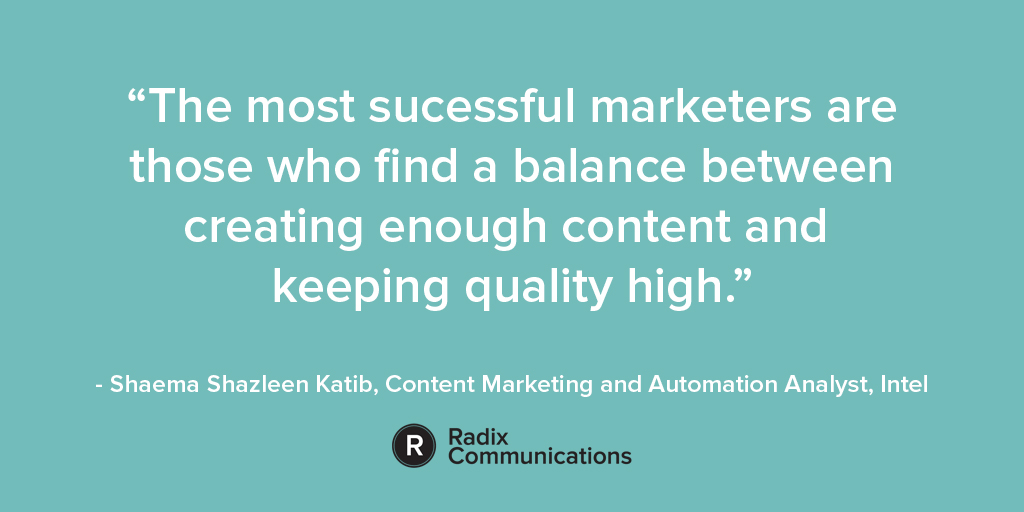
22. “What’s important is finding the right format, length, structure, and tone – and that’s a matter of knowing your audience well enough.” – Shaema Shazleen Katib, Content Marketing and Automation Analyst, Intel

Changing priorities and briefs

23. “Interruptions are a big factor. I have a whole docket of content I’ve envisioned, planned, and want to see through, but it often gets disrupted by ‘drive-by’ projects that have more urgency to them. And because I’ve got the skills and the tools, I have to make the bandwidth.” – Manufacturing marketing manager, North America

24. “Execs and decision-makers who are making it up as they go… meaning they don’t spend the time up front to define main messaging. And that impacts all the collateral that relies on the messaging – which is pretty much everything. ” – Technology copywriter, North America

25. “Convoluted targets and goals for each piece, different key internal stakeholders with contradictory targets unwilling to compromise or even communicate. Lack of subject matter expertise within the content team.” – Media marketing manager, UK

Sales versus marketing

26. “The age-old tug of war between sales and marketing. Not every piece of content I create has to have a pitch, a value proposition, or a call to action attached to it. Ads are ads and content is content. And sometimes content has to be allowed to just inform, inspire, entertain, or enlighten – to build affinity and show thoughtfulness without asking the reader to then DO something or, worse, gating the content.” – Manufacturing marketing manager, North America

27. “We’re meant to interview contacts for our content. These contacts are meant to be ones that make the most strategic sense for the sales team. When you don’t put their leads in or put people they don’t want in your content, they moan. But when the time comes to send out an email asking them for contacts, not a single person responds, until the content is finished and they pipe up that they’re contacts weren’t included??!!” – B2B marketing copywriter, UK

Basically, the internet sucks

28. “I hate that it has to be so heavily reliant on SEO. Once you’ve optimised the content, it just looks ugly, repetitive and cheap. We’ve attempted to write good opinion pieces but the blog posts drowning in keywords always have more success.” – B2B agency marketer, UK

Hell is other departments

29. “People from other departments thinking they know what’s best for marketing. Constantly sticking their oars in and criticising.” – Technology copywriter, UK

30. “Lack of interest or help from other departments that could actually really improve our content. Marketing is at the bottom of the list for attention and they don’t realise its importance for the business performing well.” – IT marketing manager, UK

31. “Management/sales/other departments that don’t know how to present relevant, useful content in a clear, concise manner so it provides true value to the customer. Corporate branding rules that are inflexible, so every piece of content must fit into predefined templates (even if you are trying to create something new). The ‘we’ve always done it this way’ mentality.” – B2B technology CMO, North America
Doug Kessler Quote 2

How do you prove it works?

33. “One of the biggest challenges that I’m sure all B2B marketers face is that creating an outstanding piece of content – that actually brings commercial value or return to the business, other than the number of likes – is increasingly hard to quantify. All evidence is qualitative, which makes it difficult to argue positive performance even in the best of circumstances. Creating something truly fantastic – that drives conversion – that’s the golden goose. And it’s always hard; it’s always a struggle. I have lots of friends in B2C marketing and by comparison their job feels like a doddle; it’s easy to write a fantastic piece of content that implements basic consumer psychological trends to sell a pair of trainers or a yoga subscription. Try doing the same thing to convince a CIO that his approach to cloud migration could do with a tweak. It’s a different ballpark. But senior B2B marketers are almost 20k behind the average B2C marketer in terms of salary.” – Software-as-a-Service CMO, UK
Mat Harper business results quote

Agencies versus clients

35. “Weak agencies who act subservient to me and don’t challenge me hard enough.” – Professional services marketing director, UK

36.”Clients destroying the work. (Nearly.) Every. Single. Time.” – B2B agency copywriter, UK

37. “Clients who go to agencies and want something different but then churn out the same shit. You have departments, just save some money and use them. Last but not least, when they want leads with zero brand awareness. For the love of god Coke still invests money in brand awareness, you need to invest in brand awareness.” – B2B marketing manager, UK

38. “Clients who don’t trust you to make the call. You’ve appointed an expert – let us get on with it.” – Freelance B2B content writer, UK

Lack of alignment

39. “The internal hurdles and the challenges of multiple teams from different departments and countries all with their own idea of what good content should look like and not listening to the strategists and the analysts is incredibly frustrating. Why hire us if you don’t want to listen to what we find?” – Multinational B2B digital marketing strategist

40. “Clients who insist upon multiple levels of approvals. I recall one press release which ‘required’ approval from 11 stakeholders. That will never result in inspired copy – everyone feels they need to change something to justify their involvement.” – B2B content writer, UK
Doug Kessler stakeholder management quote

“A new player has entered the game…”

42. “Writing a piece that I’ve mostly got my way on (aimed actually at helping the customer in their journey rather than just touting our product) and having it all approved and sent to design. Design is just having me proofread and copy check the final doc when the CEO sees it and decides to delete some pages, add in some others (very product heavy), and edit some messaging. But we HAVE to publish it the next day due to campaign timelines. No choice but to approve the change with small amends. Gah!” – Software-as-a-Service content writer

43. “The client came to us and wanted to build a game and a campaign surrounding it with a limited budget. We compiled KPIs and built a strategy to gain said KPIs. One facet was to use influencers to provide quotes to include within the game and a series of blogs. But signoff on the influencers came way after the production of the game so we weren’t able to leverage the quotes within the game. Well, the entire purpose of using the influencers was meant to get reshares of the game to those influencers’ accounts and instead we could only use the quotes within the blogs we produced to cross-promote the game. When all was said and done the effort to gain influencers, interview them, etc didn’t meet the KPI targets we originally set out for the game…” – Software-as-a-Service marketing manager, UK

Lack of time, investment and resources

44. “When I was in-house, it was totally a resourcing problem. The marketing team was growing out in the regions, but they all had to funnel through a tiny content team that was being pulled every which way. We were accused of not being strategic enough – that was because we were constantly asked to check emails, event invites, flyers, presentations, the whole lot. Content was under-valued, under-appreciated, under-resourced… yet every single person in that marketing team relied on content to do their work. Major issue in B2B: content is more than just the team’s writers and grammar experts, so give them the space and resource to do their job, not make you look better.” – B2B content writer, UK

45. “Lack of original ideas and then time to get buy-in to a concept. Poorly skilled in-house resources and/or no budget to deliver it.” – Marketing manager, multinational IT enterprise

46. “As a writer I’m fairly in demand, which means I’m working on a lot of projects for a lot of clients simultaneously, which means I can’t devote as much time/headspace as I’d like to each project.” – Agency content writer, UK

47. “Senior management not having a f’ing clue and still seeing all marketing as cost, not investment.”
– Marketing manager, law firm, UK

The usual suspects…

48. “Lack of ambition is depressing. Aiming SO low.” – B2B agency creative, UK

49. “Content by committee. It never ends well. Everyone knows this, and yet… somehow it persists.” – Technology copywriter, UK

50. “Lack of customer challenge/solution understanding. Relentless focus on leads rather than good content. Decision by committee. Over reliance on the ‘same’ content again and again. Struggle to agree balance between product detail and good creative copywriting that’s emotive rather than just functional. Lack of attention to identifying clear differentiators, etc. etc.” – B2B marketing consultant, UK

51. “Internal politics in the client organisation – ends up being design by committee.” – B2B healthcare copywriter, Oceania

52. “Where do I start? Companies that cannot succinctly articulate what they do or sell? Companies that decide they want to create a piece of content before they even decide they have anything worthwhile to say? The bullshit circus of ‘thought leadership’…” – Technology copywriter, UK

53. “A lack of bravery, and resistance against not using jargon. If clients insist on using the same old  terminology, their copy will always be boring. It’s a constant battle when you’re the only one bold enough to ask ‘What does that mean? Why would the customer care about that? So what?’ We’re the only ones with the guts to ask those questions, and it isn’t always well-received.” – Freelance B2B copywriter, UK
B2B Marketing Pain Quote

A question of attitude

55. “Inherent lack of risk taking, inability to try new things, lack of vision for creative solutions, doing it the same way because ‘that’s the way we do it’ mentality, laziness to try new things…” – Marketing manager, health IT startup, North America

56. “People trying to be too creative for B2B content to suit their own ego or career aims. Sometimes you have to write run-of-the-mill stuff, or just come up with campaigns that are helpful or informative. Not everyone needs to be like Ogilvy, ESPECIALLY in B2B but a lot of people agency-side don’t recognise that. Listen to the customer. They know the audience best. The only reason you are getting friction from a customer is because you aren’t listening to them, you’re listening to your ego.” – B2B agency marketer, UK

What would have the biggest impact on your ability to create good content?

57. “Love my work but it can be lonely and I don’t always have the right people around me to brainstorm problems or creative approaches.” – Technology startup CMO, UK

58. “A guide to managing the management that wants to interfere and get involved.” – B2B technology CMO, North America

59. “Case studies proving that interesting content works would be so helpful. There’s not enough B2B content case studies out there. Loads of B2C case studies but clients instantly ignore those positive results because the audience is different.” – B2B agency copywriter, UK

60. “Something for CEOs and non-marketers on content strategy.” – IT marketing director, North America

61. “Unlimited resource. A CRM that wasn’t a mess.” – Technology CMO, North America

62. “How to get the best from your Client Services department? How do we meet ‘their’ pain points to buy into our vision.” – B2B marketing manager, UK

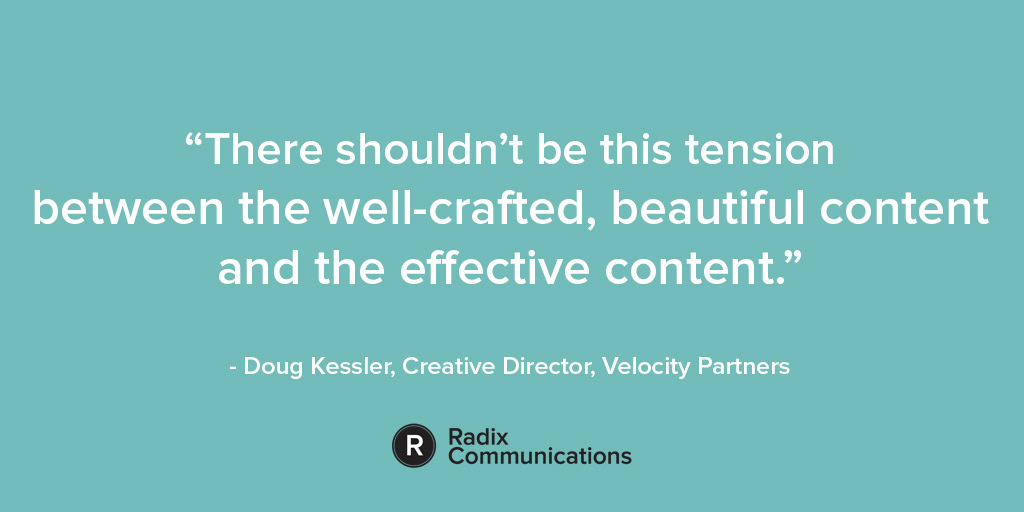
63. “There shouldn’t be this tension between the well-crafted, beautiful content and the effective content. If we don’t start by defining great content as that which has the most impact, we’re never going to succeed.” – Doug Kessler, creative director, Velocity Partners

If nothing else, realise it’s not your fault…

If some of these quotes feel a little unguarded and unpolished, it’s because we’ve tried to keep them as close as possible to the actual text as entered in the survey. What you’re feeling is the frustration of B2B marketers who are being prevented from doing their best work.

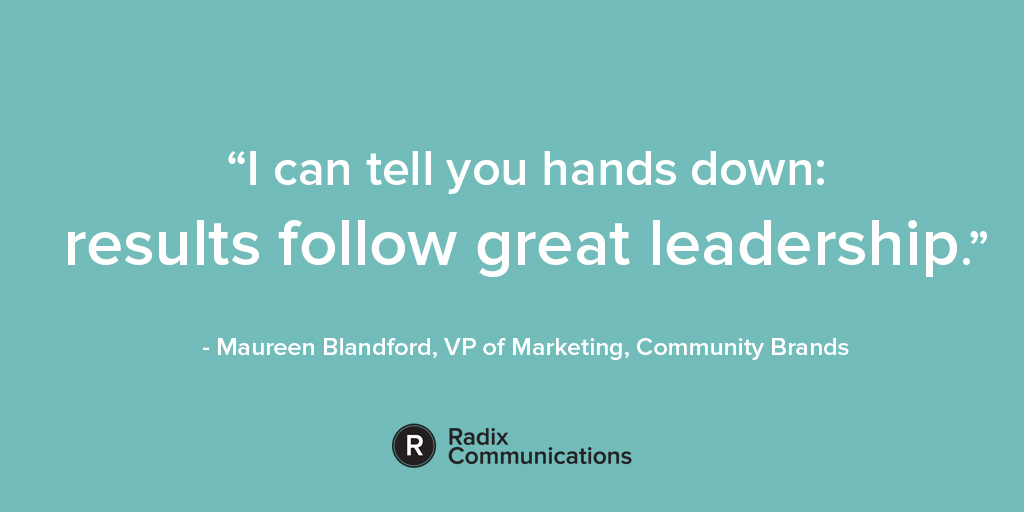
As Maureen Blandford put it in the report: “Imagine having people screwing your work up, and then being blamed by the market when your content sucks. It’s like: ‘If you only feckin’ knew.'”

And if reading this had you nodding your head until your neck is sore, that’s good (the solidarity, not the injury, anyway). It shows there are others going through the same thing. Maybe together, we can find the voice that B2B content marketers need.

We’d love to hear about your own experiences too; you can find us on LinkedIn and Twitter.
Maureen Blandford B2B results quote