Whatever happened to the content marketing heroes?

“Whatever happened to all the heroes – all the Shakespearos?
They watched their Rome burn.”

– The Stranglers: No More Heroes

It it just me, or are there fewer examples of brilliant B2B content marketing than there used to be? Am I imagining it, or has the discipline lost a little of its… zing?

I mean, it very well might just be me. I’ve had a long, long summer full of messaging frameworks and delayed trains to and from London. I could be projecting all of that onto the social feeds I’m reading and the work examples I see.

But if it is true, and people are less excited about content marketing, then it’s a problem. Because without advocates – without that fire of enthusiasm – great B2B content is almost impossible to create.

Is content marketing over?

Inevitably, there’s no shortage of contrarians lining up the obituaries for content marketing. Every “next big thing” has its backlash when marketers discover that, contrary to popular assumption, today’s hot tactic is (whisper it) not actually magic.

In case you haven’t been paying attention, here’s a quick recap:

You get the picture: it’s a regular Infinity War. Ironically, it seems the only tactic which isn’t currently dead, is publicly declaring things dead. (Oops, no: my mistake.)

But if content marketing is on the way out, it seems nobody told the users of Google…
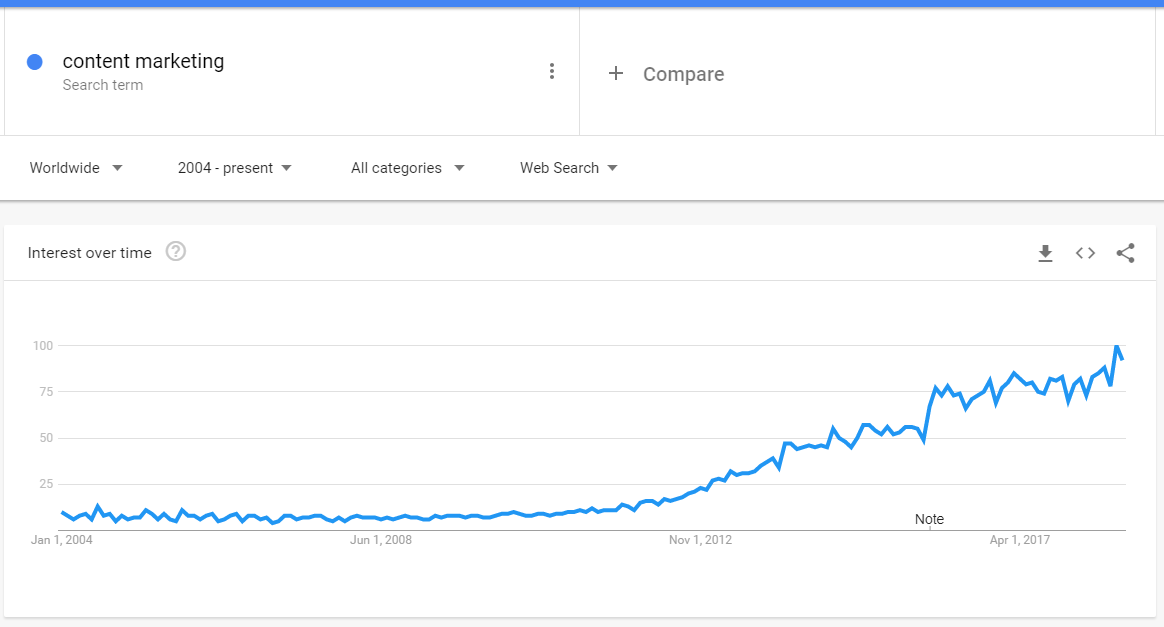
Content Marketing Google Trends

Lack of interest is not the problem. Every year, reports on Content Marketing show B2B marketers plan to maintain or increase their expenditure on the tactic.

So there are still loads of marketers, creating tonnes of content. No, the real problem is, how much of it will be great content?

Why “great” matters in B2B content (now more than ever)

It feels weird that I still need to say this. But somebody has to – and lately, it seems the traditional advocates for brilliant B2B content have been a bit quiet.

So here we go again.

If you’re creating B2B content, there’s no such thing as just “good enough”.

Not any more.

There’s a tonne of content out there, competing for your audience’s attention. And every tweak to Google’s algorithm tips the scales further in favour of quality. So assuming you want to be found, and read, and shared, your stuff needs to be different. More engaging. More relevant. More… amazing.

(And that’s backed by evidence, by the way. Orbit Media’s blogging research shows a clear correlation between time invested and strong results. Meanwhile, 83% of respondents in a CMI/Tomorrow People report attribute their increased success to better content production. This stuff works.)

Sure, there are people on social who will just share any old thing where the title looks halfway decent. And yes, you can take lazy aim at a keyword if that’s what floats your boat. But if those things move the needle on your KPIs, then I can tell you now you’re measuring the wrong stuff.

You don’t get “great” without a fight

So here’s the conundrum.

Now more than ever, successful B2B marketing depends upon outstanding, extraordinary, jawdropping content. The kind of content that takes heroes to deliver. What if it’s happening just at the moment those heroes have started to look elsewhere?

If you’re one of the brightest, boldest, most curious marketers, you’re always looking for the next new thing that can push things forward, and give you an edge. You’re naturally a bit bored by things you’ve done before. That’s what makes you tick. Content marketing isn’t shiny anymore.

But that restless streak – the willingness to challenge the status quo – is also an essential part of delivering truly genius content. Content that is…

Unflinchingly helpful, even when it hurts

Great content answers the questions your clients really ask; not just the ones you wish they would. But in They Ask, You Answer, Marcus Sheridan points out just how revolutionary that idea is, because it involves saying things that everyone in your market assumes are unsayable.

So targeted it’s actually a bit scary

In a content-saturated market, pieces that resonate deeply with a tiny, targeted niche will always beat the vague and generic. But convincing stakeholders to keep their focus that precise takes firm conviction, and nerves of steel.

Utterly, uniquely and unmistakeably yours

Fun Boy Three & Bananarama were right. Well, sort of – it’s what you say and the way that you say it. You should be able to cover up the branding on your content, and still know exactly whose it is – otherwise, why would you bother? That might mean pushing your content, or your voice, into territory it hasn’t been before. Speaking plainly. Sounding different from the crowd. Using a massive four-letter word for your title (OK, that last one’s already been done – but seriously, can you imagine anyone but Doug Kessler doing that back in 2013? That’s the point.)

Stuff like that works precisely because it’s a little rebellious. It goes against the grain, and that’s why you notice it. But it doesn’t just happen; it involves a degree of (somewhat calculated) risk. Somewhere along the line, a marketer needs to take a deep breath, and change something.

Can great content EVER be “business as usual”?

And that’s the rub. Content marketing needs rebels, while the approach itself is becoming ever more established. Maybe it’s no coincidence that this is the moment when  some of the biggest content evangelists have started to sell to big business, and enjoy a hard-earned step back.

So now B2B marketers face two choices. You can make your content “business as usual”, streamline your processes, and use efficiency gains to offset gradually diminishing returns. Or you can take that calculated risk, and shake things up.

Because even though content marketing is a mainstream tactic, the most effective B2B content is still a little subversive at heart.

What does that mean? If we can’t have our heroes back, we need some new ones to step up. Marketers who are willing to look at content in a fresh way. To ask what’s possible, and what customers really need, rather than just which boxes need to be ticked this quarter.

The stage is all yours.

“This is not the end. It is not even the beginning of the end. But it is, perhaps, the end of the beginning.”

– Winston Churchill

B2B Content Hall of Fame: the motor catalogue that repositioned a brand

Imagine you make the world’s best electric drives and motors. Your Swiss-engineered precision is legendary, and your powerful, high-value products are used everywhere a tiny motor must never, ever break.

Your customers make Formula One cars. Surgical robots. Sub-sea exploration drills. And you know that Mars rover that was supposed to work for 3 months, but lasted 15 years instead? Yup: loads of your kit on board.

Cool, huh?

But there’s a problem: legendary, Swiss-engineered precision does not come cheap. Or especially quickly. And sitting between you and every mouthwatering engineering project, there’s a purchasing person who doesn’t care two hoots about the longevity of your Neodymium magnets.

No, their KPIs are all about delivery schedules and cost – and there’s no shortage of bargain-basement competitors lining up to sell them an inferior product at a tempting price.

That’s pretty much the problem Maxon Motor faced. Right up until the company’s marketers did something really smart, that cemented the brand at the top of its market.

And at the heart of everything? A product catalogue.

Change the audience, change the outcome

The smart thing Maxon did was to stop trying to convince the purchasers, and talk instead to an audience that really does appreciate the value of a lighter, stronger, tougher motor.

Design engineers.

If you only engage with an engineering project at the buying stage, Maxon realised, a cheaper alternative will clobber you every time. But if you can convince an engineer to build you into their design? It’s a brave purchaser who’ll overrule the technical expert on such a crucial component for the sake of a few cents.

And even if Maxon is not specified overtly, a design based around the company’s motor specifications means that the purchaser now has to find a unit that can deliver this much power, in that tiny space, while reliably withstanding these conditions. Suddenly, you can count the competitors on one hand.

The trick is getting into that design phase – and that’s a content marketing challenge.

Enter the Maxon Motor catalogue.

Product catalogue as content marketing

The first thing you notice when you open a Maxon Motor catalogue (other than the terrifying thud as it almost crushes your desk) is just how little promotional product content there is – for a company with hundreds of thousands of modular combinations, anyway.

That’s because it’s not just a list selling products; it’s a selection guide. And it contains every formula, graph, schematic and circuit diagram a design engineer could possibly need when they’re specifying the right motor for their new product. Torque profiles are discussed. Thermal tolerances explained. Commutation options compared.

At one time, you’d barely see a product for the catalogue’s first 50 pages (Maxon has since shaken up the order a little, but the principle remains).

Because the second thing Maxon realised is this: Maxon’s engineers may live and breathe drives and motors every day, but a customer’s design engineer might specify a motor once a year; maybe less. They’ll have learned the theory at university, but even those who were paying attention will appreciate their memory being refreshed.

Picture the time-honoured content marketing Venn diagram: “stuff the customer is interested in” versus “stuff your brand knows about”. For Maxon, at the time a design engineer is specifying a high-precision motor (the key moment to influence), that diagram’s basically a circle.

You just have to get the content there at the right time. Which is why the format is so clever.

Content that pulls its weight

The Maxon Motor catalogue weighs a tonne. (I haven’t done the science, but I’m willing to bet it’s heavier than any of the products it describes.) For context, its page count is roughly the sames as Dickens’ Great Expectations.

That’s the genius.

Everyone hates to feel marketed to. And design engineers feel that aversion stronger than most. So when someone eschews a flimsy product showcase and sends you a big-off, serious-looking book, full of figures and diagrams? And it’s about something you need to know on a periodic basis?

First thing: the brand clearly gets you. These are people you can deal with.

Second thing: the book stays on your desk. There’s no way you’re losing something that useful. (Besides, think how many forests were beaten to death to bring it to you…)

The book’s size is precisely what enables it to put the content in the right place, at the right time. I have no idea how wince-inducing the postage is to send them out (not to mention the cost of translating 508 pages into eight different languages), but it’s worth every Euro.

And that’s not all. Maxon gives you the CAD drawing for every product in the guide. So when you know the specification you need, you pick up the file, drop it in place, and… BOOM. The design engineer’s life gets a whole lot easier, and suddenly the purchaser has to buy a motor the exact size, shape and capabilities of this Maxon motor. Neat.

You’d better believe this is great B2B content

The more B2B content marketing anchors itself at the mouth of the sales and marketing funnel, the harder it is for buyers to actually make a decision. That benefits nobody.

For years, Maxon Motor’s selection guide has quietly been aligning the brand with its most profitable target audience, by giving them the knowledge they most need, in a format that feels natural, and that customers are glad to receive and keep to hand. And Maxon has dominated its natural target market.

I can think of no more fitting nominee for our B2B Content Hall of Fame.

Ghostwriting in B2B: fake content or essential thought leadership tool?

This may not come as a shock to you, but a lot of blogs, articles, and white papers published by influential names in B2B aren’t necessarily written by that person.

Even thought-leadership pieces, where the named author is an expert in their field, are often ghostwritten by a copywriter – either because words aren’t that expert’s strong suit, or they simply don’t have the time to write it themselves.

Matching the best writing with the best expertise is a recipe for great content. But where anyone who’s willing to pay for the goods can commission a copywriter to make them look like a thought leader, there’s also the temptation to pretend you know more than you do.

So, in a bid to rid the world of disingenuous content, here’s a short guide to ghostwriting – why it’s an opportunity for true B2B experts, and why easy thought leadership isn’t something you can just buy.

What can a B2B ghostwriter do, exactly?

Let’s make one thing clear. Ghostwriting is a perfectly acceptable thing to do in B2B content marketing.

In fact, it’s invaluable for people who have a lot of important stuff to say, but little time to write it. Or who may be super smart, but simply don’t have a way with words.

Done well, ghostwriting helps to ensure we get to read interesting, engaging stuff from the real thought leaders – not just people who happen to write well, and have time on their hands.

Consider a day in a life of a CEO. They’re extremely busy, and barely have enough time as it is. And while they may have the drive to write their own content, they just don’t have the time. Or think about a product specialist, who knows absolutely everything about their subject, except what a non-expert would find interesting.

That’s where a ghostwriter is essential.

A thought leader can brief a writer on a subject – even if it’s just their big idea, or a brain dump of what they know. A good copywriter who understands the audience can find the angle, and present it in a way that reflects the true views and deep knowledge of the expert, and also chimes with their real voice.

You get the piece they would have written, but sharper and more engaging. (And actually written instead of still in their head.)

Critically, because it’s based on the expert’s real knowledge and opinions, the content says something that no one else is really talking about, or that contains genuinely unique insight.

Why can’t we all be thought leaders?

Simply, to be a thought leader, you need to know your subject inside out. You need to have insights that other people don’t have.

As a B2B technology copywriter, I’ve amassed a broad enough knowledge to write confidently about enterprise tech, and translate someone else’s knowledge into a decent piece of copy. With a solid brief, a call, and some desk research, I can soon write in a confident way on even a niche subject. On a good day, I can make the real thought leader look like a writer as well.

But I’m still far from a thought leader in anything.

Without that crucial insight from a real expert, my best content is still only going to be a rehash of views and information that’s already available in the world. It won’t add any value. It’s not thought leadership.

Faux thought leaders: why ultimately, the frauds lose

If a specialist copywriter can produce something decent from their own knowledge, why aren’t people pretending to be thought leaders in the pursuit of new business?

The short answer is, they are. And it’s a really big problem in B2B technology. Faux thought leaders passing themselves off as experts, while copywriters do the leg work of re-presenting old thoughts as if they’re new.

As a result, the internet is awash with blogs and articles which merely repeat what’s already being said. It’s disingenuous, and it contributes to the noise that makes the B2B internet such an annoying place to be.

Happily, though, the phoney thought leaders are usually wasting their money.

Fake thought leadership (the kind without any leading thoughts) is easy to spot. And not only does it reflect badly on the brand or person it represents, but when it comes to actually deliver the goods, they simply can’t.

I’ve got the knowledge, but no time. Help me.

Perfect – that’s what we like to hear. We’ll bet you have a tonne of insight ready to be put down onto paper, and copywriters are here to help.


A content marketer’s guide to the B2B Marketing Expo 2019

The sheer size of a big marketing exhibition can be both promising and frustrating. With all those exhibitors and talks, there’s bound to be a few unexpected gems that can add value to your work – but how do you cut through the parts that aren’t relevant, to find what you really need?

As a company that’s both speaking and exhibiting at London’s B2B Marketing Expo in March, we have the same concern. The niche we work in (writing content for B2B tech agencies and brands) means we’re bound to be of interest for content marketers visiting the show. But will they find us amid all the videographers, Hubspot aficionados and branded cupcake firms?

To help, we’ve combed the listings (don’t even go there… Soooo. Many. Buzzwords…) to come up with a focused tipsheet for content marketers in particular – with the keynotes, seminars and stands you won’t want to miss.

Into content marketing? Go on the Wednesday.

It may seem counterintuitive – what with SAP’s Jack Dyson giving his big content keynote on the Thursday – but we think there’s marginally more for a content marketer to see on Wednesday 27th. (And no, it’s not just because that’s the day we’re speaking.)

Here’s one potential route through the day…

11.00–11.30 Scaling visual content marketing (Keynote theatre)

This clashes with a promising-looking Inbox Insight talk in Theatre 27, but that’s also on Thursday (see below) so we’ve gone for Grant Munro from Shutterstock. Tailoring a message at scale is a tricky thing to do – whether it’s writing or visual content – so the “tools and strategies” Grant promises should be helpful. (We just hope this isn’t simply a big stock photo pitch in disguise.)

11.45–12.15 How to plan an inbound campaign in 20 minutes (Theatre Hall 26)

If Ian Guiver from Axon Garside can deliver what he promises, there should be plenty of good ideas here to set your content within an effective sales and marketing strategy… with ten minutes to spare!

13.15–13.45 Five terrifying risks you should take with your content (Theatre Hall 12)

A good hour to grab some lunch, browse some exhibition stands and hit the networking area before joining the queue for the undisputed highlight of the event. Yes, it’s Radix’s own seminar, which will give you five calculated creative risks that will help your content to stand out.

(If you’re attending on the Thursday – or if you can’t get a seat – don’t despair; we’re also planning to run this session as a webinar. Sign up for our copywriting advice emails, and we’ll keep you updated.)

14.00–14.30 Cut the crap: transparency in video (Theatre Hall 28)

This is the year video marketing is supposed to take over (which is what they said at the start of 2008, and every year since). Whether that’s true or not, we’re big fans of the insane honesty school of B2B content, for video and writing alike. Most B2B marketers could do with an occasional reminder to keep it real, so if Paul Hamblin of The Video Club has some practical tips to share, you can count us in.

15.30–16.00 10 key pointers on B2B market research (Theatre Hall 14)

OK, this one’s a bit of a curve ball. But a great, original piece of primary research is always a brilliant starting point for a tasty bit of content that really stands out. (Don’t believe us? Ask Orbit Media, or Grist and Coleman Parkes.) A basic grounding won’t go amiss, and Teresa Hadfield from The ICG’s talk promises a key pointer every three minutes on average, which seems like a pretty good return to us.

Thursday’s agenda: content marketing in context

OK, so you’ve booked to go on the Thursday. No problem; there’s still plenty of promising sessions for you to attend. Some will improve your content directly, others are more about the context where it sits.

11.00–11.30 Content that Works (Keynote theatre)

With a capital “W”, no less. Jack Dyson from SAP is promising hacks that can save your life, squeeze every last drop of value from your marketing, and takes your content from bland to brilliant. SAP create some good stuff, so this should be worth a listen (even if it’s just to find out what “couture content” is).

11.45–12.15 ABM: what it is and how to do it in B2B services (Keynote theatre)

Don’t move a muscle; stay right in your seat. Account-based marketing (ABM) is the close cousin of content marketing, and we think there’s lots of scope for crossover between the two. Andrea Clatworthy from Fujitsu is as good a speaker on the subject as you’ll find (and we’re not just saying that because she contributed some great advice to our ABM content ebook). If you want a crash course in ABM, this is the place to be.

12.30–13.00 You’re looking at the funnel the wrong way (Theatre 27)

We’ve long agreed that the funnel is a useless metaphor for the buying journey, and that other alternatives would be much more fun. But we’ve never heard the thought applied to content amplification before, and we’re intrigued to hear what Ross Howard from Inbox Insight has to say.

14.00–14.30 7 steps to creating the perfect explainer video (Theatre 25)

There are few things to beat a really good explainer video. Sadly, few explainer videos are really good. If you’ve never wondered why some work and others don’t, these seven steps from Eden Videos’ Martin Ray-Jones could be just the ticket. We’re certainly hoping to learn a few tricks and tips for our own script writing efforts.

14.45–15.15 Make B2B prospecting great again (Theatre 11)

Yes, this is Leadfeeder (one of those services that tells you which companies have been looking at your website). And no, we haven’t lost our marbles. As long as it’s above board, and not personally identifiable data, the more intelligence we can all get about who’s enjoying what content, the better we’ll all get at writing for the clients we most want. The speaker, Dipak Vadera, is a sharp guy, and we reckon this will be full of tips for bridging the gap between content and sales, without being weird about it.

Our pick of the exhibition stands

You might want to mark a few stands on the floor plan, to visit between the talks. But unless you have a military-grade tolerance for marketing clichés, we recommend you steer clear of the online exhibitor list. Seriously; we barely made it out alive.

While we were there, though, these stands struck us as worth a visit:

Animation and video production

If you want to make video content, you’re in luck. It seems like very third stand at the expo you’ll find a videographer, lying in wait. Unscientifically, the ones that caught our eye include FLETCHERWILSON (we like corporate documentaries so we’ll overlook the all caps) on stand 1582, and we like No Magnolia’s brand (stand 1986). The Animation Guys (stand 2374) have a brilliant animation showreel and The Videonauts (stand 2348) have a brilliant name. And finally, we love a whiteboard video – the more of them in B2B, the better – so we’re delighted to see Eden Videos on stand 1584.

Site search

There are any number of SEO companies to talk to at the expo, but Sooqr Search (stand 2422) are a bit different: they optimise your on-site search so your visitors can find exactly what they’re looking for. Sounds like a good idea.

Translation services

Getting content into a language your buyer is comfortable with is so important for engagement and search. And if 101translations (stand 1732) can deliver everything they promise (cultural analysis, international SEO, etc) then theirs could be a good business card to have in your pocket. We’re slightly freaked out by the lack of a space in their name, but what can we say? We’re writers.

Branded content

If branded content’s your bag, you might want to make a point of visiting the Branded Content Marketing Association (BCMA) on stand 1580. Apparently, they can connect you with experts, but we can’t say much more than that because their exhibition blurb is kind of… intense.

Content delivery

A tonne of B2B content gets shared on LinkedIn, so if InSurge (stand 1922) can help you make it that bit more successful, that’s got to help your content ROI. Maybe even see actual LinkedIn themselves on stand 2350 while you’re at it. And Landingi (stand 1982) reckon their platform can make your landing pages better – which means more downloads for your assets. Could be worth a look.

Market research

As we’ve mentioned, original primary search is always a content winner. So you might want to chat with Ardent Fieldwork (stand 2382), or The ICG (stand 2284). And we reckon there are all sorts of fun ways you could use Wizu (stand 1546) to collect useful information.

Digital asset management

There’s no point making content guidelines and assets if nobody knows how to use them. So maybe have a chat with Asset Bank (stand 1740). Widen (stand 2346) looks fancy, too.

Something a bit different

We’ve no idea how it works, but apparently CoolTabs (stand 2321) can make your written content into an “interactive experience”, which sounds intriguing. DataSine (stand 2614) say they have a “personality-based marketing content augmentation tool” (no, us neither) and it’s called Pomegranate, which is cute. Peek and Poke (stand 2349) make addictive branded games. And if you want something *really* clever, maybe talk 3D modelling and AR with bloc digital (stand 2512).

Branded cupcakes

OK, it has nothing to do with content marketing. We just love Eat My Logo’s name. If you go to stand 1784, bring us back a couple of samples.

B2B copywriting

And of course, if you’d like to talk about any aspect of B2B content writing, come and have a chat with Radix, on stand 2184 (we’re over the far side, near seminar theatres 11 and 12).

We’ve had a load of free writing guides printed, so if you want the inside track on creating good web copy, ABM content, case studies, B2B comics, blog posts or messaging, we’ll give you something helpful to take away.

If you play your cards right, you may even get a natty pencil, made from a recycled CD case. (And if that’s not worth coming to ExCeL for, I don’t know what is.)

Be there, or be an equal-sided parallelogram.

Getting started with B2B podcasting – eight quick tips for first-time podcasters

Podcasts are a great way to get in front of your target audience and show your expertise in your particular sector. And while podcasting can be a lot of fun, getting started can be a bit daunting.

To help you along, we’ve put together a set of eight content tips that will help you to profile your audience, choose the right topics and format, promote your podcast and track the results. It’s based on our experience to date with the Radix podcast – our monthly podcast looking at trends and issues in B2B marketing copywriting.

You may also like to look at our earlier SlideShare on getting the techy side of your podcast right, from choosing where to host it and investing in the right equipment to getting it on to iTunes.

65 real quotes about B2B content marketing problems

B2B marketers are angry, and that’s probably fair enough. How would you like it if your valiant efforts to create great work were thwarted at every turn, by the people who are supposed to be on your side… and then commentators kept asking why your content isn’t innovative, emotional, or brave?

When we conducted our Barriers to Great B2B Content research, we didn’t expect the volume or ferocity of responses we received.

In hindsight, perhaps we should have. By inviting B2B marketers to reveal their frustrations in secret, we gave them a chance to vent long-held frustrations about their own organisations, and the working conditions that hold them back.

Now, we’ll share those comments with you. In their entirety.

As well as the venom (be warned, some of the language does get understandably fruity), there’s plenty of wisdom and constructive advice here. And, if you’re a B2B content marketer, quite a bit of solidarity too. You are not alone.

We’ve also included some gems from our four expert commentators in the report: Maureen Blandford, Doug Kessler, Mat Harper, and Shaema Shazeel Katib.

What is it about your best content that makes you proud?

1. “Authenticity.” – B2B technology content writer, UK

2. “It is useful and relevant to the customer.” – IT/tech CMO, North America

3. “It’s differentiated from the white noise surrounding it, and it’s specific – not picking from the library of generic B2B language.” – Agency content creator, UK

4. “Not proud of any.” – Marketing manager, legal firm, UK

B2B marketing balance quote

What gets in your way when you’re trying to create great B2B content?

6. “Executive fear.” – IT marketing director, North America

7. “Not enough insight. Client too product focused. Client-side marketing does not have enough status or power.” – B2B technology marketing consultant, UK

8. “I don’t always know what language/terminology to use with the target audience, or what level of knowledge they already have.” – Engineering copywriter, UK

Stakeholder micromanagement

9. “Too many cooks in the kitchen. I’ve had many projects drag on far, far longer than they needed to because we had to have 6+ stakeholders weigh in. We revise according to their feedback and put it in front of them again, only to have them find new issues or suggest something entirely different that they’re now excited about and want to see.” – Technology marketing manager, North America

10. “I’ve heard all the following recently: ‘I really like the concept but…’ ‘Lovely job, and we got great results, but I am missing the creativity of marketing and writing.’ ‘I’m going to bring the work back in house now you have shown me a different way of approaching it.’ ‘No I don’t want to abide by your terms of 45 days notice.’ ‘Great content but it hasn’t worked. I don’t have any sales yet and website traffic hasn’t really changed.’ ‘I can see what you are saying and I enjoyed reading it, but please add in the following edits.'”  – Tech startup CMO, UK

11. “If your stakeholders are not in alignment, nothing is possible. And if they are, almost anything is.” – Doug Kessler, Creative Director, Velocity Partners

12. “I’m hired to write great copy. I do. The technical MD clearly knows best though, and needs to rewrite everything a million times just to grow his ego and make marketing feel like shit.”
– IT content writer, UK

Executives who don’t “get it”

13. “Subject matter experts not understanding that you are trying to write to the customers’ pain points.” – Marketing manager, multinational manufacturer

14. “Executives who think all content is selling/promotional – don’t get thought leadership is different.” – IT marketing director, North America

15. “In my organisation at least, non-content people don’t fully understand the true role of content (it being much more than just ‘chucking up a few blog posts’). Because it’s not understood, it’s not valued – and neither are its creators. This doesn’t stop almost everyone having an opinion on content, however, despite not being able to actually create, plan, implement or measure it themselves. Go figure…” – Content manager, business insurance, UK

16. “Too much tech talk. Internal clients don’t think clever, simple or emotional messaging/visuals are as effective as feature listing.” – Telecoms marketing executive, North America

Maureen Blandford B2B leadership quote

Forgetting about the reader

18. “Interference from management who want content to sell, sell, sell.” – Technology CMO, Europe

19. “A pretty headline with multiple adaptions (‘Lead with confidence’ ‘Train with confidence’ ‘Operate with confidence’ etc) seems to always be preferred over interesting content that readers actually care about and will engage with.” – Agency copywriter, UK

20. “One of my biggest bugbears? The fact companies think their brand matters to customers. I had a client recently contract me to write ten short blogs about eCommerce – which was fine… until the MD got involved and complained they didn’t sell what the company was doing enough. I took her point – they could be steered more in that direction – but ultimately, my argument is that good content should provide value for customers; giving them information that they can go away and use. Or it should provide insight into the challenges they’re facing. When you stop trying to sell and think about the customer (and given that they’re already reading your content on your website) you have a much better opportunity to foster their trust. But often, this is a tough sell.” – Professional services content writer, UK

21. “A brief that’s aimed at the brand not the consumer. Clients who don’t believe that business people are just people who happen to be at work. Clients who don’t show any empathy/understanding of their consumers.” – B2B marketing copywriter, UK

22. “What’s important is finding the right format, length, structure, and tone – and that’s a matter of knowing your audience well enough.” – Shaema Shazleen Katib, Content Marketing and Automation Analyst, Intel

Changing priorities and briefs

23. “Interruptions are a big factor. I have a whole docket of content I’ve envisioned, planned, and want to see through, but it often gets disrupted by ‘drive-by’ projects that have more urgency to them. And because I’ve got the skills and the tools, I have to make the bandwidth.” – Manufacturing marketing manager, North America

24. “Execs and decision-makers who are making it up as they go… meaning they don’t spend the time up front to define main messaging. And that impacts all the collateral that relies on the messaging – which is pretty much everything. ” – Technology copywriter, North America

25. “Convoluted targets and goals for each piece, different key internal stakeholders with contradictory targets unwilling to compromise or even communicate. Lack of subject matter expertise within the content team.” – Media marketing manager, UK

Sales versus marketing

26. “The age-old tug of war between sales and marketing. Not every piece of content I create has to have a pitch, a value proposition, or a call to action attached to it. Ads are ads and content is content. And sometimes content has to be allowed to just inform, inspire, entertain, or enlighten – to build affinity and show thoughtfulness without asking the reader to then DO something or, worse, gating the content.” – Manufacturing marketing manager, North America

27. “We’re meant to interview contacts for our content. These contacts are meant to be ones that make the most strategic sense for the sales team. When you don’t put their leads in or put people they don’t want in your content, they moan. But when the time comes to send out an email asking them for contacts, not a single person responds, until the content is finished and they pipe up that they’re contacts weren’t included??!!” – B2B marketing copywriter, UK

Basically, the internet sucks

28. “I hate that it has to be so heavily reliant on SEO. Once you’ve optimised the content, it just looks ugly, repetitive and cheap. We’ve attempted to write good opinion pieces but the blog posts drowning in keywords always have more success.” – B2B agency marketer, UK

Hell is other departments

29. “People from other departments thinking they know what’s best for marketing. Constantly sticking their oars in and criticising.” – Technology copywriter, UK

30. “Lack of interest or help from other departments that could actually really improve our content. Marketing is at the bottom of the list for attention and they don’t realise its importance for the business performing well.” – IT marketing manager, UK

31. “Management/sales/other departments that don’t know how to present relevant, useful content in a clear, concise manner so it provides true value to the customer. Corporate branding rules that are inflexible, so every piece of content must fit into predefined templates (even if you are trying to create something new). The ‘we’ve always done it this way’ mentality.” – B2B technology CMO, North America

Doug Kessler Quote 2

How do you prove it works?

33. “One of the biggest challenges that I’m sure all B2B marketers face is that creating an outstanding piece of content – that actually brings commercial value or return to the business, other than the number of likes – is increasingly hard to quantify. All evidence is qualitative, which makes it difficult to argue positive performance even in the best of circumstances. Creating something truly fantastic – that drives conversion – that’s the golden goose. And it’s always hard; it’s always a struggle. I have lots of friends in B2C marketing and by comparison their job feels like a doddle; it’s easy to write a fantastic piece of content that implements basic consumer psychological trends to sell a pair of trainers or a yoga subscription. Try doing the same thing to convince a CIO that his approach to cloud migration could do with a tweak. It’s a different ballpark. But senior B2B marketers are almost 20k behind the average B2C marketer in terms of salary.” – Software-as-a-Service CMO, UK

Mat Harper business results quote

Agencies versus clients

35. “Weak agencies who act subservient to me and don’t challenge me hard enough.” – Professional services marketing director, UK

36.”Clients destroying the work. (Nearly.) Every. Single. Time.” – B2B agency copywriter, UK

37. “Clients who go to agencies and want something different but then churn out the same shit. You have departments, just save some money and use them. Last but not least, when they want leads with zero brand awareness. For the love of god Coke still invests money in brand awareness, you need to invest in brand awareness.” – B2B marketing manager, UK

38. “Clients who don’t trust you to make the call. You’ve appointed an expert – let us get on with it.” – Freelance B2B content writer, UK

Lack of alignment

39. “The internal hurdles and the challenges of multiple teams from different departments and countries all with their own idea of what good content should look like and not listening to the strategists and the analysts is incredibly frustrating. Why hire us if you don’t want to listen to what we find?” – Multinational B2B digital marketing strategist

40. “Clients who insist upon multiple levels of approvals. I recall one press release which ‘required’ approval from 11 stakeholders. That will never result in inspired copy – everyone feels they need to change something to justify their involvement.” – B2B content writer, UK

Doug Kessler stakeholder management quote

“A new player has entered the game…”

42. “Writing a piece that I’ve mostly got my way on (aimed actually at helping the customer in their journey rather than just touting our product) and having it all approved and sent to design. Design is just having me proofread and copy check the final doc when the CEO sees it and decides to delete some pages, add in some others (very product heavy), and edit some messaging. But we HAVE to publish it the next day due to campaign timelines. No choice but to approve the change with small amends. Gah!” – Software-as-a-Service content writer

43. “The client came to us and wanted to build a game and a campaign surrounding it with a limited budget. We compiled KPIs and built a strategy to gain said KPIs. One facet was to use influencers to provide quotes to include within the game and a series of blogs. But signoff on the influencers came way after the production of the game so we weren’t able to leverage the quotes within the game. Well, the entire purpose of using the influencers was meant to get reshares of the game to those influencers’ accounts and instead we could only use the quotes within the blogs we produced to cross-promote the game. When all was said and done the effort to gain influencers, interview them, etc didn’t meet the KPI targets we originally set out for the game…” – Software-as-a-Service marketing manager, UK

Lack of time, investment and resources

44. “When I was in-house, it was totally a resourcing problem. The marketing team was growing out in the regions, but they all had to funnel through a tiny content team that was being pulled every which way. We were accused of not being strategic enough – that was because we were constantly asked to check emails, event invites, flyers, presentations, the whole lot. Content was under-valued, under-appreciated, under-resourced… yet every single person in that marketing team relied on content to do their work. Major issue in B2B: content is more than just the team’s writers and grammar experts, so give them the space and resource to do their job, not make you look better.” – B2B content writer, UK

45. “Lack of original ideas and then time to get buy-in to a concept. Poorly skilled in-house resources and/or no budget to deliver it.” – Marketing manager, multinational IT enterprise

46. “As a writer I’m fairly in demand, which means I’m working on a lot of projects for a lot of clients simultaneously, which means I can’t devote as much time/headspace as I’d like to each project.” – Agency content writer, UK

47. “Senior management not having a f’ing clue and still seeing all marketing as cost, not investment.”
– Marketing manager, law firm, UK

The usual suspects…

48. “Lack of ambition is depressing. Aiming SO low.” – B2B agency creative, UK

49. “Content by committee. It never ends well. Everyone knows this, and yet… somehow it persists.” – Technology copywriter, UK

50. “Lack of customer challenge/solution understanding. Relentless focus on leads rather than good content. Decision by committee. Over reliance on the ‘same’ content again and again. Struggle to agree balance between product detail and good creative copywriting that’s emotive rather than just functional. Lack of attention to identifying clear differentiators, etc. etc.” – B2B marketing consultant, UK

51. “Internal politics in the client organisation – ends up being design by committee.” – B2B healthcare copywriter, Oceania

52. “Where do I start? Companies that cannot succinctly articulate what they do or sell? Companies that decide they want to create a piece of content before they even decide they have anything worthwhile to say? The bullshit circus of ‘thought leadership’…” – Technology copywriter, UK

53. “A lack of bravery, and resistance against not using jargon. If clients insist on using the same old  terminology, their copy will always be boring. It’s a constant battle when you’re the only one bold enough to ask ‘What does that mean? Why would the customer care about that? So what?’ We’re the only ones with the guts to ask those questions, and it isn’t always well-received.” – Freelance B2B copywriter, UK

B2B Marketing Pain Quote

A question of attitude

55. “Inherent lack of risk taking, inability to try new things, lack of vision for creative solutions, doing it the same way because ‘that’s the way we do it’ mentality, laziness to try new things…” – Marketing manager, health IT startup, North America

56. “People trying to be too creative for B2B content to suit their own ego or career aims. Sometimes you have to write run-of-the-mill stuff, or just come up with campaigns that are helpful or informative. Not everyone needs to be like Ogilvy, ESPECIALLY in B2B but a lot of people agency-side don’t recognise that. Listen to the customer. They know the audience best. The only reason you are getting friction from a customer is because you aren’t listening to them, you’re listening to your ego.” – B2B agency marketer, UK

What would have the biggest impact on your ability to create good content?

57. “Love my work but it can be lonely and I don’t always have the right people around me to brainstorm problems or creative approaches.” – Technology startup CMO, UK

58. “A guide to managing the management that wants to interfere and get involved.” – B2B technology CMO, North America

59. “Case studies proving that interesting content works would be so helpful. There’s not enough B2B content case studies out there. Loads of B2C case studies but clients instantly ignore those positive results because the audience is different.” – B2B agency copywriter, UK

60. “Something for CEOs and non-marketers on content strategy.” – IT marketing director, North America

61. “Unlimited resource. A CRM that wasn’t a mess.” – Technology CMO, North America

62. “How to get the best from your Client Services department? How do we meet ‘their’ pain points to buy into our vision.” – B2B marketing manager, UK

63. “There shouldn’t be this tension between the well-crafted, beautiful content and the effective content. If we don’t start by defining great content as that which has the most impact, we’re never going to succeed.” – Doug Kessler, creative director, Velocity Partners

If nothing else, realise it’s not your fault…

If some of these quotes feel a little unguarded and unpolished, it’s because we’ve tried to keep them as close as possible to the actual text as entered in the survey. What you’re feeling is the frustration of B2B marketers who are being prevented from doing their best work.

As Maureen Blandford put it in the report: “Imagine having people screwing your work up, and then being blamed by the market when your content sucks. It’s like: ‘If you only feckin’ knew.'”

And if reading this had you nodding your head until your neck is sore, that’s good (the solidarity, not the injury, anyway). It shows there are others going through the same thing. Maybe together, we can find the voice that B2B content marketers need.

We’d love to hear about your own experiences too; you can find us on LinkedIn and Twitter.

Maureen Blandford B2B results quote

What’s the perfect work environment for creating B2B content?

If you’ve read our Barriers to Great B2B Content 2020 report, you know the results are pretty bleak. Of the 105 B2B marketers we interviewed, 68% said they’re not proud of even half their own content.

You might even be one of that number. And if so, it’s probably because where you work doesn’t work for you. Whether it’s because of internal politics, limited resources or interfering stakeholders, our survey showed that lots of marketers just don’t have the right environment to thrive.

And while many of these obstacles may be out of your control, every self-appointed marketing expert will still judge the ‘unoriginal’ work you produce as a result.

We talked to Maureen Blandford, VP of Marketing at Community Brands, about this particular frustration and she gave us a great response: “A lot of the time we have no choice, unless you happen to be in a lucky fairy land.” (Feel free to yell that whenever the mood takes you.)

But don’t give up hope. Your perfect B2B workplace – where you really can be proud of the content you publish – could be out there.

So, what would it look like and how can you identify it? We’ve spoken to Maureen and examined the statistics. Here’s what to look for.

Does company size matter?

Unsurprisingly, our survey revealed that across small, mid-sized and enterprise-scale firms, marketers have different ideas about what makes content great. Similarly, we found that different sized business find some obstacles more challenging than others:

But which will enable you to create your best content? Well, that depends what problems you find least intrusive, and what aspects of B2B content you value most.

We’ve taken a deep dive into the survey results shown above. These figures, taken directly from our global survey of B2B marketers, suggest how the benefits and obstacles of working in an enterprise, mid-sized organisation or a smaller firm could vary.

Enterprise:

Benefits

  • Least likely to struggle with workload or budget
  • Best chance of being proud of your content’s design, humour or emotional impact
  • Close correlation between perceived quality and business results

Obstacles

  • Brand, legal or policy issues could be an issue
  • Direct contact with your customers is likely to be very limited
  • Lowest chance of creating content that reflects customer priorities

Mid-size business:

Benefits

  • Highest likelihood of reflecting customer priorities
  • Slightly better chance of avoiding stakeholder interference
  • Fewest problems with brand and legal restrictions

Obstacles

  • Workload and budget issues are almost inevitable
  • Least chance of using humour, originality or emotion
  • Most likely to experience departmental friction

Small business:

Benefits

  • Easy contact with customers
  • Coordinating with other departments is less of a challenge
  • Best chance of writing copy you’re proud of

Obstacles

  • Constantly changing priorities likely to be a big issue
  • Micromanagement from senior leadership is likely
  • Smallest correlation between satisfaction and business results

When we asked Maureen, she said:

“I work in a sizable company as head of marketing for one of the divisions, and I’ve also worked for small tech companies and start-ups. And while size doesn’t really matter, a HUGE difference – in our quality of work and its results – is seen when bosses and executive teams are switched on and work collaboratively.”

So if you have an excellent leadership team, you’re more likely to create effective content you’re happy with – regardless of where you work. But what does that team look like? Well…

“Results follow good leadership”

When Totaljobs surveyed 2000 UK employees, they found one in two people had left a job because of bad management. And HR tech firm AdviserPlus found that in at least 70% of cases, management coaching resulted in better employee performance.

So the chances are, you’ve had at least one boss with questionable leadership skills.

And whether your boss was (or is) completely incompetent, or just a bit of a micromanager, poor leaders can prevent you from creating your best copy – or stop it being released.

We asked Maureen about great leadership in a B2B working environment – and how it can enable you to write copy you’re proud of. She said:

“There’s a whole bunch of stuff that goes into making content, that the market doesn’t acknowledge. Talent, passion and will are maybe 10% of it. Do you have a supportive team? Are sales co-operative? What about the leadership team? What kind of budget and tools do you have? How many micromanagers are there?

“I can tell you about my boss here, and my previous boss in Amsterdam, who runs a smaller technology company. Both of them had my back, completely supported me, and bought in to transformation.

“And the experiences I’ve had is exactly what Harvard Business School would say. The results are much stronger when leaders actually know how to lead, as opposed to leaders who are micromanaging jerks. Results follow good leadership.”

Toxic workplaces: “just get out”

You’ll find a B2B marketing workplace is always challenging – as our survey results made clear. With so many different departments and functional areas, everyone has their own goals and priorities. And earning their respect is no easy job – you’ll need to juggle a LOT of opinions.

And even though a challenging workplace is normal, it can still prevent you from producing your best work. 86% of our respondents say a problem with departmental co-operation gets in the way of their content.

We asked Maureen how she navigates this obstacle:

“I treat internal stakeholders like customers and prospects. I anticipate their objections, and what their values are. I’m never going to pitch our Head of Sales on some fancy-schmancy thing I want to do, or talk about colours. I’ll ask about her conversion rates, and where she wants to do better. Then I’ll frame projects to her business objectives.

“When I’m mentoring colleagues, I tell them we’re planting seeds. The first or second seed you plant may not grow or sprout ideas in their minds, but after a couple they start to understand your perspective.”

But a challenging culture is very different from a toxic one. So, how can you clearly define the two? Maureen draws a clear line between them:

“In most cultures, it’s challenging to work with colleagues in other functional areas. I don’t think I can code better than the software developers or do F&I better than the CFO; that’s not a thing. But of course everyone thinks they can do marketing.

“But a toxic culture is to do with the CEO; are they encouraging lying, cheating, stealing, hustling or hacking? People should be respectful but challenging, not demeaning and arrogant. If it’s a demeaning culture, that’s a toxic culture. And you’re not going to be able to change that, so just get out.”

And if you’re really, really determined to find the perfect workplace…

…You might need to commute a little further.

The statistics show that if you were to work in North America, you’re more likely to create content you’re proud of. Our survey found 39% of North Americans are happy with most of their work – a big jump from the 12.87% of European respondents.

It seems strange, we’ll give you that. But the figures above suggest some possible reasons. Only 30% of North American marketers find workload a big problem, compared to 50% of Europeans.

Meanwhile, North American marketers are least likely to agree with statement: “There’s always a trade-off between creating enough content, and keeping quality high”, while the European marketers we spoke to agreed 100%.

Of course, you’ll find plenty of job opportunities closer to home. We’re just saying – it’s an option.

How do you spot your ideal workplace IRL?

By now, you (hopefully) have a better image of a workplace that will enable you to create the content you’re proud of.

But when faced with a real-life opportunity, you might not have the transparency you need to know it’s right for you. Even Glassdoor can’t always help – despite having 67 million visits a month.

And truthfully, you’re going to have to gamble a bit. As Maureen says:

“For the most part, and this is not just for marketers, it is really hard to understand the culture until you get there. And it’s important not to feel ashamed about that – you did your best.

“But one way around that is if you actually know people at a company. If you’re being hired and you know someone, they can give you the straight scoop.”

So, use this guide to know exactly what you’re looking for. Then tailor the search to your specific preferences and find someone on the inside to get a clear picture. And when you get there? That’s when the real work begins.

Should we rename “B2B content”? An interview with Palo Alto Networks marketer Mat Harper

Tweets. Blog posts. Explainer videos. Podcasts. Long-ass web pages. Interactive infographics. Hundred-page ABM reports. Even board games. Each of these marketing formats has a different style and function. But they all have one big thing in common.

Whether it’s the tiniest social seed or a big ol’ whitepaper, we categorise them all under one abstract and indeterminable word: content.

And Mat Harper, EMEA marketing chief of staff at Palo Alto Networks, believes that’s a problem.

Our recent content obstacles survey revealed that 68% of B2B marketers aren’t proud of even half their own work. In our drive to find out why, we outlined six obstacles to creating great content, from stakeholder interference to conflicting priorities. But Mat thinks we need to dig deeper.

In an interview for the survey report, he said we need to reconsider how we actually talk about creative marketing assets in B2B. More specifically, that we need to stop labelling everything as ‘content’ that should yield certain results. Because by doing so, he thinks we lose something equally important – the space for creativity.

And when we asked him how and why, he made some intriguing points. So we’ve put together the full interview for you. Here’s what he had to say…

Radix: You’ve seen the survey results. 37% of marketers say they’re only proud of a handful of work, ever. And 3% said they’d never produced work to be proud of. Having worked in B2B tech marketing for years, did you feel a sense of familiarity in these figures? Did anything make you really stop in your tracks?

Mat: “A lot of them made sense, and there’s definitely a feeling of familiarity there – I recognised many of the points in the observations from my own experiences.

“But one thing that really stood out to me, and we’re taking a bit of a step away here, is the impact of how we refer to all marketing content as just ‘content’. It’s a strange place we’ve put ourselves in.

“If you were a creative person, would you like your work to be defined as ‘content’? I certainly wouldn’t.”

“For a long time, and for the majority of my career, the word ‘content’ has been an umbrella term that encompasses everything – everyone from social media influencers to marketing professionals are using it. It’s always: ‘What is the content? We need more content.’

“And I think we need to understand where it’s come from. Would you refer to an artist’s work as ‘content’? No. So we have to stop and think – if you were a really creative person, and had fully poured yourself into your work, would you like it to be defined just as ‘content’? I certainly wouldn’t.”

Radix: But how does the catch-all word ‘content’ actually create limitations for B2B marketers?

Mat: “When we think about ‘content’, we’re always thinking about it as something that must drive to a result or outcome. And that might not be the smartest idea.

“We’ve got to a point where we’re completely data-driven and obsessed with ROI. We only focus on how many leads content engages with, or how many click-throughs it sees. And we have to ask ourselves: are they actually business results we’re talking about – is a clickthrough a business result? Do we even necessarily need to build content with a specific business result in mind?

“Because when you look at what some people are saying in the content obstacle survey results, it’s clear they’re not satisfied with what they’re producing. They think that in the drive to produce effective ‘content’, there’s too much influence from others, and too many people have their hands in sign-off.

“Can you really be proud something that’s just ‘content’ created by committee? Maybe you can’t.”

“If you are a creative person, the more people add their opinion or want to make changes, the further away it moves from your vision or plan. And can you really be proud or take ownership of something that’s not really you, that’s just ‘content’ that’s created by committee on behalf of the company? The more I think about it, the more I realise – maybe you can’t.

“The idea phase of content creation is brilliant. I get to dive into a project I’m passionate about. But often I see people stop there, because it’s near-impossible to justify an idea that came naturally. There’s no point in starting.

“Any really original idea can become the victim of its own success; it gets a reputation within your organisation, and suddenly it’s like people are putting gambling chips on what you’re creating.

“As the stakes get higher, ideas get interrogated. You need to predict the business benefit, or the pipeline, and justify yourself on all these levels, which is not where the idea came from. It’s demotivating.”

Radix: But the copy we write does have to have a business impact – we’re not just making art.  So how can marketers align that with creating content they’re proud of? And as a tech marketing chief of staff, how would you suggest our readers find that balance?

Mat: “I’m not an idealist who thinks everyone should be a creative artist who expresses themselves on a canvas every day at work. Marketing has a role, and we have to produce ROI and business results for the company. But who’s to say the creator should be focused on that?

“Maybe, to get the best business impact, we should allow our employees who have expertise, passions and interests – and understand our customers – to express that, and have a bit of hope that it will resonate with human beings. Because that’s who we’re marketing to: human beings who can connect on an emotional, personal level.

“We’re marketing to human beings who connect on an emotional level… Perhaps we should allow people to express themselves.”

“Perhaps we should even allow people to express themselves as a journalist would. Within the remit of the role and company values, let your employees find what’s interesting to them, something they can put their stamp on, be proud of and stand behind. Give them the confidence and freedom to go build that on their own. And let that resonance become their measure of success.

“Then it puts the onus on the marketing operations team to figure out how we make the most of that impact, and build the systems to translate it into results.”

Radix: it would be unusual for marketers to be given the freedom to play with content creation without establishing a watertight business case first. Do you think it’s realistic?

Mat: “I think it could be in small doses. Marketers are always having to justify their worth, and their place in the company. That makes it difficult for them to spend time on something that isn’t easily measurable or doesn’t quickly show ROI – which can lead to a lack of originality.

“But you can manage creativity into an organisation; you just need to be realistic about what is possible.

“Marketers are always having to justify their worth, and their place in the company. That can lead to a lack of originality.”

“I once worked with a manager who didn’t like people to have job roles that were too defined. She’d happily encourage someone who had come up with an idea to go away and produce that work, regardless of their job title. To her, your role is only defined by the eventual outcome of what that role needs to be – how you get there is up to you.

“And that’s a great example of how to build space for creative freedom into a large company without losing sight of the results.

“The only difficult part, is where do you draw the line? You can give people the extra space and time to be creative, but at some point you need to measure the results of that decision, so you can decide whether that time was invested well. And that’s a real challenge.”

Can creative space help you find original concepts and great results?

Mat’s view might sound controversial to you. Especially if you’re currently fighting for a marketing budget that’s been merciless hacked down.

However, the survey results do show the importance of making space for creativity. When we asked content writers and creators ‘what is it about your best content that makes you proud?’, 39% said clever, or original concepts. Yet 75% of the same group aren’t proud of even half their own work.

When we put the same question to CMOs and directors, the tensions became clearer. The results were dramatically reversed – only 18% said clever concepts, while 45% said business results. From those signing off, there is more of an emphasis on business outcomes than originality. But that’s not the only thing preventing marketers from being more creative.

High workloads also play a role. The less time you have to create something, the more tempted you may be to resort to safe, tried-and-tested methods. 9 out of 10 marketers said workload gets in the way of great content. And those who said this was a ‘big problem’ were 25% less likely to say their best content had a clever, original concept.

Making space for originality doesn’t mean you have to reinvent your entire strategy, or should start using every weird and wonderful format you can find. Start small – perhaps with headline formats, subject lines or customer quotes – rigorously collect the results and use that data to justify your choice. Then you can continue to build from there. You can find more helpful tips here.

To quote Doug Kessler (also in the survey report): “There shouldn’t be this tension between the well-crafted, beautiful content and the effective content.”

In other words, the first step is proving that great content works.

Thanks again to Mat Harper of Palo Alto Networks for being so generous with his time and experience.

How original research can boost your B2B content | B2B Content Tuesday

As Andy Crestodina of Orbit Media notes, B2B research is the “one kind of content that crushes almost anything else you can publish.” Truly, words to live by.

At Radix, we can attest to this. Our Barriers to Great B2B Content survey of 105 B2B marketers is easily our most popular piece of content of the last year – followed by our Best B2B Content awards.

But not all research is the same. To have impact, you need to ensure yours is valuable, credible and substantiated.

As part of our B2B Content Tuesdays webinar series, David put together four steps to help your research-based content pack a punch. Some of them are from our own experience, and some insights we’ve shamelessly stolen from B2B research expert Simon Hayhurst, business consultant at Coleman Parkes, whose brain we were lucky enough to pick for our podcast.

Plus, we’ve summarised David’s chat with marketing consultant Luan Wise, who’s just completed an exciting new research project of her own…

Four steps to better research-based content:

1. Figure out what your audience wants to know – and what no-one else has answered

Whatever research you’re carrying out, it has to be relevant to your audience. Otherwise, no-one will want to spend their valuable time reading it.

Start by considering who your audience are, what content they might be interested in, and where knowledge gaps exist. Is there a particular stat missing they may want to know about, for example?

2. Devise a credible way to answer that question, based on the resources available

Although surveys are sometimes seen as the Holy Grail of B2B research, they’re not the only way to do it.

Once you know what gap your research is filling, think about the best way to get that information. Sure, a survey could work. But so could A/B testing, aggregating publicly available information, crunching your own numbers, or doing qualitative interviews with a small number of highly relevant people.

Bonus tip: when you’re thinking about which questions to ask, keep the end content in mind.

3. Test an attention-grabbing hypothesis

We asked 105 B2B marketers if they agreed with this statement: “If nobody else had to sign off our content, the results would be a lot better.”

Now, we can say that nearly 60% of marketers think their own sign-off processes make their results significantly worse. How’s that for attention grabbing?

4. Slice and dice your results every way you can

Once you’ve finalised your research, there are tons of ways you can atomise the results into smaller content assets. Take key data points and specific stats, and turn them into blog posts, infographics, LinkedIn posts, T-shirts – you name it. Each one leads back to the main report (except the T-shirts).

David talks to B2B marketing consultant Luan Wise about research

David: “Welcome, Luan! I hear you’ve been collecting data for a new research project. Do you mind telling us about your experience?”

Luan: “I’ve been working with Warwick Business School (WBS) on a piece of research, as part of their Marketing Insight Series programme. The programme aims to bridge the gap between academia and the real world.

“Following frequent discussions with lecturers and academics about the world of B2B social media, they suggested we do some research. And because it’s an academic study, I got quizzed on what I wanted to test, what I wanted to find out, and what I wanted to know.

“Our data collection questionnaire is 60 questions long, so it’s a chunky piece of research. But because we have the WBS name behind it, people know it’s an academic piece – and are happy to complete it.”

David: “Before the questions went live, was there a testing process – a control test for instance – or were they just internally reviewed?”

Luan: “Before the WBS would put their name to the research, it had to go through the WBS ethics committee approval process, so the questions were rigorously tested before we put it out. One of the challenges was balancing the non-academic and academic – and that requires a lot of testing – so I asked a few trusted friends to try the questionnaire out before publishing.”

David: “That’s a great process to go through, because it makes the final piece, and the end content, really credible and bomb-proof. Did you find that the things that were right ethically were also right for businesses?”

Luan: “Yes, it was really interesting to have that balance of ‘These are the questions that mapped to different studies, what do you think?’ But as a marketer, I have no way to answer that. So hopefully we’ve balanced the academic and non-academic well. And luckily for me as a marketer, I don’t have to do the data analysis – I can just come in and say ‘This means X, I’d advise Y.’

“And the collaboration with WBS is great, because they bring a level of academic credibility to the party that I, as an individual marketer, can’t.”

David: “Without giving away spoilers, have you got the great stories you need from a marketing POV?”

Luan: “We’ve got some great stories. Because the approval process was a long one, we thought we would be releasing it in February originally. Then something happened with the world!

“So when we sent it out, we had to add a disclaimer saying ‘We’d like you to answer this with a pre-coronavirus business mindset’, and include a final question on what had changed for them in the past few weeks.

“And actually, this turned out to be a quick win. What was going to be one white paper, albeit a chunky one, will now be two. The first will be based on the changes the coronavirus has bought about, almost as a teaser, then the second will be bigger and built out with interviews.

“I’ve already got my three key takeaways, and will be writing them up next week – so keep an eye out for when it’s published!”

Thank you, Luan, for your time. You can find out more about WBS Marketing Insight Series here, or watch the webinar in full below.

The best B2B content of 2020: cast your vote now

By rights, 2020 should be a landmark year for B2B marketing content. The best content can educate people about new challenges, help them implement change, and release strong emotions about work. It also fights hard to secure engagement in the face of other distractions.

To put it mildly, this year has presented plenty of opportunity to do that kind of work.

So we asked friends and colleagues around the industry to nominate their favourite piece of B2B content from 2020… and compiled 15 inspiring nominations below.

After last year’s best content nominations, we were excited to see what you would send us this time around. In a year that has been straight-up weird, would 2020’s B2B content follow suit?

Spoiler alert: pretty much. This year’s shortlist includes everything from a homemade productivity-rewarding cookie dispenser (yup, it’s exactly as it sounds) to an erotically-charged cyber-security Q&A that’s almost as informative as it is disturbing. Almost.

Thankfully, the nominations you sent us aren’t all about COVID. But they do all show the real value B2B content can have in a crisis – and many creative ways that marketers have addressed the unique challenge of speaking to B2B audiences in a year that changed work forever.

Here’s the full list of 15. Enjoy.

(Alternatively, if you already know your favourite, you can skip straight to the voting.)

A) Apple: The whole working-from-home thing

Seven-minute video story

https://www.youtube.com/watch?v=6_pru8U2RmM

Emily King, Senior Writer and Editor at Bluefruit Software, says: “It’s chaotic, human, relatable… just a joy to watch. One of the few pieces of content relating to the events of this year that didn’t make me want to pull my hair out.”

B) B2B Institute / LinkedIn: 2030 B2B Trends

In-depth research report

b2b institute 2030 trends reportRuss Powell, Managing Director and Founder at Sharper B2B Marketing says: “My nomination is the 2030 trends report from the B2B Institute at LinkedIn. It backs up what we’ve been saying to our clients about the long term approach needed in B2B, and gave me some ideas around targeting and personalisation. A useful report that we can use to build into our strategy for the next decade.” 

C) Bottomline Technologies: Think These 5 AP Opportunities are Myths? Think Again

Horror-themed assessment quiz

bottomline.comLizzie Cresswell, Junior Copywriter at Radix Communications, says: “Bottomline make complex business payments simple and secure for organisations across the globe (cash management tools/payment automation etc). This is fun, and on-brand with their tone – it takes a boring subject and creates an interactive piece of content marketing that is both informative and engaging. Plus it’s a bit weird, so right up my street. Looks at the ‘myths’ of AP/revenue opportunities you might be missing, with a series of mythical creatures featuring on the way. Yes, it’s a little cheesy in places, but its good fun and, for a subject that is (let’s face it) a tad boring, it’s genuinely engaging.”

D)  Cognizant Center for the Future of Work: After the Virus

Part Turtl story, part prophecy

after the virusNominated by Karla Rivershaw, Head of Marketing at Turtl.

A history lesson from the future – telling the story of what happened in the five years after COVID. It includes some pretty bold predictions.

E) CyberOff: Meet the Bearded Babe

Nausea-inducing cybersecurity video (you have been warned)

Nominated by Giles Shorthouse, Head of Business Development & Marketing at Octopus Group.

(So blame Giles, not us. Now, has anyone seen my mind bleach?)

F) Google: What board members say about the CMO—off the record

Long, scrolling web page

Google CMO Insights ContentAndrew Last, Managing Director at Harvard, says: “I nominate ‘Think with Google’ for their industry insights on the role of the CMO. Fortune 1000 board members discussed the CMO role anonymously. They gave Google over 100,000 words with insights. Google then distilled them into one single paragraph: Great expectations: What the board wants from you…”

G) LinkedIn Marketing Solutions: An interactive video content experience for B2B Marketers

Interactive explainer video

an interactive video content experience for B2B MarketersNominated by Giles Shorthouse, Head of Business Development & Marketing at Octopus Group.

Unusual concept, this: a mash-up between an explainer video and a choose-your-own-adventure game.

H) McKinsey: These eight charts show how COVID-19 has changed B2B sales forever

Data-packed article… and a whole body of work

https://www.mckinsey.com/business-functions/marketing-and-sales/our-insights/these-eight-charts-show-how-covid-19-has-changed-b2b-sales-forever#Paul Hewerdine, Strategy Partner at Earnest, says: “My favourite content this year is not one piece, but a whole body of work. For me, McKinsey has completely bossed COVID-19 with its regular briefings and insights. They’ve become a go-to source, a real barometer of the state of play out there and how business leaders need to adapt. This is a really prime example, it’s Informative, enlightening, and thought-provoking. But it’s not all COVID-related content; they recently launched their McKinsey for Kids series (for an example, see “Hungry fish, baffled farmers, and what happened next”) which definitely appealed to big kids like me. It looked like it started as an initiative aimed at kids of McKinsey employees to explain what their parents do, but it’s got far wider appeal. Beautifully executed and again truly insightful. McKinsey = content marketing team of the year.”

I) Megan Rose: Looking for examples of great content and tone of voice?

Blog post with practical examples

Tone of Voice - Megan RoseAndré Spiteri, Director and Chief Copywriter at Maverick Words, says: “This is amazing. It’s a bit meta, granted (as it’s by copywriters for copywriters) but I think it’s a fab one for the swipe file.”

(Think that’s meta, André? Try including a best-practice roundup post in a best-practice roundup post…)


J) monday.com: I built a cookie machine to motivate people at monday.com. It didn’t work.

Man annoys colleagues on video

Doug Kessler, Creative Director at Velocity Partners, says: “It’s about someone who invented a machine that delivers cookies to people’s desks whenever a project is completed, and it’s funny!”

K) Nationwide Children’s Hospital: PediaCast CME

Podcast for paediatricians

https://www.pediacastcme.org/Kerry O’Shea Gorgone, Educational Content Director at MarketingProfs, says: “This podcaster didn’t even realize his show is B2B! Dr Mike Patrick is a board-certified paediatrician and Fellow of the American Academy of Paediatrics. He’s done a show called ‘PediaCast’ for parents since 2006, then in 2015 he started a show for paediatric professionals. This is AMAZING B2B content, sponsored by Nationwide Children’s Hospital in Ohio.”

L) Profitwell: COVID basically doesn’t exist in B2B SaaS

Twitter thread and video

https://twitter.com/i/status/1316385881188708352

Harry Kapur, B2B tech marketing consultant and freelance copywriter says: “Patrick Cambell, CEO at Profitwell, reveals that their B2B SaaS index hasn’t been affected by COVID and new revenue has accelerated.”

M) Turtl: Spock vs Homer and the psychology of personalization

Blog post and presentation

Spock v Homer

Joel Harrison, Editor in Chief at B2B Marketing, says: “I loved the piece by  Turtl on different buying decision making – Homer versus Spock.”


N) Xero Accounting Software: Capture bills and receipts in a snap

Cute, funny video ad

https://www.youtube.com/watch?v=LFmC8PejW30

Lisa Woodruff, Marketing Manager Radix Communications, says: “This ad is great because it addresses the pain that most sole traders feel, spending time doing paperwork. It’s funny but it works.”

O) xiQ: New-Age B2B Marketing – Innovate or Die

Post-COVID infographic

Covid B2B Marketing InfographicNominated by Eman Malik, Client Success and Support Manager at xiQ.

(There’s nothing in the rules against nominating your brand’s own content if you’re proud of it, especially if it’s as timely and informative as this.)


Found your favourite? It’s time to vote…

Simply click your favourite in the form below and hit “submit”… then sit back and wait for December’s edition of Good Copy, Bad Copy: The B2B Copywriting Podcast, where we’ll be joined by leading B2B marketers to count down the top ten… and finally reveal the winner.

You have until Tuesday 8th December at 09:00 GMT.

Or, if you think we’ve missed the year’s piece of standout B2B content, let us know on social media or [email protected]!